Reference: Subject Clearing Beingness
Please see Glossary: Postulate Mechanics
Awareness is the ultimate in perception. It is the perception being supported and enhanced in depth by assimilated experience. The better is the assimilation of the experience, the higher is the awareness.
.
Definition of AWARENESS
Awareness of something separates us from it. We give that something a meaning and that becomes its beingness. That something is separate because that is also the meaning we are giving to it. This makes awareness our ability to sense and give meaning to what we sense.
This meaning comes from our assimilated experience, which assimilates this new sensation too. All our knowledge and awareness comes from this assimilated experience of sensation. The finer is the assimilation of sensation, the sharper is the awareness. One can then perceive in depth.
Sensation, assimilation, and perception occur together as an expanding spiral of awareness.
.
Misconceptions
1. It is a misconception to think that inanimate objects have no sense perception. The planets sense other planets through gravity. This perception is the basis of awareness in humans, but it is not as sophisticated; so we tend to deny it. Our misconceptions come from our human-centric fixations.
2. Awareness is more common than we think. There are fields of awareness all around us. These are fields of different types. It is a matter of getting tuned to them.
.
Reference: Subject Clearing Universe
The knowable is sensed but it still needs to be given meaning with the help of postulates. Postulates have existed since the ancient times, and they have improved over the time. As a result we have a much better knowledge of the universe today.
.
Definition of KNOWABLE
The ancients postulated earth, water, air, fire and aether as the elements that helped describe the universe. Today these elements have been refined to matter, energy, space and time. All that we sense is understood in terms of these elements.
Since Einstein equated energy to matter, both of these may be combined together into a single element called substance. We then find that thought can also be included in the element of substance.
We may further associate space and time with the element of substance according to the theory of relativity. Space comes to represent the extents of substance, and Time comes to represent the duration of substance.
This reduces all the elements to the sole element of substance. We may say that the knowable universe starts to take shape with the postulate of substance.
.
Misconceptions
1. It is a misconception to think that the primary division exists between the physical and spiritual “universes”. The spiritual and physical domains may be very different, but they both consist of substance. The primary division is between the knowable universe and the Unknowable.
2. MEST is an acronym formed in Scientology from the initial letters of Matter, Energy, Space and Time. Scientology makes the error of limiting the designation of MEST to the physical universe only. But MEST applies equally to the spiritual universe which is made of thought substance.
.
Reference: Subject Clearing Universe
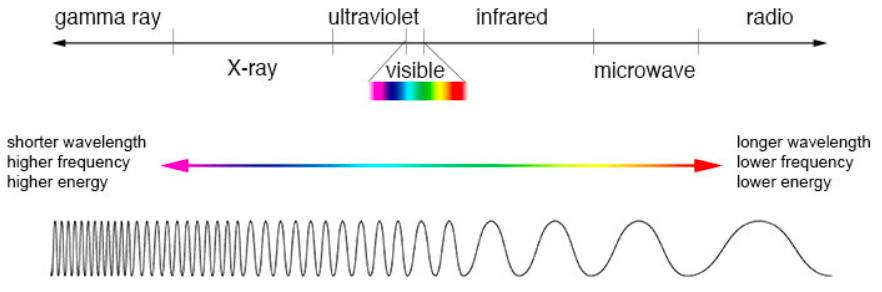
The highest degree of consistency (mass) is measured indirectly by the weight of matter. We cannot do that with energy because its consistency is many orders of magnitude less. So we measure the consistency of energy by its wavelength that tells us how thick or thin the energy field is.
.
Definition of WAVELENGTH
The wave-length as applied to energy is not really the distance between two adjacent crests as we imagine for the ripples of water. That visualization is limited to matter only.
For energy, the wave-length is a measure of how expanded or contracted the field of energy is. As the consistency of energy increases its field condenses, and its wave-length becomes shorter.
Thus, we may use wavelength as a measure of the consistency of substance.
Even matter can be shown to have a wavelength, but it is extremely short.
On the other hand, the wavelength of thought shall be larger than the largest wavelength of energy by many orders of magnitude.
.
Misconceptions
1. It is a misconception to think of the wavelength of substance as the distance between two adjacent crests of waves because at the basic level, any substance is a field of force. The wavelength is simply a number that tells one how thick of thin the field is.
.
Reference: Subject Clearing Universe
Reference: “Energy” in Quantum Mechanics
NOTE: The subject of Physics treats these fundamental particles mathematically, and it does not provide a proper visualization for them. The effort on this blog is to provide a visualization that is consistent with what is known. It does not change the mathematics of Physics.
The concept of quantum was first applied to electromagnetic radiation. It had to do with the amount of radiation that was absorbed and emitted by atoms. Such an amount was found to be proportional to the frequency of radiation, and not to its intensity.
.
Definition of QUANTUM
In physics, a quantum is the minimum amount of any physical entity involved in an interaction. In the Standard Model of Particle Physics, quantum applies to the discrete amount of energy, which is radiated from an atom, or absorbed in an atom. This amount is proportional to the frequency of the radiation it represents.
Thus, the concept of quantum applies to the radiative “particles” of spin 1 that can merge into each other forming a continuous flow that has a definite consistency. The particles of spin 1/2 are spinning vortices that cannot merge with each other to form a continuous flow; so, they are treated as units in themselves and don’t need the concept of quantum.
In summary, the concept of quantum is used to specify the unit of radiative energy that otherwise have a continuous flow with no distinguishable particles. Radiative energy of different consistencies have different quanta.
.
Misconceptions
1. It is a misconception to think of a quantum of energy as a particle in space and not as the amount of energy involved in a sub-atomic reaction.
2. It is a misconception to think of a quantum as a “wave-packet” of energy. The quanta do not have defined boundaries as a continuous flow in space, just like drops of water do not have defined boundaries in a glass of water.
3. It is a misconception to think of a “wave-packet” as a packet of waves of certain wave-length. It is actually an energy field of certain consistency.
.
Reference: Postulate Mechanics
The Space
When we sense some substance, that substance must have some extension. This extension is called SPACE. We may say that the substance is occupying this space; but that space denotes the dimension of the substance.
In short, space is a characteristic of the substance that we sense. In the absence of substance there is no space. When we observe “empty space” around us, it is empty of matter only; It is not empty of radiation and thought. It is an error to think that there can be a void in which nothing exists. What comes closest to being a void is non-awareness.
When a substance condenses it becomes smaller. This we see as space contracting. It amounts to a shortening of the wavelength of the substance. It is assumed that that the wavelength of the universe is infinite.
Matter has the smallest wavelength. The wavelength of radiation is larger by many orders of magnitude. The wavelength of thought is still larger by many orders of magnitude. Thought may approximate the infinite wavelength of the universe’s space. Science views this space mathematically without associating any substance with it.
The planets, stars and galaxies are floating in a sea of radiation. And that sea of radiation is most likely floating in a much larger sea of thought.
.