Category Archives: Physics

A Study of Maxwell

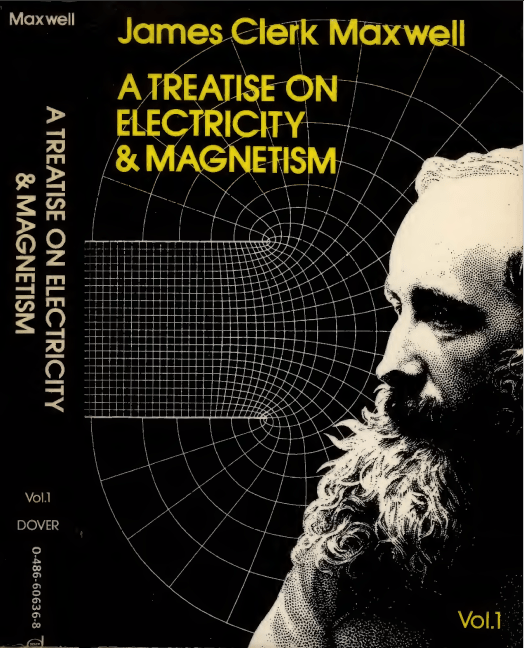
Maxwell Cover

Reference: Disturbance Theory

.

Maxwell (1831 – 1879) constructed his theory of Electromagnetism based on the inspiration he got from the experimental research of Michael Faraday (1791 – 1867); but there was a fundamental difference. Faraday believed in the idea of a continuum of the force of nature permeating all space.  But Maxwell ended up siding with the idea of isolated entities moving through a void of empty space.

Maxwell didn’t intend it that way for he writes in the preface of his major work “A Treatise on Electricity & Magnetism”:

“Faraday, in his mind’s eye, saw lines of force traversing all space where the mathematicians saw centres of force attracting at a distance: Faraday saw a medium where they saw nothing but distance: Faraday sought the seat of the phenomena in real actions going on in the medium, they were satisfied that they had found it in a power of action at a distance impressed on the electric fluids.”

Maxwell seems to have tried his best to unlock the mystery of action going on in the medium that Faraday sought, but he did not quite understand what Faraday meant by “force of nature”. Michael Faraday was quite clear in saying that his ideas involving “lines of force” were an alternative to the aether theory. But Maxwell couldn’t move beyond the mechanical view of nature as presented in the theory of aether.

The excellent article “Why Maxwell Couldn’t Explain Gravitypoints out where Maxwell was influenced by the aether theory and diverged from the ideas of Michael Faraday.

“Maxwell’s understanding of the electrical force that exists between charged particles was based on the idea that even the ‘empty space’ of the vacuum is actually permeated with some kind of substance, called the ether, which consists of individual parts that can act as dielectrics… In simple terms, he pictured ordinary empty space, when devoid of any electric field, as consisting of many small pairs of positive and negative charge elements, and in the absence of an electric field the two opposite charges in each pair are essentially co-located, so there is no net change or electric potential observable at any point. If an electric potential is established across some region of this medium (e.g., empty space), it tends to pull the components of each pair apart slightly. Maxwell termed this an electric displacement in the medium. Of course, the constituent parts of the dielectric pairs attract each other, so the electric displacement is somewhat like stretching a little spring at each point in space.”

The article goes on to say,

“It’s interesting that this theory, which supposedly denies the intelligibility of distant action, nevertheless ends up invoking (albeit on a very small scale) what appears to be elementary attraction between distinct and separate entities.”

Maxwell was thus unable to unlock the mystery of action going on in the medium because he assumed charges to be discrete. Discreteness implies separation and, thus, action at a distance.

Thus, Maxwell could not provide a solution to the problem of “action at a distance” that Faraday sought with his “lines of force”. However, Maxwell’s work did pave the way that could lead one out of the limitations imposed by ideas, such as, the aether theory based on discrete particles.

.

The most important conclusions that I draw from a study of Maxwell are as follows:

  1. A changing electric field produces a magnetic field of force

  2. A changing magnetic field produces an electric field of force

Thus, both electric and magnetic phenomena have to do with change and force. Change in one phenomenon seems to create force in another phenomenon. Therefore, each phenomenon seems to act as the potential for the other phenomenon. This is the bottom line in the conservation of energy.

This happens with light in space in the absence of discrete charge and mass. What part does charge and mass play? Is light the product of charge and mass, or is charge and mass the product of light? Or, is light, charge and mass the product of space?

  1. Per dimensional analysis provided by Maxwell, a charge has same characteristics as mass.

[M] = [Q] = [L3-2] = Area x acceleration

Is the acceleration of two dimensional wave front of space in the third dimension somehow responsible for the production of light, charge and mass?

The questions asked in this essay shall be dealt with in subsequent essays.

.
Theory of Relativity & SRF

600_332158572

Per Maxwell’s equations, the speed of light ‘c’ is determined by the properties of space. Light appears to travel in space from one location to another as a transverse wave. From the model of a wave traveling in a medium it appears that the medium of light is space. The new idea here is that a non-material space acts as a medium. Up till now the medium was thought to be “ether” of material-like properties. That didn’t work out. So, what are the non-material properties of space as a medium?

Space, when disturbed seems to break into electric and magnetic fields. Space “doesn’t move”, but the disturbance in space (electromagnetic field) moves. This disturbance moves in such a way that the ratio of its wavelength to period is the constant ‘c’. This is what an electromagnetic wave is.

But light also moves at speed ‘c’ relative to uniformly moving material, regardless of how fast or how slow that material might be moving. Therefore, uniformly moving material has a velocity zero relative to space. It is “carrying space” with it, so to say. That is why no “ether wind” was discovered in Michelson-Morley’s experiments.

We have two different reference frames. The first is Galilean Reference or relativistic frame attached to matter called MRF (material frame of reference). The other is non-material reference frame attached to space called SRF (space frame of reference). The latter has never been considered in science. NOTE: The Lorentz transformations, like Galilean transformations are part of MRF.

We are conditioned to MRF. In it we see the distance changing uniformly between two uniformly moving material bodies moving towards each other or away from each other. But in SRF a uniformly moving material has a velocity zero relative to space. So, the distance is invariable, or it does not exist, between two uniformly moving material bodies.

In MRF we see time changing as a material body moves with uniform speed. In SRF the time is invariable, or it does not exist. The truth is that space and time exist in SRF as “wavelength” and “period” and the ratio between them is the constant ‘c’. All matter has infinitesimal wavelength and period. This gives us a uniform character of space and time in MRF. But in SRF this situation exists only at the upper end of the electromagnetic spectrum. MRF is, therefore, a specialized subset of SRF.

SRF gives us a much wider view of reality than MRF. This explains the relativistic “length contraction” and “time dilation” in terms of increasing or decreasing frequency. In MRF the frequency is collapsed beyond gamma range and appears to be “uniform”; and this gives us a uniform measure of length and time.

The relativistic world is understood much better when viewed through Space Reference Frame (SRF) derived directly from Maxwell’s Equations.

It appears that the speed ‘c’ can be attained only by an inertialess particle in MRF. As particle gains inertia its maximum attainable speed will reduce to a fraction of ‘c’. This is evident by the speed of electrons in MRF.

The Unified Field Theory

discreteness

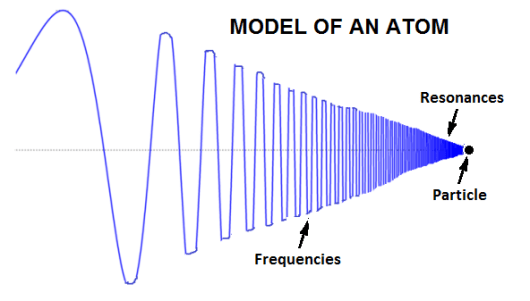
Evolution starts by increasing discreteness. This aspect of evolution covers the whole realm of physics. Discreteness evolves from

  1. Frequency of disturbance to
  2. Resonance as reinforced frequency to
  3. Particle as collapsed resonance.

.

The subject of physics started from observation of the motion of planets and other heavenly bodies in the sky. The fundamental property associated with these bodies was mass. So, physics evolved within a frame of reference based on mass. This aspect of physics was rounded up by Newton in the second half of 17th century.

Another aspect of Physics emerged in the beginning of 20th century when Einstein formulated the Theory of Relativity. This theory established the speed of light as a universal constant. The concepts of space and time could no longer be conceived as independent of each other as it was in the frame of reference based on mass. The frame of reference of Physics had now shifted from mass to energy.

NOTE 12/05/19: Both mass and energy are forms of substance.

Following the above development, another aspect of physics evolved very rapidly during the first quarter of 20th century to explain the observations made at atomic dimensions. This aspect was called Quantum Mechanics because it did not have a well-grounded theory, and was based primarily on mathematical models. It seemed to have a frame of reference based on resonance.

Physics has long been trying to come up with a unified theory that can bring these three aspects of physics together. We may make some progress in that direction by relating the frames of reference of Theory of Relativity, Quantum Mechanics, and Newtonian Physics on a scale of increasing discreteness. On this scale space shall have zero discreteness.

Energy (frequency) obviously is disturbed space; resonance is reinforced frequency; and mass (particle) appears to be collapsed (folded up) resonance. We may be able to use space as a reference point for all these frames of references.

Thus, if we can reformulate the Theory of Relativity, Quantum Mechanics, and Newtonian Physics using a frame of reference based on space, we may be able to come up with a unified theory. This is the idea underlying the Disturbance theory, which is currently under development.

Granted the above ideas are very sketchy and are nothing more than conjectures at this stage, but they provide an overall coherence within which a unified theory may be developed.

.

Reality of Relativity (Part I)

Relativity

  • Neither locations in space, nor Instances in time are absolute.
  • Ratio of space-time intervals becomes absolute in EM disturbance.
  • Space-time intervals become infinitesimal in the core of atom.
  • Then location and instances appear absolute as matter.

Space and time intervals appear in a constant ratio as “disturbance”, which we see as light or dynamic electromagnetic field. In the absence of this disturbance neither space nor time exists. When space and time intervals become infinitesimal in the core of an atom, we have matter.  Matter seems to acquire absolute locations and instances in space and time. [EM = electromagnetic]

.

  • The nature of this disturbance is electromagnetic.
  • It reflects permittivity and permeability of disturbed space.
  • This electromagnetic disturbance is its own medium.
  • The “speed” of this disturbance as light is constant.

The above is the basic postulate of Einstein’s theory of relativity. It is supported by experimental evidence.

.

  • The “wavelength to period ratio” of the disturbance is constant.
  • Both wavelength and period are scaled up and down by frequency.
  • The “frequency” denotes the energy of space-time disturbance.
  • It is this energy that brings form to the disturbance.

The disturbance appears as electromagnetic field which is shaped by frequency gradients in it. What is there in absence of the field is unknown, but it allows the field to spread.

.

  • There cannot be absolute units of space and time at this stage.
  • Space manifests as the continuity of forms throughout the field.
  • Time manifests as the dynamic harmony of forms within the field.
  • The only property that can be measured in absolute unit is frequency.

With space and time varying in a fundamental way we cannot find absolute units to separate them. But since they vary in a constant ratio, we find that an absolute unit may be applied to frequency.

.

  • We may only speculate what came before space-time.
  • But after space-time came energy and matter.
  • A whole spectrum of frequency characterizes energy.
  • At the upper end of spectrum frequency collapses as matter.

Space-time provides a dynamically changing environment in terms of frequency. This environment is called energy that has a large spectrum of frequency. At the upper end of this spectrum the space and time intervals become so small that energy collapses into matter.

.

  • Space and time intervals vary in energy spectrum.
  • But they always occur in absolute ratio as frequency.
  • At the upper end of spectrum these intervals become infinitesimal.
  • And space and time seem to acquire separate and absolute units.

Space and time seem to have absolute and separate units only for matter and not for the electromagnetic field. Classical mechanics deals with matter and treats space and time as absolute. This does not lead to error.

.

  • Velocity is defined by constant units for space and time.
  • The concept of velocity applies to matter, and not to EM field.
  • The constant ‘c’ is the ratio of space time intervals of light.
  • Its interpretation as “speed of light” is a matter-centric view.

The theory of relativity correctly recognizes ‘c’ as a universal constant, but it looks at it as “speed” from a matter-centric view. This misinterpretation gives rise to subjective ideas of length contraction and time dilation.

.

  • Velocity may be used to assess relativity among matter particles.
  • It cannot assess relativity between EM field (light) and matter.
  • Frequency is appropriate to assess relativity within energy field.
  • Frequency is also more appropriate to assess relativity of field to matter.

Einstein’s theory of relativity introduces confusion by using the concept of velocity to compare matter with field. The concept of velocity cannot be applied to electromagnetic field because space and time does not have absolute units in that context. Frequency is a more appropriate criterion to compare matter with field.

.

  • Velocity, by definition, is relative to a fixed location in space.
  • A location can be fixed in space only by the presence of matter.
  • No velocity exists when there is no matter to reference from.
  • The concept of velocity is limited to material particles only.

When we talk about velocity of a wave it is only relative to a fixed location in space. A location can be fixed in space only by the presence of matter. Therefore, in absence of matter, the concept of velocity cannot be applied to waves and field.

.

  • The uniform velocity cannot be distinguished from state at rest.
  • A uniform velocity cannot have a value of its own.
  • Its value depends on the motion of another material object.
  • Therefore, uniform velocity can only be subjective in nature.

How do we know that we are not moving uniformly at the speed of light? How should something moving uniformly at the speed of light appear? If we try to measure our speed relative to another moving material object, then the view of our speed will depend on the other object. Magnitude of uniform velocity is subjective at best.

.

  • Only acceleration has value relative to itself.
  • Therefore, acceleration provides an objective measure.
  • Acceleration also applies to matter only.
  • Acceleration is a meaningful measure rather than velocity.

Only thing that we can measure objectively for matter is acceleration. Any measure of uniform velocity is subjective. Therefore, the use of Lorentz Factor in the theory of relativity, only leads to subjective conclusions.

.

  • The Lorentz factor derives from Pythagorean Theorem.
  • And from the use of rigid coordinates referenced from matter.
  • These conditions do not apply to electromagnetic field.
  • The Lorentz factor does not apply to electromagnetic field.

The properties of electromagnetic field are very different from the properties of matter. The concept of velocity applies to matter and not to electromagnetic field. The theory of relativity treats electromagnetic field to be rigid like matter when it is not. It also treats matter to contort in space and time like electromagnetic field when it does not.

.

Wave Function Collapse (Part 1)

Here is a nice explanation of WAVE FUNCTION COLLAPSE, a concept from Quantum Mechanics,

Is Consciousness the ultimate wave?

Is Self the collapse of consciousness wave function?

Is Thought the collapse of self wave function?

Is Reality the collapse of thought wave function?

Is Physical universe the collapse of reality wave function?

The ultimate observer or looker is, of course, Unknowable. 🙂

Like the last digit of the decimal rendition of pi.

Because neither exists as we know existence.

.

Added October 28, 2012:

WAVE FUNCTION COLLAPSE = MANIFESTING

What is there before manifesting may only be speculated upon. Speculation then manifests.

So all manifesting may simply be preceded by speculation or visualization.

See AXIOM ZERO

.

Addition (12/31/18)

The assumption in the following video is that electrons are like little balls. This assumption is incorrect. Electrons are waves that are simply quite substantial. As far as “observer” goes, they have an instrument there, whose electric field interferes with the experiment. Please see,

Einstein’s Light Quanta

.