Category Archives: Physics Book

The Physics Book.

Eddington 1927: Reality and Mysticism

a-lei-da-simetria_1

Reference: The Nature of the Physical World

This paper presents Chapter XV (section 4) from the book THE NATURE OF THE PHYSICAL WORLD by A. S. EDDINGTON. The contents of this book are based on the lectures that Eddington delivered at the University of Edinburgh in January to March 1927.

The paragraphs of original material are accompanied by brief comments in color, based on the present understanding.  Feedback on these comments is appreciated.

The heading below links to the original materials.

.

Reality and Mysticism

But a defence before the scientists may not be a defence to our own self-questionings. We are haunted by the word reality. I have already tried to deal with the questions which arise as to the meaning of reality; but it presses on us so persistently that, at the risk of repetition, I must consider it once more from the standpoint of religion. A compromise of illusion and reality may be all very well in our attitude towards physical surroundings; but to admit such a compromise into religion would seem to be a trifling with sacred things. Reality seems to concern religious beliefs much more than any others. No one bothers as to whether there is a reality behind humour. The artist who tries to bring out the soul in his picture does not really care whether and in what sense the soul can be said to exist. Even the physicist is unconcerned as to whether atoms or electrons really exist; he usually asserts that they do, but, as we have seen, existence is there used in a domestic sense and no inquiry is made as to whether it is more than a conventional term. In most subjects (perhaps not excluding philosophy) it seems sufficient to agree on the things that we shall call real, and afterwards try to discover what we mean by the word. And so it comes about that religion seems to be the one field of inquiry in which the question of reality and existence is treated as of serious and vital importance.

We generate models to assert the consistency, harmony and continuity that we observe. Such models become our reality. We modify these models as more observations are made. We do this by resolving anomalies. A religion is also a model, but of deeper significances. To modify a religious model is a bit difficult as it requires deeper understanding.

But it is difficult to see how such an inquiry can be profitable. When Dr. Johnson felt himself getting tied up in argument over “Bishop Berkeley’s ingenious sophistry to prove the non-existence of matter, and that everything in the universe is merely ideal”, he answered, “striking his foot with mighty force against a large stone, till he rebounded from it,—’I refute it thus* “. Just what that action assured him of is not very obvious; but apparently he found it comforting. And to-day the matter-of-fact scientist feels the same impulse to recoil from these flights of thought back to something kickable, although he ought to be aware by this time that what Rutherford has left us of the large stone is scarcely worth kicking.

We must seek consistency etc., between thought and matter. It is there to be found.

There is still the tendency to use “reality” as a word of magic comfort like the blessed word “Mesopotamia”. If I were to assert the reality of the soul or of God, I should certainly not intend a comparison with Johnson’s large stone—a patent illusion—or even with the p’s and q’s of the quantum theory—an abstract symbolism. Therefore I have no right to use the word in religion for the purpose of borrowing on its behalf that comfortable feeling which (probably wrongly) has become associated with stones and quantum co-ordinates.

Soul, God, etc., are abstract thought realities and not material realities. But there is some sort of continuity there to be realized. Same goes for quantum realities.

Scientific instincts warn me that any attempt to answer the question “What is real?” in a broader sense than that adopted for domestic purposes in science, is likely to lead to a floundering among vain words and high-sounding epithets. We all know that there are regions of the human spirit untrammelled by the world of physics. In the mystic sense of the creation around us, in the expression of art, in a yearning towards God, the soul grows upward and finds the fulfilment of something implanted in its nature. The sanction for this development is within us, a striving born with our consciousness or an Inner Light proceeding from a greater power than ours. Science can scarcely question this sanction, for the pursuit of science springs from a striving which the mind is impelled to follow, a questioning that will not be suppressed. Whether in the intellectual pursuits of science or in the mystical pursuits of the spirit, the light beckons ahead and the purpose surging in our nature responds. Can we not leave it at that? Is it really necessary to drag in the comfortable word “reality” to be administered like a pat on the back?

Reality consists of material, field and thought substance, which are consistent, harmonious and continuous. This consistency, harmony and continuity need to be understood.

The problem of the scientific world is part of a broader problem—the problem of all experience. Experience may be regarded as a combination of self and environment, it being part of the problem to  disentangle these two interacting components. Life, religion, knowledge, truth are all involved in this problem, some relating to the finding of ourselves, some to the finding of our environment from the experience confronting us. All of us in our lives have to make something of this problem; and it is an important condition that we who have to solve the problem are ourselves part of the problem. Looking at the very beginning, the initial fact is the feeling of purpose in ourselves which urges us to embark on the problem. We are meant to fulfil something by our lives. There are faculties with which we are endowed, or which we ought to attain, which must find a status and an outlet in the solution. It may seem arrogant that we should in this way insist on moulding truth to our own nature; but it is rather that the problem of truth can only spring from a desire for truth which is in our nature.

Science deals with experience of the physical environment. Religion deals with the experience of ‘self’ and how ‘self’ interacts with the environment. Truth is seeing things for what they are.

A rainbow described in the symbolism of physics is a band of aethereal vibrations arranged in systematic order of wave-length from about .000040 cm. to .000072 cm. From one point of view we are paltering with the truth whenever we admire the gorgeous bow of colour, and should strive to reduce our minds to such a state that we receive the same impression from the rainbow as from a table of wave-lengths. But although that is how the rainbow impresses itself on an impersonal spectroscope, we are not giving the whole truth and significance of experience—the starting-point of the problem—if we suppress the factors wherein we ourselves differ from a spectroscope. We cannot say that the rainbow, as part of the world, was meant to convey the vivid effects of colour; but we can perhaps say that the human mind as part of the world was meant to perceive it that way.

The perception of rainbow through spectroscope, and through aesthetic senses, is simply different aspects of what is there.

.

Eddington 1927: Defence of Mysticism

trimurthis

Reference: The Nature of the Physical World

This paper presents Chapter XV (section 3) from the book THE NATURE OF THE PHYSICAL WORLD by A. S. EDDINGTON. The contents of this book are based on the lectures that Eddington delivered at the University of Edinburgh in January to March 1927.

The paragraphs of original material are accompanied by brief comments in color, based on the present understanding.  Feedback on these comments is appreciated.

The heading below links to the original materials.

.

Defence of Mysticism

A defence of the mystic might run something like this. We have acknowledged that the entities of physics can from their very nature form only a partial aspect of the reality. How are we to deal with the other part? It cannot be said that that other part concerns us less than the physical entities. Feelings, purpose, values, make up our consciousness as much as sense-impressions. We follow up the sense-impressions and find that they lead into an external world discussed by science; we follow up the other elements of our being and find that they lead—not into a world of space and time, but surely somewhere. If you take the view that the whole of consciousness is reflected in the dance of electrons in the brain, so that each emotion is a separate figure of the dance, then all features of consciousness alike lead into the external world of physics. But I assume that you have followed me in rejecting this view, and that you agree that consciousness as a whole is greater than those quasi-metrical aspects of it which are abstracted to compose the physical brain. We have then to deal with those parts of our being unamenable to metrical specification, that do not make contact—jut out, as it were—into space and time. By dealing with them I do not mean make scientific inquiry into them. The first step is to give acknowledged status to the crude conceptions in which the mind invests them, similar to the status of those crude conceptions which constitute the familiar material world.

Physics started with investigating the material-substance. With quantum theory it is investigating the field-substance as a continuum of material-substance. Soon it may investigate thought-substance as a continuum of both material and field substance.

Our conception of the familiar table was an illusion.  But if some prophetic voice had warned us that it was an illusion and therefore we had not troubled to investigate further we should never have found the scientific table. To reach the reality of the table we need to be endowed with sense-organs to weave images and illusions about it. And so it seems to me that the first step in a broader revelation to man must be the awakening of image-building in connection with the higher faculties of his nature, so that these are no longer blind alleys but open out into a spiritual world—a world partly of illusion, no doubt, but in which he lives no less than in the world, also of illusion, revealed by the senses.

Mind is investigating through visualization of consistency, harmony and continuity, and sorting out of anomalies.

The mystic, if haled before a tribunal of scientists, might perhaps end his defence on this note. He would say, The familiar material world of everyday conception, though lacking somewhat in scientific truth, is good enough to live in; in fact the scientific world of pointer readings would be an impossible sort of place to inhabit. It is a symbolic world and the only thing that could live comfortably in it would be a symbol. But I am not a symbol; I am compounded of that mental activity which is from your point of view a nest of illusion, so that to accord with my own nature I have to transform even the world explored by my senses. But I am not merely made up of senses; the rest of my nature has to live and grow. I have to render account of that environment into which it has its outlet. My conception of my spiritual environment is not to be compared with your scientific world of pointer readings; it is an everyday world to be compared with the material world of familiar experience. I claim it as no more real and no less real than that. Primarily it is not a world to be analysed, but a world to be lived in.”

Both the scientist and the mystic are using thought-substance for the defence of their viewpoints. They both have anomalies to sort out to get the complete picture.

Granted that this takes us outside the sphere of exact knowledge, and that it is difficult to imagine that anything corresponding to exact science will ever be applicable to this part of our environment, the mystic is unrepentant. Because we are unable to render exact account of our environment it does not follow that it would be better to pretend that we live in a vacuum.

Exact knowledge must be accompanied by basic logic and resolution of anomalies.

If the defence may be considered to have held good against the first onslaught, perhaps the next stage of the attack will be an easy tolerance. “Very well. Have it your own way. It is a harmless sort of belief—not like a more dogmatic theology. You want a sort of spiritual playground for those queer tendencies in man’s nature, which sometimes take possession of him. Run away and play then; but do not bother the serious people who are making the world go round.” The challenge now comes not from the scientific materialism which professes to seek a natural explanation of spiritual power, but from the deadlier moral materialism which despises it. Few deliberately hold the philosophy that the forces of progress are related only to the material side of our environment, but few can claim that they are not more or less under its sway. We must not interrupt the “practical men”, these busy moulders of history carrying us at ever-increasing pace towards our destiny as an ant-heap of humanity infesting the earth. But is it true in history that material forces have been the most potent factors? Call it of God, of the Devil, fanaticism, unreason; but do not underrate the power of the mystic. Mysticism may be fought as error or believed as inspired, but it is no matter for easy tolerance—

We are the music-makers
And we are the dreamers of dreams
Wandering by lone sea-breakers
And sitting by desolate streams ;
World-losers and world-forsakers,
On whom the pale moon gleams:
Yet we are the movers and shakers
Of the world for ever, it seems.

.

Eddington 1927: Symbolic Knowledge and Intimate Knowledge

Unknowable

Reference: The Nature of the Physical World

This paper presents Chapter XV (section 2) from the book THE NATURE OF THE PHYSICAL WORLD by A. S. EDDINGTON. The contents of this book are based on the lectures that Eddington delivered at the University of Edinburgh in January to March 1927.

The paragraphs of original material are accompanied by brief comments in color, based on the present understanding.  Feedback on these comments is appreciated.

The heading below links to the original materials.

.

Symbolic Knowledge and Intimate Knowledge

May I elaborate this objection to introspection? We have two kinds of knowledge which I call symbolic knowledge and intimate knowledge. I do not know whether it would be correct to say that reasoning is only applicable to symbolic knowledge, but the more customary forms of reasoning have been developed for symbolic knowledge only. The intimate knowledge will not submit to codification and analysis; or, rather, when we attempt to analyse it the intimacy is lost and it is replaced by symbolism.

For an illustration let us consider Humour. I suppose that humour can be analysed to some extent and the essential ingredients of the different kinds of wit classified. Suppose that we are offered an alleged joke. We subject it to scientific analysis as we would a chemical salt of doubtful nature, and perhaps after careful consideration of all its aspects we are able to confirm that it really and truly is a joke. Logically, I suppose, our next procedure would be to laugh. But it may certainly be predicted that as the result of this scrutiny we shall have lost all inclination we may ever have had to laugh at it. It simply does not do to expose the inner workings of a joke. The classification concerns a symbolic knowledge of humour which preserves all the characteristics of a joke except its laughableness. The real appreciation must come spontaneously, not introspectively. I think this is a not unfair analogy for our mystical feeling for Nature, and I would venture even to apply it to our mystical experience of God. There are some to whom the sense of a divine presence irradiating the soul is one of the most obvious things of experience. In their view a man without this sense is to be regarded as we regard a man without a sense of humour. The absence is a kind of mental deficiency. We may try to analyse the experience as we analyse humour, and construct a theology, or it may be an atheistic philosophy, which shall put into scientific form what is to be inferred about it. But let us not forget that the theology is symbolic knowledge whereas the experience is intimate knowledge. And as laughter cannot be compelled by the scientific exposition of the structure of a joke, so a philosophic discussion of the attributes of God (or an impersonal substitute) is likely to miss the intimate response of the spirit which is the central point of the religious experience.

Intimate knowledge is spontaneous. It does not require any reasoning. But symbolic knowledge requires reasoning. Somewhere along the way, the reasoning through symbolic knowledge may trigger the ecstasy of intimate knowledge.  

.

Eddington 1927: Science and Mysticism

Mysticism

Reference: The Nature of the Physical World

This paper presents Chapter XV (section 1) from the book THE NATURE OF THE PHYSICAL WORLD by A. S. EDDINGTON. The contents of this book are based on the lectures that Eddington delivered at the University of Edinburgh in January to March 1927.

The paragraphs of original material are accompanied by brief comments in color, based on the present understanding.  Feedback on these comments is appreciated.

The heading below links to the original materials.

.

Science and Mysticism

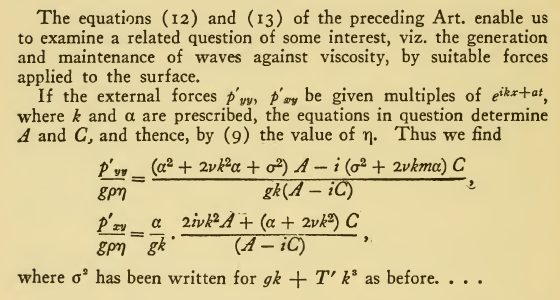
One day I happened to be occupied with the subject of “Generation of Waves by Wind”. I took down the standard treatise on hydrodynamics, and under that heading I read—

XV

And so on for two pages. At the end it is made clear that a wind of less than half a mile an hour will leave the surface unruffled. At a mile an hour the surface is covered with minute corrugations due to capillary waves which decay immediately the disturbing cause ceases. At two miles an hour the gravity waves appear. As the author modestly concludes, “Our theoretical investigations give considerable insight into the incipient stages of wave-formation”.

On another occasion the same subject of “Generation of Waves by Wind” was in my mind; but this time another book was more appropriate, and I read—

There are waters blown by changing winds to laughter
And lit by the rich skies, all day. And after,
Frost, with a gesture, stays the waves that dance
And wandering loveliness. He leaves a white
Unbroken glory, a gathered radiance,
A width, a shining peace, under the night.

The magic words bring back the scene. Again we feel Nature drawing close to us, uniting with us, till we are filled with the gladness of the waves dancing in the sunshine, with the awe of the moonlight on the frozen lake. These were not moments when we fell below ourselves. We do not look back on them and say, “It was disgraceful for a man with six sober senses and a scientific understanding to let himself be deluded in that way. I will take Lamb’s Hydrodynamics with me next time”. It is good that there should be such moments for us. Life would be stunted and narrow if we could feel no significance in the world around us beyond that which can be weighed and measured with the tools of the physicist or described by the metrical symbols of the mathematician.

Of course it was an illusion. We can easily expose the rather clumsy trick that was played on us. Aethereal vibrations of various wave-lengths, reflected at different angles from the disturbed interface between air and water, reached our eyes, and by photoelectric action caused appropriate stimuli to travel along the optic nerves to a brain-centre. Here the mind set to work to weave an impression out of the stimuli. The incoming material was somewhat meagre; but the mind is a great storehouse of associations that could be used to clothe the skeleton. Having woven an impression the mind surveyed all that it had made and decided that it was very good. The critical faculty was lulled. We ceased to analyse and were conscious only of the impression as a whole. The warmth of the air, the scent of the grass, the gentle stir of the breeze, combined with the visual scene in one transcendent impression, around us and within us. Associations emerging from their storehouse grew bolder. Perhaps we recalled the phrase “rippling laughter”. Waves—ripples—laughter—gladness —the ideas jostled one another. Quite illogically we were glad; though what there can possibly be to be glad about in a set of aethereal vibrations no sensible person can explain. A mood of quiet joy suffused the whole impression. The gladness in ourselves was in Nature, in the waves, everywhere. That’s how it was.

The mind is capable of great imagination. The person is not being deceived as long as he aware that it is imagination.

It was an illusion. Then why toy with it longer? These airy fancies which the mind, when we do not keep it severely in order, projects into the external world should be of no concern to the earnest seeker after truth. Get back to the solid substance of things, to the material of the water moving under the pressure of the wind and the force of gravitation in obedience to the laws of hydrodynamics. But the solid substance of things is another illusion. It too is a fancy projected by the mind into the external world. We have chased the solid substance from the continuous liquid to the atom, from the atom to the  electron, and there we have lost it. But at least, it will be said, we have reached something real at the end of the chase—the protons and electrons. Or if the new quantum theory condemns these images as too concrete and leaves us with no coherent images at all, at least we have symbolic co-ordinates and momenta and Hamiltonian functions devoting themselves with single-minded purpose to ensuring that qp—pq shall be equal to ih/2π.

After atom we have gotten only as far as the proton and electron; and mathematical functions and relationships.

In a previous chapter I have tried to show that by following this course we reach a cyclic scheme which from its very nature can only be a partial expression of our environment. It is not reality but the skeleton of reality. “Actuality” has been lost in the exigencies of the chase. Having first rejected the mind as a worker of illusion we have in the end to return to the mind and say, “Here are worlds well and truly built on a basis more secure than your fanciful illusions. But there is nothing to make any one of them an actual world. Please choose one and weave your fanciful images into it. That alone can make it actual”. We have torn away the mental fancies to get at the reality beneath, only to find that the reality of that which is beneath is bound up with its potentiality of awakening these fancies. It is because the mind, the weaver of illusion, is also the only guarantor of reality that reality is always to be sought at the base of illusion. Illusion is to reality as the smoke to the fire. I will not urge that hoary untruth “There is no smoke without fire”. But it is reasonable to inquire whether in the mystical illusions of man there is not a reflection of an underlying reality.

The knowledge obtained through science may be in the form of a cyclic scheme (tautology), but that cycle keeps on growing in detail. The difference between illusion and reality lies in the amount of anomalies present. The fewer anomalies there are the more real it is. Imagination is not opposite of reality. It has its place in reality as long as we recognize it for what it is, and resolve any anomalies present.

To put a plain question—Why should it be good for us to experience a state of self-deception such as I have described? I think everyone admits that it is good to have a spirit sensitive to the influences of Nature, good to exercise an appreciative imagination and not always to be remorselessly dissecting our environment after the manner of the mathematical physicists. And it is good not merely in a utilitarian sense, but in some purposive sense necessary to the fulfilment of the life that is given us. It is not a dope which it is expedient to take from time to time so that we may return with greater vigour to the more legitimate employment of the mind in scientific investigation. Just possibly it might be defended on the ground that it affords to the non-mathematical mind in some feeble measure that delight in the external world which would be more fully provided by an intimacy with its differential equations. (Lest it should be thought that I have intended to pillory hydrodynamics, I hasten to say in this connection that I would not rank the intellectual (scientific) appreciation on a lower plane than the mystical appreciation; and I know of passages written in mathematical symbols which in their sublimity might vie with Rupert Brooke’s sonnet.) But I think you will agree with me that it is impossible to allow that the one kind of appreciation can adequately fill the place of the other. Then how can it be deemed good if there is nothing in it but self-deception? That would be an upheaval of all our ideas of ethics. It seems to me that the only alternatives are either to count all such surrender to the mystical contact of Nature as mischievous and ethically wrong, or to admit that in these moods we catch something of the true relation of the world to ourselves—a relation not hinted at in a purely scientific analysis of its content. I think the most ardent materialist does not advocate, or at any rate does not practice, the first alternative; therefore I assume the second alternative, that there is some kind of truth at the base of the illusion.

In no way is the literary pursuit of imagination deceptive if it is understood for what it is. Using science is a reference point to judge is false.

But we must pause to consider the extent of the illusion. Is it a question of a small nugget of reality buried under a mountain of illusion? If that were so it would be our duty to rid our minds of some of the illusion at least, and try to know the truth in purer form. But I cannot think there is much amiss with our appreciation of the natural scene that so impresses us. I do not think a being more highly endowed than ourselves would prune away much of what we feel. It is not so much that the feeling itself is at fault as that our introspective examination of it wraps it in fanciful imagery. If I were to try to put into words the essential truth revealed in the mystic experience, it would be that our minds are not apart from the world; and the feelings that we have of gladness and melancholy and our yet deeper feelings are not of ourselves alone, but are glimpses of a reality transcending the narrow limits of our particular consciousness—that the harmony and beauty of the face of Nature is at root one with the gladness that transfigures the face of man. We try to express much the same truth when we say that the physical entities are only an extract of pointer readings and beneath them is a nature continuous with our own. But I do not willingly put it into words or subject it to introspection. We have seen how in the physical world the meaning is greatly changed when we contemplate it as surveyed from without instead of, as it essentially must be, from within. By introspection we drag out the truth for external survey; but in the mystical feeling the truth is apprehended from within and is, as it should be, a part of ourselves.

.

Eddington 1927: Interference with Statistical Laws

Human-body-elements

Reference: The Nature of the Physical World

This paper presents Chapter XIV (section 8) from the book THE NATURE OF THE PHYSICAL WORLD by A. S. EDDINGTON. The contents of this book are based on the lectures that Eddington delivered at the University of Edinburgh in January to March 1927.

The paragraphs of original material are accompanied by brief comments in color, based on the present understanding.  Feedback on these comments is appreciated.

The heading below links to the original materials.

.

Interference with Statistical Laws

Has the mind power to set aside statistical laws which hold in in organic matter? Unless this is granted its opportunity of interference seems to be too circumscribed to bring about the results which are observed to follow from mental decisions. But the admission involves a genuine physical difference between inorganic and organic (or, at any rate, conscious) matter. I would prefer to avoid this hypothesis, but it is necessary to face the issue squarely. The indeterminacy recognised in modern quantum theory is only a partial step towards freeing our actions from deterministic control. To use an analogy—we have admitted an uncertainty which may take or spare human lives; but we have yet to find an uncertainty which may upset the expectations of a life- insurance company. Theoretically the one uncertainty might lead to the other, as when the fate of millions turned on the murders at Sarajevo. But the hypothesis that the mind operates through two or three key-atoms in the brain is too desperate a way of escape for us, and I reject it for the reasons already stated.

The material, field, and thought substances work in conjunction with each other to maintain the continuum. This is the overall boundary condition. The rest comes out of that.

It is one thing to allow the mind to direct an atom between two courses neither of which would be improbable for an inorganic atom; it is another thing to allow it to direct a crowd of atoms into a configuration which the secondary laws of physics would set aside as “too improbable”. Here the improbability is that a large number of entities each acting independently should conspire to produce the result; it is like the improbability of the atoms finding themselves by chance all in one half of a vessel. We must suppose that in the physical part of the brain immediately affected by a mental decision there is some kind of interdependence of behaviour of the atoms which is not present in inorganic matter.

Interdependence of atoms comes from the boundary condition stated above. There are no totally independent (arbitrary) decisions.  Laws function as they are supposed to function.

I do not wish to minimise the seriousness of admitting this difference between living and dead matter. But I think that the difficulty has been eased a little, if it has not been removed. To leave the atom constituted as it was but to interfere with the probability of its undetermined behaviour, does not seem quite so drastic an interference with natural law as other modes of mental interference that have been suggested. (Perhaps that is only because we do not understand enough about these probabilities to realise the heinousness of our suggestion.) Unless it belies its name, probability can be modified in ways which ordinary physical entities would not admit of. There can be no unique probability attached to any event or behaviour; we can only speak of “probability in the light of certain given information”, and the probability alters according to the extent of the information. It is, I think, one of the most unsatisfactory features of the new quantum theory in its present stage that it scarcely seems to recognise this fact, and leaves us to guess at the basis of information to which its probability theorems are supposed to refer.

In dead matter the free-will (the ability of the mind to manipulate thought-substance) is missing.

Looking at it from another aspect—if the unity of a man’s consciousness is not an illusion, there must be some corresponding unity in the relations of the mind-stuff which is behind the pointer readings. Applying our measures of relation structure, as in chapter XI, we shall build matter and fields of force obeying identically the principal field-laws; the atoms will individually be in no way different from those which are without this unity in the background. But it seems plausible that when we consider their collective behaviour we shall have to take account of the broader unifying trends in the mind-stuff, and not expect the statistical results to agree with those appropriate to structures of haphazard origin.

I think that even a materialist must reach a conclusion not unlike ours if he fairly faces the problem. He will need in the physical world something to stand for a symbolic unity of the atoms associated with an individual consciousness, which does not exist for atoms not so associated—a unity which naturally upsets physical predictions abased on the hypothesis of random disconnection. For he has not only to translate into material configurations the multifarious thoughts and images of the mind, but must surely not neglect to find some kind of physical substitute for the Ego.

Neither material nor thought substance calls the shots. The conditions are determined by the drive to achieve an overall equilibrium.

.