Reference: Einstein’s 1920 Book
Section XXXII (Part 3)
The Structure of Space According to the General Theory of Relativity
Please see Section XXXII at the link above.
.
Summary
The geometrical properties of space are not independent of matter. The matter is almost at rest; whereas, light has a tremendous velocity of transmission. They both contribute to the geometrical property of space.
The presence of gravitational fields around matter tells us that the geometry of the universe is not exactly Euclidean. But it is conceivable that our universe differs only slightly from a Euclidean one, because matter is only a very small part of it.
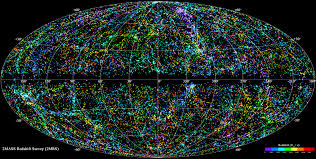
The detailed distribution of matter is not uniform in this universe. The real universe will deviate in individual parts from the spherical, but it will be necessarily finite.
.
Final Comments
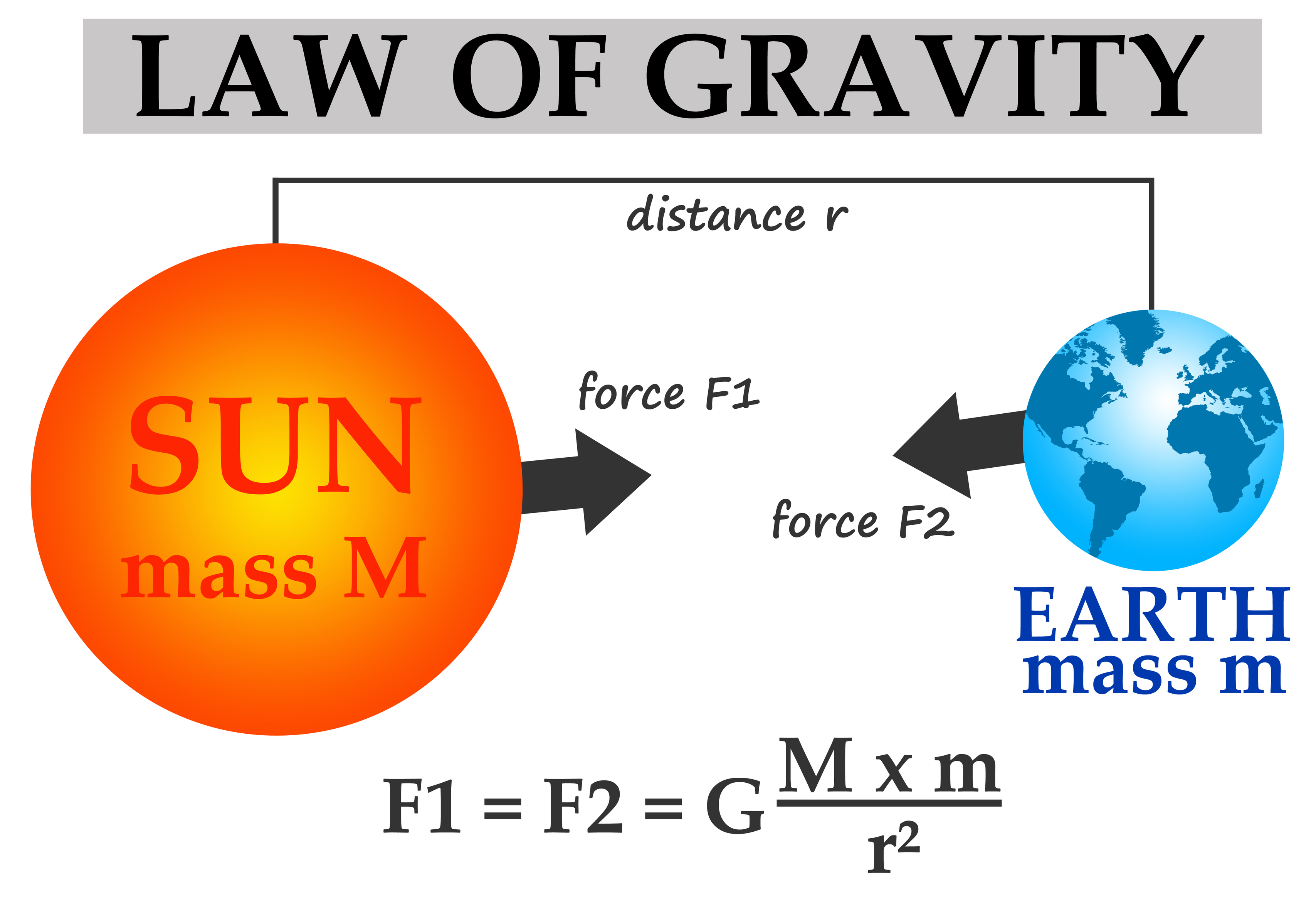
The space has substantiality, which gives it a measure of consistency. When the consistency is extremely small, the space appears as fluid energy that has a very high velocity. When the consistency is extremely large, the space appears as rigid matter that has a very low velocity. In between, the space appears as the gravitational field of variable consistency and velocity. The velocity has an inverse relationship with consistency. It is the balance of inherent motion of matter floating in a sea of energy that is perceived as the phenomenon of Gravity.
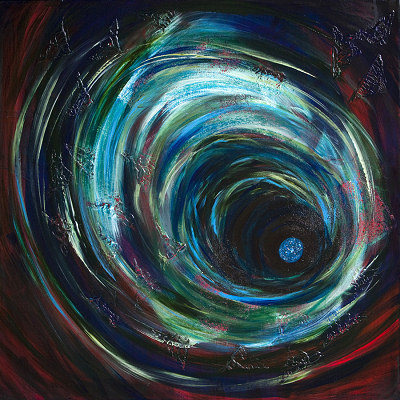
The spectrum of energy/matter based on the property of consistency suggests a vortex type pattern, which is seen repeated in nature at all scales. For example, the atoms display this pattern where the electrons form a vortex, at the center of which there is an extremely dense and small spinning nucleus. The “gravitational field” at this level appears as charge.
At the level of the solar system, planets revolve, as if they are caught up in a vortex of gravity, at the center which is a massive and spinning sun. In their turn, the spinning planets form the center of smaller vortices of gravity in which their moons are caught up.
On a much larger cosmic scale, we have solar or star systems that are caught up in a vortex of gravity which appears as a galaxy. At the center of the galaxy is an extremely dense and small spinning black hole.
All these vortices at different scales seem to be overlapping and producing a very complex pattern in which the inherent motions of the heavenly bodies balance each other in a cosmic dance. We may thus visualize the universe having a “solid” spinning center made up uncountable number of galaxies with a great periphery of curving light far away of unimaginable proportions.
This “vortex universe” is devoid of solid masses in about 99% of its volume; but that volume is filled with palpable energy. The universe may be considered to be finite yet unbounded because it seems to curve upon itself.
.