Category Archives: Religion

BUDDHISM: The Eightfold Path

Reference: Buddhism

[NOTE: In color are Vinaire’s comments.]

The result of right concentration is not simply a new philosophy of life; but a regeneration: change into a different kind of creature, who experienced the world in a new way.

The Buddha’s approach to the problem of life in the Four Noble Truths was essentially that of a physician. He began by examining carefully the symptoms that provoke concern. If everything were going smoothly, so smoothly that we noticed ourselves as little as we normally notice our digestion, there would be nothing to worry about and we would have to attend no further to our way of life. But this is not the case. There is less creativity, more conflict, and more pain than we feel there should be. These symptoms the Buddha summarized in the First Noble Truth, with the declaration that life is dukkha, or out of joint. The next step was diagnosis. Throwing rites and faith to the winds, he asked, practically, what is causing these abnormal symptoms? Where is the seat of the infection? What is always present when suffering is present, and absent when suffering is absent? The answer was given in the Second Noble Truth: the cause of life’s dislocation is tanha, or the drive for private fulfillment. What, then, of the prognosis? The Third Noble Truth is hopeful: the disease can be cured by overcoming the egoistic drive for separate existence. This brings us to prescription; how is this overcoming to be accomplished? The Fourth Noble Truth provides the answer. The way to the overcoming of self-seeking is through the Eightfold Path.

The Fourth Noble Truth provides the prescription to the overcoming the egoistic drive for separate existence, which throws life out of joint.

The Eightfold Path, then, is a course of treatment. But it is not an external treatment, to be accepted passively by the patient as coming from without. It is not treatment by pills, or rituals, or grace. Instead, it is treatment by training. People routinely train for sports and their professions, but with notable exceptions like Benjamin Franklin, they are inclined to assume that one cannot train for life itself. The Buddha disagreed. He distinguished two ways of living. One—a random, unreflective way, in which the subject is pushed and pulled by impulse and circumstance like a twig in a storm drain—he called “wandering about.” The second, the way of intentional living, he called the Path. What he proposed was a series of changes designed to release the individual from ignorance, unwitting impulse, and tanha. It maps a complete course; steep grades and dangerous curves are posted, and rest spots indicated. By long and patient discipline, the Eightfold Path intends nothing less than to pick one up where one is and set one down as a different human being, one who has been cured of crippling disabilities. “Happiness he who seeks may win,” the Buddha said, “if he practice.”

The cure comes about when the Eightfold Path is practiced.

What is this practice the Buddha is talking about? He breaks it down into eight steps. They are preceded, however, by a preliminary he does not include in his list, but refers to so often elsewhere that we may assume that he was presupposing it here. This preliminary step is right association. No one has recognized more clearly than the Buddha the extent to which we are social animals, influenced at every turn by the “companioned example” of our associates, whose attitudes and values affect us profoundly. Asked how one attains illumination, the Buddha began: “An arouser of faith appears in the world. One associates oneself with such a person.” Other injunctions follow, but right association is so basic that it warrants another paragraph.

The preliminary step is right association.

When a wild elephant is to be tamed and trained, the best way to begin is by yoking it to one that has already been through the process. By contact, the wild one comes to see that the condition it is being led toward is not wholly incompatible with being an elephant—that what is expected of it does not contradict its nature categorically and heralds a condition that, though startlingly different, is viable. The constant, immediate, and contagious example of its yoke-fellow can teach it as nothing else can. Training for the life of the spirit is not different. The transformation facing the untrained is neither smaller than the elephant’s nor less demanding. Without visible evidence that success is possible, without a continuous transfusion of courage, discouragement is bound to set in. If (as scientific studies have now shown) anxieties are absorbed from one’s associates, may not persistence be assimilated equally? Robert Ingersoll once remarked that had he been God he would have made health contagious instead of disease; to which an Indian contemporary responded: “When shall we come to recognize that health is as contagious as disease, virtue as contagious as vice, cheerfulness as contagious as moroseness?” One of the three things for which we should give thanks every day, according to Shankara, is the company of the holy; for as bees cannot make honey unless together, human beings cannot make progress on the Way unless they are supported by a field of confidence and concern that Truthwinners generate. The Buddha agrees. We should associate with Truthwinners, converse with them, serve them, observe their ways, and imbibe by osmosis their spirit of love and compassion. 

We should associate with Truthwinners, converse with them, serve them, observe their ways, and imbibe by osmosis their spirit of love and compassion. 

With this preliminary step in place we may proceed to the Path’s eight steps proper. 

1. Right Views. A way of life always involves more than beliefs, but it can never bypass them completely, for in addition to being social animals, as was just noted, human beings are also rational animals. Not entirely, to be sure—the Buddha would have been quick to acknowledge this. But life needs some blueprint, some map the mind can trust if we are to direct our energies purposively. To return to the elephant for illustration, however great the danger in which it finds itself, it will make no move to escape until it has first assured itself that the track it must tread will bear its weight. Without this conviction it will remain trumpeting in agony in a burning wagon rather than risk a fall. Reason’s most vociferous detractors must admit that it plays at least this much of a role in human life. Whether or not it has the power to lure, it clearly holds power of veto. Until reason is satisfied, an individual cannot proceed in any direction wholeheartedly. 

Until reason is satisfied, an individual cannot proceed in any direction wholeheartedly. 

Some intellectual orientation, therefore, is needed if one is to set out other than haphazardly. The Four Noble Truths provide this orientation. Suffering abounds, it is occasioned by the drive for private fulfillment, that drive can be tempered, and the way to temper it is by traveling the Eightfold Path.

The Four Noble Truths provide this orientation.

2. Right Intent. Whereas the first step summoned us to make up our minds as to what life’s problem basically is, the second advises us to make up our hearts as to what we really want. Is it really enlightenment, or do our affections swing this way and that, dipping like kites with every current of distraction? If we are to make appreciable headway, persistence is indispensable. People who achieve greatness are almost invariably passionately invested in some one thing. They do a thousand things each day, but behind these stands the one thing they count supreme. When people seek liberation with single-mindedness of this order, they may expect their steps to turn from sliding sandbank scrambles into ground-gripping strides. 

People who achieve greatness are almost invariably passionately invested in some one thing. 

3. Right Speech. In the next three steps we take hold of the switches that control our lives, beginning with attention to language. Our first task is to become aware of our speech and what it reveals about our character. Instead of starting with a resolve to speak nothing but the truth—one that is likely to prove ineffective at the outset because it is too advanced—we will do well to start further back, with a resolve to notice how many times during the day we deviate from the truth, and to follow this up by asking why we did so. Similarly with uncharitable speech. Begin not by resolving never to speak an unkind word, but by watching one’s speech to become aware of the motives that prompt unkindness.

Begin not by resolving never to speak an unkind word, but by watching one’s speech to become aware of the motives that prompt unkindness. Same with untruth.

After this first step has been reasonably mastered, we will be ready to try some changes. The ground will have been prepared, for once we become aware of how we do talk, the need for changes will become evident. In what directions should the changes proceed? First, toward veracity. The Buddha approached truth more ontologically than morally; he considered deceit more foolish than evil. It is foolish because it reduces one’s being. For why do we deceive? Behind the rationalizations, the motive is almost always fear of revealing to others or to ourselves what we really are. Each time we give in to this “protective tariff,” the walls of our egos thicken to further imprison us. To expect that we can dispense with our defenses at a stroke would be unrealistic, but it is possible to become progressively aware of them and recognize the ways in which they hem us in. 

Once we become aware of how we do talk, the need for changes will become evident. Be what you truly are.

The second direction in which our speech should move is toward charity. False witness, idle chatter, gossip, slander, and abuse are to be avoided, not only in their obvious forms but also in their covert ones. The covert forms—subtle belittling, “accidental” tactlessness, barbed wit—are often more vicious because their animus is veiled.

The second direction in which our speech should move is toward charity.

4. Right Conduct. Here, too, the admonition (as the Buddha detailed it in his later discourses) involves a call to understand one’s behavior more objectively before trying to improve it. The trainee is to reflect on actions with an eye to the motives that prompted them. How much generosity was involved, and how much self-seeking? As for the direction in which change should proceed, the counsel is again toward selflessness and charity. These general directives are detailed in the Five Precepts, the Buddhist version of the second or ethical half of the Ten Commandments:

Understand your behavior more objectively before trying to improve it. Any change should proceed toward selflessness and charity as spelled out in the Five Precepts below.

Do not kill. Strict Buddhists extend this proscription to animals and are vegetarians.
Do not steal.
Do not lie.
Do not be unchaste. For monks and the unmarried, this means continence. For the married it means restraint in proportion to one’s interests in, and distance along, the Path.
Do not drink intoxicants. It is reported that an early Russian Czar, faced with the decision as to whether to choose Christianity, Islam, or Buddhism for his people, rejected the latter two because both included this fifth proscription.

5. Right Livelihood. The word “occupation” is well devised, for our work does indeed occupy most of our waking attention. Buddha considered spiritual progress to be impossible if the bulk of one’s doings pull against it: “The hand of the dyer is subdued by the dye in which it works.” Christianity has agreed. While explicitly including the hangman as a role society regrettably requires, Martin Luther disallowed usurers and speculators. 

One’s occupation should not pull against one’s spiritual progress.

For those who are intent enough on liberation to give their entire lives to the project, right livelihood requires joining the monastic order and subscribing to its discipline. For the layperson it calls for engaging in occupations that promote life instead of destroying it. Again the Buddha was not content with generalizing. He named names—the professions of his day he considered incompatible with spiritual seriousness. Some of these are obvious: poison peddler, slave trader, prostitute. Others if adopted worldwide would be revolutionary: butcher, brewer, arms maker, tax collector (profiteering was then routine). One of the number continues to be puzzling. Why did the Buddha condemn the occupation of caravan trader? 

Engage in occupations that promote life instead of destroying it. 

While the Buddha’s explicit teachings about work were aimed at helping his contemporaries decide between occupations that were conducive to spiritual progress and ones that impeded it, there are Buddhists who suggest that if he were teaching today he would be less concerned with specifics than with the danger that people forget that earning a living is life’s means, not life’s end.

Earning a living is life’s means, not life’s end.

6. Right Effort. The Buddha laid tremendous stress on the will. Reaching the goal requires immense exertion; there are virtues to be developed, passions to be curbed, and destructive mind states to be expunged so compassion and detachment can have a chance. “‘He robbed me, he beat me, he abused me’—in the minds of those who think like this, hatred will never cease.” But the only way such crippling sentiments can be dispelled, indeed the only way to shake off fetters of any sort, is by what William James called “the slow dull heave of the will.” “Those who follow the Way,” said Buddha, “might well follow the example of an ox that marches through the deep mire carrying a heavy load. He is tired, but his steady gaze, looking forward, will never relax until he comes out of the mire, and it is only then he takes a respite. O monks, remember that passion and sin are more than the filthy mire, and that you can escape misery only by earnestly and steadily thinking of the Way.” Velleity—a low level of volition, a mere wish not accompanied by effort or action to obtain it—won’t do.

Reaching the goal requires immense exertion; there are virtues to be developed, passions to be curbed, and destructive mind states to be expunged so compassion and detachment can have a chance.

In discussing right effort, the Buddha later added some after-thoughts about timing. Inexperienced climbers, out to conquer their first major peak, are often impatient with the seemingly absurd saunter at which their veteran guide sets out, but before the day is over his staying pace is vindicated. The Buddha had more confidence in the steady pull than in the quick spurt. Stretched too taut, a string will snap; a plane that ascends too sharply will crash. In China the author of the Tao Te Ching made the point with a different image: “He who takes the longest strides does not walk farthest.”

The Buddha had more confidence in the steady pull than in the quick spurt. 

Because the West has found the last two steps in the Eightfold Path of special importance for the understanding of the human mind and its workings—there are several meditation centers in the United States, catering disproportionately to mental health professionals, that are dedicated exclusively to their practice—these will be discussed at greater length. 

7. Right Mindfulness. No teacher has credited the mind with more influence over life than did the Buddha. The best loved of all Buddhist texts, the Dhammapada, opens with the words, “All we are is the result of what we have thought.” And respecting the future, it assures us that “all things can be mastered by mindfulness.” 

All we are is the result of what we have thought. All things can be mastered by mindfulness.

Among Western philosophers, Spinoza stands closest to the Buddha on the mind’s potential. Spinoza’s dictum—“to understand something is to be delivered of it”—comes close to summarizing his entire ethic. The Buddha would have agreed. If we could really understand life, if we could really understand ourselves, we would find neither a problem. Humanistic psychology proceeds on the same assumption. When “awareness of experience is fully operating,” Carl Rogers writes, “human behavior is to be trusted, for in these moments the human organism becomes aware of its delicacy and tenderness towards others.” The Buddha saw ignorance, not sin, as the offender. More precisely, insofar as sin is our fault, it is prompted by a more fundamental ignorance—most specifically, the ignorance of our true nature. 

Insofar as sin is our fault, it is prompted by a more fundamental ignorance—most specifically, the ignorance of our true nature. 

To gradually overcome this ignorance, the Buddha counsels such continuous self-examination as to make us wilt (almost) at the prospect, but he thought it necessary because he believed that freedom—liberation from unconscious, robot-like existence—is achieved by self-awareness. To this end he insisted that we seek to understand ourselves in depth, seeing everything minutely, “as it really is.” If we maintain a steady attention to our thoughts and feelings, we perceive that they swim in and out of our awareness, and are in no way permanent parts of us. We should witness all things non-reactively, especially our moods and emotions, neither condemning some nor holding on to others. A miscellany of other practices are recommended, some of which are these: The aspirant is to keep the mind in control of the senses and impulses, rather than being driven by them. Fearful and disgusting sights are to be meditated on until one no longer experiences aversion toward them. The entire world should be pervaded with thoughts of loving-kindness. 

The aspirant is to keep the mind in control of the senses and impulses, rather than being driven by them. Fearful and disgusting sights are to be meditated on until one no longer experiences aversion toward them. The entire world should be pervaded with thoughts of loving-kindness. 

Out of the semi-alertness that comprises the consciousness of the average human being, this seventh step summons the seeker to steady awareness of every action that is taken, and every content that turns up in one’s stream of consciousness. The adept becomes aware of the moment when sleep takes over, and whether breath was coming in or going out at that moment. Obviously, this takes practice. In addition to working at it continuously to some extent, special times should be allotted for undistracted introspection. Periods of complete withdrawal for the purpose must also be built into one’s schedule. 

This seventh step summons the seeker to steady awareness of every action that is taken, and every content that turns up in one’s stream of consciousness.

Here is a Western observer’s description of monks in Thailand practicing this seventh step: 

One of them spends hours each day slowly walking about the grounds of the wat in absolute concentration upon the minutest fraction of every action connected with each step. The procedure is carried into every single physical act of daily life until, theoretically, the conscious mind can follow every step that goes into the generation of a feeling, perception or thought. A fifty-year-old monk meditates in a small graveyard adjoining his wat, because he’s undisturbed there. He seats himself, cross-legged and immobile but with his eyes open, for hours on end—through the driving rain at midnight or the blistering heat of noonday. His usual length of stay is two or three hours. 

Through this practice one arrives at a number of insights: (1) Every emotion, thought, or image is accompanied by a body sensation, and vice versa. (2) One discerns obsessive patterns in what arises in one’s mind and how these patterns constitute our misery (dukkha). For some it is a nursing of old grievances; others find themselves preoccupied with longings and self-pity, and still others simply feel at sea. With continuing practice the obsessive grip of these patterns loosens. (3) Every mental and physical state is in flux; none is solid and enduring. Even physical pain is a series of discrete sensations that can suddenly change. (4) The meditator realizes how little control we have over our minds and our physical sensations, and how little awareness we normally have of our reactions. (5) Most important, one begins to realize that there is nobody behind the mental/physical events, orchestrating them. When the capacity for microscopic attention is refined, it becomes apparent that consciousness itself is not continuous. Like the light from a light bulb, the on/off is so rapid that consciousness seems to be steady, whereas in fact it is not. With these insights, the belief in a separate self-existent self begins to dissolve.

With this close examination of one’s nature, one starts to realize that there is no separate self-existent self.

8. Right Concentration. This involves substantially the techniques we have already encountered in Hinduism’s raja yoga and leads to substantially the same goal. In his later years the Buddha told his disciples that his first intimations of deliverance came to him before he left home when, still a boy and sitting one day in the cool shade of an apple tree in deep thought, he found himself caught up into what he later identified as the first level of the absorptions. It was his first faint foretaste of deliverance, and he said to himself, “This is the way to enlightenment.” It was nostalgia for the return and deepening of this experience, as much as his disillusionment with the usual rewards of worldly life, that led him to his decision to devote his life completely to spiritual adventure. The result, as we have seen, was not simply a new philosophy of life. It was regeneration: change into a different kind of creature, who experienced the world in a new way. Unless we see this, we shall be unequipped to fathom the power of Buddhism in human history. Something happened to the Buddha under that Bo Tree, and something has happened to every Buddhist since who has persevered to the final step of the Eightfold Path. Like a camera, the mind had been poorly focused, but the adjustment has now been made. With the “extirpation of delusion, craving, and hostility,” the three poisons, we see that things were not as we had supposed. Indeed, suppositions of whatsoever sort have vanished, to be replaced by direct perception. The mind reposes in its true condition.

The result of right concentration is not simply a new philosophy of life; but a regeneration: change into a different kind of creature, who experienced the world in a new way. Suppositions of whatsoever sort vanish, to be replaced by direct perception. The mind reposes in its true condition.

.

CHRISTIANITY: The Good News

Reference: Christianity

[NOTE: In color are Vinaire’s comments.]

The people who first heard Jesus’ disciples proclaiming the Good News were impressed by their tranquility, simplicity, and cheerfulness that was encountered nowhere else. 

The conviction that Jesus continued to live transformed a dozen or so disconsolate followers of a slain and discredited leader into one of the most dynamic groups in human history. We read that tongues of fire descended upon them. It was a fire destined to set the Mediterranean world aflame. People who were not speakers waxed eloquent. They exploded across the Greco-Roman world, preaching what has come to be called the Gospel but which, if translated literally, would be called the Good News. Starting in an upper room in Jerusalem, they spread their message with such fervor that in Jesus’ very generation it took root in every major city of the region.

The conviction that Jesus continued to live transformed a dozen or so disconsolate followers of a slain and discredited leader into one of the most dynamic groups in human history. 

And what was this Good News that snapped Western history like a dry twig, into B.C. and A.D. and left its impact through the Christian Church? Was it Jesus’ ethical teachings—the Golden Rule, the Sermon on the Mount? Not at all. We have already noted that every teaching of Jesus was already in the literature of his day. Paul, whose letters epitomize the concerns of the early Church, knew what Jesus had taught, but he almost never quotes him. Obviously, the news that transformed him was not Jesus’ ethical precepts nor even the way his life embodied them. It was something quite different.

The news that transformed Paul, the father of early church, was not Jesus’ ethical precepts nor even the way his life embodied them. It was something quite different.

What this other something was may be approached through a symbol. If we had been living around the eastern Mediterranean in the early centuries of the Christian era, we might have noticed scratched here and there on the sides of walls and houses or simply on the ground the crude outline of a fish. Even if we had seen it in several places, we would probably have dismissed it as innocuous graffiti or a doodle, for these were mainly seaport towns where fishing was a part of daily life. Had we been Christians, however, we would have seen these drawings as the logo for the Good News. The heads of the fish would have pointed us toward the place where the local Christian group held its underground meetings. For in those years of catacombs and arenas, when to be known as a Christian meant that one might be thrown to the lions or turned into a human torch, Christians were forced to more cryptic symbols than the cross. The fish was one of their favorites, for the Greek letters for the word fish are also the first letters of the Greek words for “Jesus Christ, Son of God, Savior.” This was the Good News, epitomized in the crude outline of an ordinary fish. 

The “Good News” was the cryptic symbol of fish that epitomized the phrase, “Jesus Christ, Son of God, Savior.”

But what does the phrase itself mean: Jesus Christ, Son of God, Savior? Those who have grown up with it may know the answer well. Our task, however, is to go behind the immense history of the phrase and try to work our way into what it meant to the men and women who first uttered it, for the entire subsequent history of Christianity grew out of their understanding of its significance. 

To the men and women who first uttered this phrase, it had a special significance.

In doing so one is tempted to plunge at once into ideas, definitions, and theology, but it will be wise to begin in another way. Ideas are important in life, but of themselves they seldom provide starting points. They grow out of facts and experiences and, torn from this soil, lose their life like uprooted trees. We shall find ourselves quite incapable of understanding Christian theology unless we manage to see clearly the experience it tried to account for. 

We shall find ourselves quite incapable of understanding Christian theology unless we manage to see clearly the experience it tried to account for. 

The people who first heard Jesus’ disciples proclaiming the Good News were as impressed by what they saw as by what they heard. They saw lives that had been transformed—men and women who were ordinary in every way except for the fact that they seemed to have found the secret of living. They evinced a tranquility, simplicity, and cheerfulness that their hearers had nowhere else encountered. Here were people who seemed to be making a success of the enterprise everyone would like to succeed at—that of life itself.

The people who first heard Jesus’ disciples proclaiming the Good News were impressed by their tranquility, simplicity, and cheerfulness that was encountered nowhere else. 

Specifically, there seemed to be two qualities in which their lives abounded. The first of these was mutual regard. One of the earliest observations about Christians that we have by an outsider is, “See how these Christians love one another.” Integral to this mutual regard was a total absence of social barriers; it was a “discipleship of equals,” as one New Testament scholar puts it. Here were men and women who not only said that everyone was equal in the sight of God but who lived as though they meant it. The conventional barriers of race, gender, and status meant nothing to them, for in Christ there was neither Jew nor Gentile, male nor female, slave nor free. As a consequence, in spite of differences in function or social position, their fellowship was marked by a sense of genuine equality. 

Here were men and women who not only said that everyone was equal in the sight of God but who lived as though they meant it. The conventional barriers of race, gender, and status meant nothing to them.

E. Schillebeeckx tells us that “being sad in Jesus’ presence [was] an existential impossibility,” and this takes us to the second quality that early Christians exhibited. Jesus once told his followers that his teachings were to the end “that my joy may be in you, and that your joy may be complete” (John 15:11), and to a remarkable degree that object appears to have been realized. Outsiders found this baffling. These scattered Christians were not numerous. They were not wealthy or powerful. If anything, they faced more adversity than the average man or woman. Yet, in the midst of their trials, they had laid hold of an inner peace that found expression in a joy that seemed exuberant. Perhaps radiant would be a better word. Radiance is hardly the word used to characterize the average religious life, but none other fits as well the life of these early Christians. Paul is an example. Here was a man who had been ridiculed, driven from town to town, shipwrecked, imprisoned, flogged until his back was covered with stripes. Yet here was a life in which joy was the constant refrain: “Joy unspeakable and full of glory.” “Thanks be to God who giveth us the victory.” “In all things we are more than conquerors.” “God who commanded the light to shine out of darkness has shined in our hearts.” “Thanks be to God for his unspeakable gift.” The joy of these early Christians was unspeakable. As the fifth chapter of Ephesians suggests, they sang not out of convention but from the irrepressible overflow of their direct experience. Life for them was no longer a matter of coping. It was glory discerned. 

These scattered early Christians had somehow laid hold of an inner peace that found expression in a joy that seemed exuberant, in spite of  life’s adversities.

What produced this love and joy in these early Christians? The qualities themselves are universally desired; the problem is how they are to be obtained. The explanation, insofar as we are able to gather from the New Testament record, is that three intolerable burdens had suddenly and dramatically been lifted from their shoulders. The first of these was fear, including the fear of death. We have the word of Carl Jung that he never met a patient over forty whose problems did not root back to fear of approaching death. The reason the Christians could not be intimidated by the lions and even sang as they entered the arena was that Jesus’ counsel, “Fear not, for I am with you,” worked for them. 

They had conquered the fear of death.

The second burden from which they had been released was guilt. Rationalists consider guilt a vanishing phenomenon, but psychologists do not agree. Recognized or repressed, guilt of some degree seems built into the human condition, for no one lives up to his or her ideals completely. It is not only that we behave less well toward others than conscience dictates; we also fail ourselves by leaving talents undeveloped and letting opportunities slip. We may manage to keep remorse at bay while the sun is up, but in sleepless hours of the night it visits us:

…the rending pain of re-enactment
Of all that you have done, and been; the shame
Of motives late revealed, and the awareness
Of things ill done and done to other’s harm
Which once you took as exercise of virtue.
(T. S. Eliot, “Little Gidding”)

Unrelieved guilt reduces creativity. In its acute form it can rise to a fury of self-condemnation that shuts life down. Paul had felt its force before he was released: “Wretched man that I am! Who will rescue me from this body of death?” (Romans 7:24). 

They were released from the burden of guilt.

The third release the Christians experienced was from the cramping confines of the ego. There is no reason to suppose that prior to their new life these men and women had been any more self-centered than the next person, but this was enough for them to know that their love was radically restricted. They knew that “the human curse is to love and sometimes to love well, but never well enough.” Now this curse had been dramatically lifted. 

They were released from the cramping confines of the ego. 

It is not difficult to see how release from guilt, fear, and self could feel like rebirth. If someone were to free us from these crippling impediments, we too would call that person savior. But this only pushes our question back a step. How did the Christians get free of these burdens? And what did a man named Jesus, now gone, have to do with the process that they should credit it as his doing? 

How did the Christians get free of these burdens? 

The only power that can effect transformations of the order we have described is love. It remained for the twentieth century to discover that locked within the atom is the energy of the sun itself. For this energy to be released, however, the atom must be bombarded from without. So too, locked in every human being is a store of love that partakes of the divine—the imago dei, image of God, it is sometimes called. And it too can be activated only through bombardment, in its case love’s bombardment. The process begins in infancy, where a mother’s initially unilateral loving smile awakens love in her baby and, as coordination develops, elicits its answering smile. The process continues into childhood. A loving human being is not produced by exhortations, rules, and threats. Love only takes root in children when it comes to them—initially and most importantly from nurturing parents. Ontogenetically speaking, love is an answering phenomenon. It is literally a response. 

The only power that can effect transformations of the order we have described is love. Love only takes root in children when it comes to them—initially and most importantly from nurturing parents.

An actual incident may help to bring this point home: 

He was a diffident freshman in a small midwestern college when one morning the instructor, one he idolized in the way the young idolize their role models, opened the class by saying, “Last evening I read some of the most significant sentences that I can recall.” As he proceeded to read them the boy’s heart leapt into his throat, for he was hearing his own words being read back to him from the paper he had submitted the preceding week. As he relates the incident: “I don’t remember another thing that occurred during that hour, but I shall never forget my feelings when the bell brought me to my senses. It was noon and October was never so beautiful. I was exultant. If anyone had asked me for anything, I would have given it gladly, for I wanted nothing. I ached only to give to the world that had given so much to me.” 

If a young man found himself changed to this extent by the interest a mere man had shown in him, it is not difficult to imagine the change that would have come over the early Christians if they knew that they were loved by God. Imagination may fail us here, but logic need not. If we too felt loved, not abstractly or in principle but vividly and personally, by one who unites all power and perfection, the experience could melt our fear, guilt, and self-concern permanently. As Kierkegaard said, if at every moment both present and future I were certain that nothing has happened or can ever happen that would separate us from the infinite love of the Infinite, that would be the reason for joy. 

The early Christians had a vivid experience of being loved by God. In other words, they felt one with the world around them.

God’s love is precisely what the first Christians did feel. They had experienced Jesus’ love and had became convinced that Jesus was God incarnate. Once that love reached them it could not be stopped. Melting the barriers of fear, guilt, and self, it poured through them as if they were sluice gates, augmenting the love they had hitherto felt for others until the difference in degree became a difference in kind and a new quality, which the world has come to call Christian love, was born. Conventional love is evoked by lovable qualities in the beloved, but the love people encountered from Christ embraced sinners and outcasts, Samaritans and enemies. It gave, not prudentially in order to receive, but because giving was its nature. Paul’s famous description of Christian love in the thirteenth chapter of First Corinthians ought not to be read as if he were commenting on an attitude we are already familiar with. His words point to the attribute of a specific person, Jesus Christ. In phrases of classic beauty it describes the divine love that Paul believed Christians would reflect toward others once they experienced Christ’s love for them. The reader should approach Paul’s words as if they define a novel capacity which, as it had been fully realized “in the flesh” only in Christ, Paul was describing for the first time.

The early Christians had experienced Jesus’ love and had became convinced that Jesus was God incarnate. To them love had taken new dimensions as described thus:

Love is patient; love is kind; love is not envious or arrogant or rude. It does not insist on its own way; it is not irritable or resentful; it does not rejoice in wrongdoing, but rejoices in the truth. It bears all things, believes all things, hopes all things, endures all things. Love never ends. (1 Corinthians 13:4–8)

So astonishing did the first Christians find this love and the fact that it had actually entered their lives that they had to appeal for help in describing it. Paul, in closing one of the earliest recorded sermons on the Good News, turned back to the words of one of the prophets, who in turn was speaking for God: “Look at this, you scornful souls, and lose yourselves in wonder; for in your days I do such a deed that, if men were to tell you this story, you would not believe it” (Acts 13:41).

It was a new and enlightening experience for people burdened with fear, guilt and self-concern.

.

BUDDHISM: The Four Noble Truths

Reference: Buddhism

[NOTE: In color are Vinaire’s comments.]

Our evolution depends on resolving the anomalies of the universe and not the fictitious “anomalies of self.”

When the Buddha finally managed to break through the spell of rapture that rooted him to the Immovable Spot for the forty-nine days of his enlightenment, he arose and began a walk of over one hundred miles toward India’s holy city of Banaras. Six miles short of that city, in a deer park at Sarnath, he stopped to preach his first sermon. The congregation was small—only five ascetics who had shared his severe austerities but had broken with him in anger when he renounced that approach, only to have now become his first disciples. His subject was the Four Noble Truths. His first formal discourse after his awakening, it was a declaration of the key discoveries that had come to him as the climax of his six-year quest. 

The first sermon of Buddha was on Four Noble Truths. It was a summarization of his key realizations of his six-year quest.

Asked to list in propositional form their four most considered convictions about life, most people would probably stammer. The Four Noble Truths constitute Buddha’s answer to that request. Together they stand as the axioms of his system, the postulates from which the rest of his teachings logically derive. 

The For Noble Truths stand as the axioms of Buddha’s system.

The First Noble Truth is that life is dukkha, usually translated “suffering.” Though far from its total meaning, suffering is an important part of that meaning and should be brought to focus before proceeding to other connotations. 

The First Noble Truth is that life is dukkha, usually translated “suffering.”

Contrary to the view of early Western interpreters, the Buddha’s philosophy was not pessimistic. A report of the human scene can be as grim as one pleases; the question of pessimism does not arise until we are told whether it can be improved. Because the Buddha was certain that it could be, his outlook falls within Heinrich Zimmer’s observation that “everything in Indian thought supports the basic insight that, fundamentally, all is well. A supreme optimism prevails everywhere.” But the Buddha saw clearly that life as typically lived is unfulfilling and filled with insecurity.

Buddha saw clearly that life as typically lived is unfulfilling and filled with insecurity.

He did not doubt that it is possible to have a good time and that having a good time is enjoyable, but two questions obtruded. First, how much of life is thus enjoyable. And second, at what level of our being does such enjoyment proceed. Buddha thought the level was superficial, sufficient perhaps for animals but leaving deep regions of the human psyche empty and wanting. By this understanding even pleasure is gilded pain. “Earth’s sweetest joy is but disguised pain,” William Drummond wrote, while Shelley speaks of “that unrest which men miscall delight.” Beneath the neon dazzle is darkness; at the core—not of reality but of unregenerated human life—is the “quiet desperation” Thoreau saw in most peoples’ lives. That is why we seek distractions, for distractions divert us from what lies beneath the surface. Some may be able to distract themselves for long periods, but the darkness is unrelieved.

Lo! as the wind is, so is mortal life:
A moan, a sigh, a sob, a storm, a strife.

By Buddha’s understanding even pleasure was gilded pain. 

That such an estimate of life’s usual condition is prompted more by realism than by morbidity is suggested by the extent to which thinkers of every stripe have shared it. Existentialists describe life as a “useless passion,” “absurd,” “too much (de trop).” Bertrand Russell, a scientific humanist, found it difficult to see why people should take unhappily to news that the universe is running down, inasmuch as “I do not see how an unpleasant process can be made less so [by being] indefinitely repeated.” Poetry, always a sensitive barometer, speaks of “the pitiful confusion of life” and “time’s slow contraction on the most hopeful heart.” The Buddha never went further than Robert Penn Warren:

Oh, it is real. It is the only real thing.
Pain. So let us name the truth, like men.
We are born to joy that joy may become pain.
We are born to hope that hope may become pain.
We are born to love that love may become pain.
We are born to pain that pain may become more
Pain, and from that inexhaustible superflux
We may give others pain as our prime definition.

Such an estimate of life’s usual condition is prompted more by realism than by morbidity.

Even Albert Schweitzer, who considered India pessimistic, echoed the Buddha’s appraisal almost to idiom when he wrote, “Only at quite rare moments have I felt really glad to be alive. I could not but feel with a sympathy full of regret all the pain that I saw around me, not only that of men, but of the whole creation.” 

In my opinion, the whole purpose of life is to evolve, and that is not easy. But with that purpose all pain becomes tolerable.

Dukkha, then, names the pain that to some degree colors all finite existence. The word’s constructive implications come to light when we discover that it was used in Pali to refer to wheels whose axles were off-center, or bones that had slipped from their sockets. (A modern metaphor might be a shopping cart we try to steer from the wrong end.) The exact meaning of the First Noble Truth is this: Life (in the condition it has got itself into) is dislocated. Something has gone wrong. It is out of joint. As its pivot is not true, friction (interpersonal conflict) is excessive, movement (creativity) is blocked, and it hurts. 

The exact meaning of the First Noble Truth is this: Life (in the condition it has got itself into) is dislocated. Something has gone wrong. It is out of joint. As its pivot is not true, friction (interpersonal conflict) is excessive, movement (creativity) is blocked, and it hurts. 

Having an analytical mind, the Buddha was not content to leave this First Truth in this generalized form. He went on to pinpoint six moments when life’s dislocation becomes glaringly apparent. Rich or poor, average or gifted, all human beings experience: 

1. The trauma of birth. Psychoanalysts have in our time made a great deal of this point. Though Freud came to deny that the birth trauma was the source of all later anxiety, to the end he considered it anxiety’s prototype. The birth experience “involves just such a concatenation of painful feelings, of discharges and excitation, and of bodily sensations, as have become a prototype for all occasions on which life is endangered, ever after to be reproduced again in us as the dread of ‘anxiety’ conditions.”

2. The pathology of sickness. 

3. The morbidity of decrepitude. In the early years sheer physical vitality joins with life’s novelty to render life almost automatically good. In later years the fears arrive: fear of financial dependence; fear of being unloved and unwanted; fear of protracted illness and pain; fear of being physically repulsive and dependent on others; fear of seeing one’s life as a failure in some important respect. 

4. The phobia of death. On the basis of years of clinical practice, Carl Jung reported that he found death to be the deepest terror in every patient he had analyzed who had passed the age of forty. Existentialists join him in calling attention to the extent to which the fear of death mars healthy living.

5. To be tied to what one dislikes. Sometimes it is possible to break away, but not always. An incurable disease, a stubborn character defect—for better or for worse there are martyrdoms to which people are chained for life. 

6. To be separated from what one loves. 

All human beings experience the trauma of birth, the pathology of sickness, the morbidity of decrepitude, the phobia of death, to be tied to what one dislikes, and to be separated from what one loves. 

No one denies that the shoe of life pinches in these six places. The First Noble Truth pulls them together by concluding that the five skandas (life components) are painful. As these skandas are body, sensations, thoughts, feelings, and consciousness—in short, the sum of what we generally consider life to be—the statement amounts to the assertion that the whole of human life (again, as usually lived) is suffering. Somehow life has become estranged from reality, and this estrangement precludes real happiness until it is overcome. 

The five components of life—body, sensations, thoughts, feelings, and consciousness—are painful. 

For the rift to be healed we need to know its cause, and the Second Noble Truth identifies it. The cause of life’s dislocation is tanha. Again imprecisions of translations—all are to some degree dishonest—make it wise to stay close to the original word. Tanha is usually translated as “desire.” There is some truth in this—the kind we encounter in Heartbreak House when George Bernard Shaw has Ellie exclaim, “I feel now as if there was nothing I could not do, because I want nothing,” which assertion moves Captain Shotover to his one enthusiasm in the play: “That’s the only real strength. That’s genius. That’s better than rum.” But if we try to make desire tanha’s equivalent, we run into difficulties. To begin with, the equivalence would make this Second Truth unhelpful, for to shut down desires, all desires, in our present state would be to die, and to die is not to solve life’s problem. But beyond being unhelpful, the claim of equivalence would be flatly wrong, for there are some desires the Buddha explicitly advocated—the desire for liberation, for example, or for the happiness of others. 

The Second Noble truth: The cause of life’s dislocation is tanha, usually translated as “thirst.”

Tanha is a specific kind of desire, the desire for private fulfillment. When we are selfless we are free, but that is precisely the difficulty—to maintain that state. Tanha is the force that ruptures it, pulling us back from the freedom of the all to seek fulfillment in our egos, which ooze like secret sores. Tanha consists of all “those inclinations which tend to continue or increase separateness, the separate existence of the subject of desire; in fact, all forms of selfishness, the essence of which is desire for self at the expense, if necessary, of all other forms of life. Life being one, all that tends to separate one aspect from another must cause suffering to the unit which even unconsciously works against the Law. Our duty to our fellows is to understand them as extensions, other aspects, of ourselves—fellow facets of the same Reality.”

Our duty to our fellows is to understand them as extensions, other aspects, of ourselves—fellow facets of the same Reality.

This is some distance from the way people normally understand their neighbors. The customary human outlook lies a good halfway toward Ibsen’s description of a lunatic asylum in which “each shuts himself in a cask of self, the cask stopped with a bung of self and seasoned in a well of self.” Given a group photograph, whose face does one scan for first? It is a small but telling symptom of the devouring cancer that causes sorrow. Where is the man who is as concerned that no one go hungry as that his own children be fed? Where is the woman who is as concerned that the standard of living for the entire world rise, as that her own salary be raised? Here, said the Buddha, is where the trouble lies; this is why we suffer. Instead of linking our faith and love and destiny to the whole, we persist in strapping these to the puny burros of our separate selves, which are certain to stumble and give out eventually. Coddling our individual identities, we lock ourselves inside “our skin-encapsulated egos” (Alan Watts), and seek fulfillment through their intensification and expanse. Fools to suppose that imprisonment can bring release! Can we not see that “tis the self by which we suffer”? Far from being the door to abundant life, the ego is a strangulated hernia. The more it swells, the tighter it shuts off the free-flowing circulation on which health depends, and the more pain increases.

Instead of linking our faith and love and destiny to the whole, we persist in strapping these to the puny burros of our separate selves, which are certain to stumble and give out eventually. 

The Third Noble Truth follows logically from the Second. If the cause of life’s dislocation is selfish craving, its cure lies in the overcoming of such craving. If we could be released from the narrow limits of self-interest into the vast expanse of universal life, we would be relieved of our torment. The Fourth Noble Truth prescribes how the cure can be accomplished. The overcoming of tanha, the way out of our captivity, is through the Eightfold Path.

The Third Noble truth: If the cause of life’s dislocation is selfish craving, its cure lies in the overcoming of such craving. 

The Fourth Noble truth: The way out of our captivity, is through the Eightfold Path.

.

CHRISTIANITY: The End and the Beginning

Reference: Christianity

[NOTE: In color are Vinaire’s comments.]

The resurrection reversed the cosmic position in which the cross had placed Jesus’ goodness. Instead of being fragile, the compassion the disciples had encountered in him was victorious over even death itself.

The way that Jesus’ earthly ministry ended is known to everyone. After mingling with his people and teaching them for a number of months, he was crucified. 

Jesus was crucified very soon after mingling with his people and teaching them.

That might well have been the end of the story. History abounds with visionaries who proposed schemes, died, and that is the last that is heard of them. In this case, however, it was just the beginning. Within a short time his followers were preaching the gospel of their Risen Lord. 

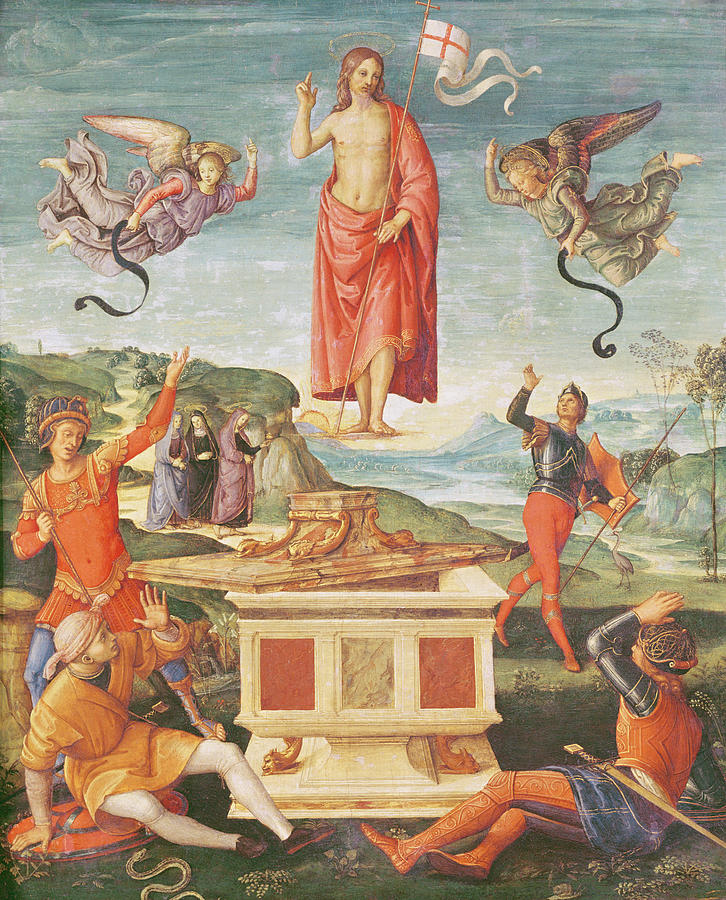
But Jesus was resurrected. Within a short time his followers were preaching the gospel of their Risen Lord. 

We are given too few details to know exactly what happened after the crucifixion; virtually all that is certain is that his followers were convinced that death had not held him. They reported that beginning on Easter Sunday he “appeared to them” as the same person they had known during his ministry but in a new way. It is not possible to determine exactly what that new way was; certain accounts suggest corporeality—eating, and Thomas’s touching the wound in his side—while others are more visionary, reporting him as passing through closed doors. Fidelity to the reports, all of which were entered by disciples who were convinced of Jesus’ resurrection, make clear that he did not simply resume his former physical body; resurrection was not resuscitation. Instead, it was entry into another mode of being, a mode that was sometimes visible but usually was not. What is clear is that Jesus’ followers began to experience him in a new way, namely as having the qualities of God. He could now be known anywhere, not just in physical proximity.

The disciples were convinced of Jesus’ resurrection. For them, it was entry into another mode of being, a mode that was sometimes visible but usually was not. Jesus’ followers began to experience him as having the qualities of God.

Faith in Jesus’ resurrection produced the Church and its Christology. To grasp the power of the belief, we must see that it did not merely concern the fate of a worthy man. Its claim extended ultimately to the status of goodness in the universe, contending that it was all-powerful. If Golgotha’s cross had been the end, the goodness Jesus embodied would have been beautiful, but how significant? A fragile blossom afloat on a torrential stream, soon to be dashed—how relevant is goodness if it has no purchase on reality, no power at its disposal? The resurrection reversed the cosmic position in which the cross had placed Jesus’ goodness. Instead of being fragile, the compassion the disciples had encountered in him was powerful; victorious over everything, even the seeming end of everything, death itself. “Grave, where is your victory? Death, where is your sting?” 

The resurrection reversed the cosmic position in which the cross had placed Jesus’ goodness. Instead of being fragile, the compassion the disciples had encountered in him was victorious over even death itself.

The way this message moved into, and eventually took over, the Mediterranean world is our next concern.

.

BUDDHISM: The Rebel Saint

Reference: Buddhism

[NOTE: In color are Vinaire’s comments.]

“Therefore, O Ananda, be lamps unto yourselves. Betake yourselves to no external refuge. Hold fast as a refuge to the Truth. Work out your own salvation with diligence.

In moving from Buddha the man to Buddhism the religion, it is imperative that the latter be seen against the background of the Hinduism out of which it grew. Unlike Hinduism, which emerged by slow, largely imperceptible spiritual accretion, the religion of the Buddha appeared overnight, fully formed. In large measure it was a religion of reaction against Hindu perversions—an Indian protestantism not only in the original meaning of that word, which emphasized witnessing for (testis pro) something, but equally in its latter-day connotations, which emphasize protesting against something. Buddhism drew its lifeblood from Hinduism, but against its prevailing corruptions Buddhism recoiled like a whiplash and hit back—hard. 

Buddhism drew its lifeblood from Hinduism, but against Hinduism’s prevailing corruptions Buddhism recoiled like a whiplash and hit back—hard. 

To understand the teachings of the Buddha, then, we shall need a minimal picture of the existing Hinduism that partly provoked it. And to lead into this, several observations about religion are in order. 

Six aspects of religion surface so regularly as to suggest that their seeds are in the human makeup. One of these is authority. Leaving divine authority aside and approaching the matter in human terms only, the point begins with specialization. Religion is not less complicated than government or medicine. It stands to reason, therefore, that talent and sustained attention will lift some people above the average in matters of spirit; their advice will be sought and their counsels generally followed. In addition, religion’s institutional, organized side calls for administrative bodies and individuals who occupy positions of authority, whose decisions carry weight. 

In religion, talent and sustained attention will lift some people above the average in matters of spirit. There will also be administrative bodies and individuals who occupy positions of authority, whose decisions carry weight. 

A second normal feature of religion is ritual, which was actually religion’s cradle, for anthropologists tell us that people danced out their religion before they thought it out. Religion arose out of celebration and its opposite, bereavement, both of which cry out for collective expression. When we are crushed by loss or when we are exuberant, we want not only to be with people; we want to interact with them in ways that make the interactions more than the sum of their parts—this relieves our isolation. The move is not limited to the human species. In northern Thailand, as the rising sun first touches the treetops, families of gibbons sing half-tone descending scales in unison as, hand over hand, they swoop across the topmost branches. 

Religion arose out of celebration and its opposite, bereavement, both of which cry out for collective expression.

Religion may begin in ritual, but explanations are soon called for, so speculation enters as a third religious feature. Whence do we come, whither do we go, why are we here?—people want answers to these questions. 

Religion may begin in ritual, but explanations are soon called for, so speculation enters as a third religious feature. 

A fourth constant in religion is tradition. In human beings it is tradition rather than instinct that conserves what past generations have learned and bequeath to the present as templates for action. A fifth typical feature of religion is grace, the belief—often difficult to sustain in the face of facts—that Reality is ultimately on our side. In last resort the universe is friendly; we can feel at home in it. “Religion says that the best things are the more eternal things, the things in the universe that throw the last stone, so to speak, and say the final word.”

A fourth constant in religion is tradition. A fifth typical feature of religion is grace. In last resort the universe is friendly.

Finally, religion traffics in mystery. Being finite, the human mind cannot begin to fathom the Infinite it is drawn to. 

Finally, religion traffics in mystery. 

Each of these six things—authority, ritual, speculation, tradition, grace, and mystery—contributes importantly to religion, but equally each can clog its works. In the Hinduism of the Buddha’s day they had done so, all six of them. Authority, warranted at the start, had become hereditary and exploitative as brahmins took to hoarding their religious secrets and charging exorbitantly for ministrations. Rituals became mechanical means for obtaining miraculous results. Speculation had lost its experiential base and devolved into meaningless hair-splitting. Tradition had turned into a dead weight, in one specific by insisting that Sanskrit—no longer understood by the masses—remain the language of religious discourse. God’s grace was being misread in ways that undercut human responsibility, if indeed responsibility any longer had meaning where karma, likewise misread, was confused with fatalism. Finally, mystery was confused with mystery-mongering and mystification—perverse obsession with miracles, the occult, and the fantastic.

Each of these six things—authority, ritual, speculation, tradition, grace, and mystery—contributes importantly to religion, but equally each can clog its works. In the Hinduism of the Buddha’s day they had done so, all six of them. 

Onto this religious scene—corrupt, degenerate, and irrelevant, matted with superstition and burdened with worn-out rituals—came the Buddha, determined to clear the ground that truth might find new life. The consequence was surprising. For what emerged was (at the start) a religion almost entirely devoid of each of the above-mentioned ingredients without which we would suppose that religion could not take root. This fact is so striking that it warrants being documented. 

The Buddha came determined to clear the ground that truth might find new life. 

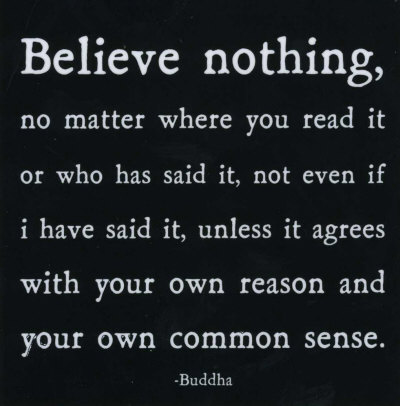
1. Buddha preached a religion devoid of authority. His attack on authority had two prongs. On the one hand he wanted to break the monopolistic grip of the brahmins on religious teachings, and a good part of his reform consisted of no more than making generally accessible what had hitherto been the possession of a few. Contrasting his own openness with the guild secrecy of the brahmins, he pointed out that “there is no such thing as closed-fisted-ness in the Buddha.” So important did he regard this difference that he returned to it on his deathbed to assure those about him: “I have not kept anything back.” But if his first attack on authority was aimed at an institution—the brahmin caste—his second was directed toward individuals. In a time when the multitudes were passively relying on brahmins to tell them what to do, Buddha challenged each individual to do his own religious seeking. “Do not accept what you hear by report, do not accept tradition, do not accept a statement because it is found in our books, nor because it is in accord with your belief, nor because it is the saying of your teacher. Be lamps unto yourselves. Those who, either now or after I am dead, shall rely upon themselves only and not look for assistance to anyone besides themselves, it is they who shall reach the topmost height.”

Buddha preached a religion devoid of authority. There is no closed-fisted-ness in the Buddha. Be lamps unto yourselves. Those who shall rely upon themselves only shall reach the topmost height.

2. Buddha preached a religion devoid of ritual. Repeatedly, he ridiculed the rigmarole of Brahmanic rites as superstitious petitions to ineffectual gods. They were trappings—irrelevant to the hard, demanding job of ego-reduction. Indeed, they were worse than irrelevant; he argued that “belief in the efficacy of rites and ceremonies” is one of the Ten Fetters that bind the human spirit. Here, as apparently everywhere, the Buddha was consistent. Discounting Hinduism’s forms, he resisted every temptation to institute new ones of his own, a fact that has led some writers to characterize his teachings (unfairly) as a rational moralism rather than a religion. 

Buddha preached a religion devoid of ritual. They were trappings—irrelevant to the hard, demanding job of ego-reduction.

3. Buddha preached a religion that skirted speculation. There is ample evidence that he could have been one of the world’s great metaphysicians if he had put his mind to the task. Instead, he skirted “the thicket of theorizing.” His silence on that front did not pass unnoticed. “Whether the world is eternal or not eternal, whether the world is finite or not, whether the soul is the same as the body or whether the soul is one thing and the body another, whether a Buddha exists after death or does not exist after death—these things,” one of his disciples observed, “the Lord does not explain to me. And that he does not explain them to me does not please me, it does not suit me.” There were many it did not suit. Yet despite incessant needling, he maintained his “noble silence.” His reason was simple. On questions of this sort, “greed for views…tends not to edification.” His practical program was exacting, and he was not going to let his disciples be diverted from the hard road of practice into fields of fruitless speculation. 

His famous parable of the arrow smeared thickly with poison puts the point with precision.

It is as if a man had been wounded by an arrow thickly smeared with poison, and his friends and kinsmen were to get a surgeon to heal him, and he were to say, I will not have this arrow pulled out until I know by what man I was wounded, whether he is of the warrior caste, or a brahmin, or of the agricultural or the lowest caste. Or if he were to say, I will not have this arrow pulled out until I know of what name of family the man is;—or whether he is tall, or short, or of middle height; or whether he is black, or dark, or yellowish; or whether he comes from such and such a village, or town, or city; or until I know whether the bow with which I was wounded was a chapa or a kodanda, or until I know whether the bow-string was of swallow-wort, or bamboo fiber, or sinew, or hemp, or of milk-sap tree, or until I know whether the shaft was from a wild or cultivated plant; or whether it was feathered from a vulture’s wing or a heron’s or a hawk’s, or a peacock’s; or whether it was wrapped round with the sinew of an ox, or of a buffalo, or of a ruru-deer, or of a monkey; or until I know whether it was an ordinary arrow, or a razor-arrow, or an iron arrow, or of a calf-tooth arrow. Before knowing all this, that man would die.

Similarly, it is not on the view that the world is eternal, that it is finite, that body and soul are distinct, or that the Buddha exists after death, that a religious life depends. Whether these views or their opposites are held, there is still rebirth, there is old age, there is death, and grief, lamentation, suffering, sorrow, and despair…. I have not spoken to these views because they do not conduce to absence of passion, or to tranquillity and Nirvana. 

And what have I explained? Suffering have I explained, the cause of suffering, the destruction of suffering, and the path that leads to the destruction of suffering have I explained. For this is useful. 

Buddha preached a religion that skirted speculation. His practical program was exacting, and he was not going to let his disciples be diverted from the hard road of practice into fields of fruitless speculation.  

4. Buddha preached a religion devoid of tradition. He stood on top of the past and its peaks extended his vision enormously, but he saw his contemporaries as largely buried beneath those peaks. He encouraged his followers, therefore, to slip free from the past’s burden. “Do not go by what is handed down, nor on the authority of your traditional teachings. When you know of yourselves: ‘These teachings are not good: these teachings when followed out and put in practice conduce to loss and suffering’—then reject them.” His most important personal break with archaism lay in his decision—comparable to Martin Luther’s decision to translate the Bible from Latin into German—to quit Sanskrit and teach in the vernacular of the people. 

Buddha preached a religion devoid of tradition. His most important personal break with archaism lay in his decision to quit Sanskrit and teach in the vernacular of the people.

5. Buddha preached a religion of intense self-effort. We have noted the discouragement and defeat that had settled over the India of Buddha’s day. Many had come to accept the round of birth and rebirth as unending, which was like resigning oneself to a nightmarish sentence to hard labor for eternity. Those who still clung to the hope of eventual release had resigned themselves to the brahmin-sponsored notion that the process would take thousands of lifetimes, during which they would gradually work their way into the brahmin caste as the only one from which release was possible.

Nothing struck the Buddha as more pernicious than this prevailing fatalism. He denies only one assertion, that of the “fools” who say there is no action, no deed, no power. “Here is a path to the end of suffering. Tread it!” Moreover, every individual must tread this path himself or herself, through self-arousal and initiative. “Those who, relying upon themselves only, shall not look for assistance to any one besides themselves, it is they who, shall reach the topmost height.” No god or gods could be counted on, not even the Buddha himself. When I am gone, he told his followers in effect, do not bother to pray to me; for when I am gone I will be really gone. “Buddhas only point the way. Work out your salvation with diligence.” The notion that only brahmins could attain enlightenment the Buddha considered ridiculous. Whatever your caste, he told his followers, you can make it in this very lifetime. “Let persons of intelligence come to me, honest, candid, straightforward; I will instruct them, and if they practice as they are taught, they will come to know for themselves and to realize that supreme religion and goal.”

Buddha preached a religion of intense self-effort. The notion that only brahmins could attain enlightenment the Buddha considered ridiculous. Whatever your caste you can make it in this very lifetime. 

6. Buddha preached a religion devoid of the supernatural. He condemned all forms of divination, soothsaying, and forecasting as low arts, and, though he concluded from his own experience that the human mind was capable of powers now referred to as paranormal, he refused to allow his monks to play around with those powers. “By this you shall know that a man is not my disciple—that he tries to work a miracle.” For all appeal to the supernatural and reliance on it amounted, he felt, to looking for shortcuts, easy answers, and simple solutions that could only divert attention from the hard, practical task of self-advance. “It is because I perceive danger in the practice of mystic wonders that I strongly discourage it.” 

Buddha preached a religion devoid of the supernatural. Looking for shortcuts, easy answers, and simple solutions could only divert attention from the hard, practical task of self-advance.

Whether the Buddha’s religion—without authority, ritual, theology, tradition, grace, and the supernatural—was also a religion without God will be reserved for later consideration. After his death all the accoutrements that the Buddha labored to protect his religion from came tumbling into it, but as long as he lived he kept them at bay. As a consequence original Buddhism presents us with a version of religion that is unique and therefore historically invaluable, for every insight into the forms that religion can take increases our understanding of what in essence religion really is. Original Buddhism can be characterized in the following terms:

1. It was empirical. Never has a religion presented its case with such unequivocal appeal to direct validation. On every question personal experience was the final test of truth. “Do not go by reasoning, nor by inferring, nor by argument.” A true disciple must “know for himself.” 

Original Buddhism was empirical. On every question personal experience was the final test of truth.

2. It was scientific. It made the quality of lived experience its final test, and directed its attention to discovering cause-and-effect relationships that affected that experience. “That being present, this becomes; that not being present, this does not become.” There is no effect without its cause. 

Original Buddhism was scientific. There is no effect without its cause. 

3. It was pragmatic—a transcendental pragmatism if one wishes, to distinguish it from the kind that focuses on practical problems in everyday life, but pragmatic all the same in being concerned with problem solving. Refusing to be sidetracked by speculative questions, Buddha kept his attention riveted on predicaments that demanded solution. Unless his teachings were useful tools, they had no value whatsoever. He likened them to rafts; they help people cross streams, but are of no further value once the further shore is reached. 

Original Buddhism was pragmatic in being concerned with problem solving. . There is no effect without its cause. Unless his teachings were useful tools, they had no value whatsoever. 

4. It was therapeutic. Pasteur’s words, “I do not ask you either your opinions or your religion; but what is your suffering?” could equally have been his. “One thing I teach,” said the Buddha: “suffering and the end of suffering. It is just Ill and the ceasing of Ill that I proclaim.”

Original Buddhism was therapeutic. “One thing I teach,” said the Buddha: “suffering and the end of suffering.”

5. It was psychological. The word is used here in contrast to metaphysical. Instead of beginning with the universe and moving to the place of human beings within it, the Buddha invariably began with the human lot, its problems, and the dynamics of coping with them. 

Original Buddhism was psychological. Buddha invariably began with the human lot, its problems, and the dynamics of coping with them. 

6. It was egalitarian. With a breadth of view unparalleled in his age and infrequent in any, he insisted that women were as capable of enlightenment as men. And he rejected the caste system’s assumption that aptitudes were hereditary. Born a kshatriya (warrior, ruler) yet finding himself temperamentally a brahmin, he broke caste, opening his order to all regardless of social status. 

Original Buddhism was egalitarian. He insisted that women were as capable of enlightenment as men. He opened his order to all regardless of social status. 

7. It was directed to individuals. Buddha was not blind to the social side of human nature; he not only founded a religious order (sangha)—he insisted on its importance in reinforcing individual resolves. Yet in the end his appeal was to the individual, that each should proceed toward enlightenment through confronting his or her individual situation and predicaments.

Original Buddhism was directed to individuals. He taught that each should proceed toward enlightenment through confronting his or her individual situation and predicaments.

Therefore, O Ananda, be lamps unto yourselves. Betake yourselves to no external refuge. Hold fast as a refuge to the Truth. Work out your own salvation with diligence. 

.