Category Archives: Postulate Mechanics

SC: Hinduism


Reference: Postulate Mechanics

The following key words and definitions act as stable data that help understand the fundamentals of Hinduism. For all key words, please see Glossary: Hinduism.

NOTE: “SC” is the abbreviation for Subject ClearingThe contents provided here are open to further refinement and update as long as they comply with the postulate of ONENESS

.

JIVĀTMAN (Personal self)
The divine core (consciousness) of a person is the individual self, or JIVATMAN. Jivatman makes a person unique and different from others around him. Jivatman is essentially a bundle of karma (identifications) activated by atman. As a person dissolves his unsettled karma, he rises in his consciousness from Jivatman to Atman (Sākār Brahman). He loses all identifications and individuality. Upon death of an individual, the bundle of his unresolved karma continues in the form of genetic programming in his descendants; and also as the unresolved effects of his actions in the society.

ĀTMAN (Universal Self)
In Bhagavad Gita, ĀTMAN (Self) is used in the sense of universal divine essence, or pure consciousness. Atman (pure consciousness) may reside in a body, and take care of that body. But it is not identified with anything in the universe; and so, it has no individuality. Atman has the same sense as Sākār Brahman. It is realized when all unsettled karma has been resolved.

PARAMĀTMAN (Ultimate Self)
Paramatman is the ultimate state of pure consciousness. Paramatman has the same sense as Sākār Brahman. As the awareness of a person rises, it converges to this state. Selflessness is the attribute of Paramatman, where all personality/individuality vanishes.

BRAHMAN
Brahman encapsulates the sense of pure consciousness of everything. This is considered to be Brahman that is Sākār (With Form). The realization of Sākār Brahman occurs as one is able to see things as they are without assumptions and misconceptions. This is essentially becoming conscious of the knowable Universe in its purity.

Brahman also encapsulates the sense of the all-inclusive source of everything, transcending all dualities and limitations. This is considered to be Brahman that is Nirākār (Formless). The realization of Nirākār Brahman occurs as one follows the process of “neti, neti” (not this, not that). This is essentially the realization that the ultimate source of everything is “Unknowable.” 

MĀYĀ
Māyā is the process by which Nirākār (Formless) arises to be Sākār (With Form); or, in modern terms, the Unknowable becomes knowable. Māyā has been described as the cosmic illusion or creative potential; but, in modern terms, it is best described as the process of ‘postulation.’ Dictionaries define a ‘postulate’ as a creative thought that is claimed to be true, and which is then used as the starting point for reasoning. So, matter, energy, space and time are postulates, and so are Krishna, Shiva and Kali. Thus, the knowable universe is manifested through the process of postulation. The source of the postulates is Unknowable.

POSTULATE
Māyā is viewed as illusion but it is really a creative postulate. When all the postulates are consistent there exists a solid reality. That solid reality is our universe. Also consult PM: Glossary.

MOKSHA AND NIRVANA
In Hinduism, Moksha is the realization that Atman and Brahman are one and the same. Atman is the universal divine essence that is loaded with karma. As this karma is dissolved, the state of Atman approaches the state of Brahman. Moksha comes about when a person attains the state of pure consciousness of Sākār Brahman. Nirvana occurs when the person realizes that pure consciousness is constituted of māyā and the ultimate reality is unknowable as the state of Nirākār Brahman.

ONENESS
Liberation (Moksha), in Hinduism, is experiencing oneness with all reality. It is like one has become the whole reality. It is not  sameness; but a feeling of continuity, consistency and harmony everywhere. There is continuity of dimensions, consistency of realities, and harmony of relations. It is not a monotone canvas; but a beautiful painting full of colors and forms that are in perfect alignment with each other. Also consult PM: Glossary.

KARMA
Karma is action that is committed out of ignorance. When a person is dissolving his “karma,” he is basically dissolving his ignorance, which led to that action. Karma is stored in the form of “mental impressions”. Such impressions are carried forward genetically.

Kriyamana karma = Current actions being generated by one’s ignorance
Prarabdha Karma = Stored actions generated by individual ignorance
Sanchita Karma = Stored actions generated by universal ignorance

MEDITATION
The purpose of meditation is to assimilate the unassimilated content of the mind and to look beyond. Meditation has a precise technology based on the understanding of the nature of the mind. The first description of meditation is found in the ancient Rig Veda. Meditation is all about looking and investigating. It has little to do with thinking and trying to empty the mind. A person first acquires the spiritual discipline of seeing things as they are. He then practices Karma yoga, acting for the benefit of all, so as not to keep adding to his karma. He then starts practicing meditation to start reducing his accumulated karma. As he assimilates karma he acquires many insights.

ANOMALY
Anomaly is something that does not make sense because it is a violation of oneness. Anomaly represents a lack of assimilation. It generates doubts, perplexities and problems. Meditation is the key process to resolve anomalies. Also consult PM: Glossary.

ASSIMILATION
Please consult PM: Glossary.

DIVINE
The root meaning of the word DIVINE is ‘to shine’ from the observation that sun, moon and stars shine in the heavens. Divine is associated with phenomena that is amazing, inspired or prophetic. Divine attributes are those, which are “excellent in the highest degree.” Divine refers to higher ideals or spiritual qualities, such as, love, inspiration, excellence, selflessness, and the ability to resolve difficulties. Divinity is that, which has these attributes and qualities.

GOD
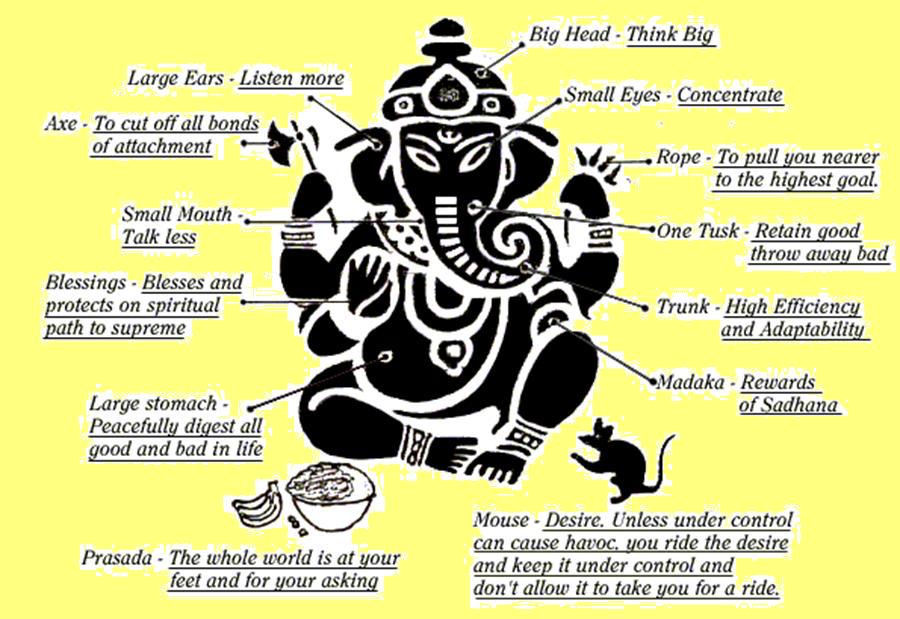
God is visualized as a being that has divine attributes. In Hinduism, different gods and deities emphasize different divine attributes or principles. For example, Ganesha is a god in Hinduism, who is viewed as the remover of obstacles. Such a visualization of a god helps the devotee absorb god’s spiritual attributes both intuitively and descriptively. It is intuitively felt that all spiritual attributes integrate into a oneness. Thus, Hindus may worship different gods on different occasions, and even worship the gods of other religions.

DEITY
A deity is the symbolic representation of a postulate or a system of postulates. For example, Hindu trinity of Brahma, Vishnu, Mahesh is a symbolic representation of the principle of Create, Survive, Destroy. This is a cycle that applies to the fundamentals of life. Through the “worship” of deities a person evolves to new levels of consciousness. The Bhagavad Gita visualizes Krishna as the God teaching Jnana, Karma and Bhakti yoga. The Bhagavata Purana focuses on the worship of Krishna as the cosmic deity of Bhakti yoga.

BHAKTI AND JNANA
Bhakti takes the “heart” approach. The “heart” in spiritual discourse typically refers to the source of emotions, intuition, and inner wisdom. Heart-centered approaches foster emotional intelligence, self-awareness, compassion, and a direct connection with a deeper sense of meaning or higher purpose. Bhakti Yoga centers on loving devotion to God, emphasizing emotional connection, surrender, and worship. Practices include prayer, singing hymns (bhajans), puja (rituals), pilgrimage, and developing a personal relationship with a chosen deity (Ishta Devata).

Jnana takes the “mind” approach. The “mind” represents the faculties of understanding, discernment, and critical thinking. Jnana Yoga focuses on intellectual inquiry and self-knowledge, seeking direct realization of the Self (Atman) as one with Brahman through wisdom and discrimination. Mind-centered spirituality might focus on studying, meditating on, or intellectually understanding spiritual teachings, and is crucial for discerning truth and applying knowledge wisely.

Most contemporary spiritual teachers and philosophies suggest a holistic approach: true spiritual maturity arises when one allows the mind and heart to inform and balance each other in all aspects of life. Regular spiritual practices such as meditation, prayer, contemplation, and self-reflection can help cultivate this integration, leading to greater peace, resilience, and fulfillment.

ADVAITA AND DVAITA
In Hindu philosophy, Advaita emphasizes non-duality, meaning that the ultimate reality (Brahman) and the individual soul (Atman) are one and the same. Dvaita, on the other hand, asserts a dualistic view where the supreme being (Brahman) and individual souls (jivas) are eternally distinct realities. 

Philosophically, non-duality is looking at the whole dimension; for example, the dimension of temperature. Whereas, duality is looking at the two ends of the dimension, such as hot-cold, while ignoring all the gradients in between. The gradient between Brahman and Atman is the gradient of unresolved anomalies. The lesser are the anomalies left to be resolved the closer one is to realizing Brahman.

YAJNA
Yajna is to sacrifice one’s individuality in the process of acquiring universal consciousness. Yajna means selfless action done for the welfare of the world. For example, Jnana yajna is performed to spread jnana for larger benefit of community. The ritual of yajna is a symbol for such action. Please see SACRIFICE.

SACRIFICE (YAJNA)
Sacrifice means that our actions should be in harmony with the physical and spiritual laws of nature, and not just fixated on ourselves. The nature provides us with everything to sustain ourselves; and we must do everything to sustain the nature back. A community is part of that nature. Yajna (sacrifice) means the performance of one’s duty to foster and nourish others in their advancement in accordance with the laws of nature. Such karma is naturally assimilated.

UNDER REVIEW

REBIRTH
For a specie to continue, the DNA passes from a life organism to its progeny. Birth and death of a life organism are a part of this continuation of the specie and its evolution. This applies to humans also. Rebirth is the concept of a human being carrying forth the karma of the specie. This determines certain attributes of the person existing from birth that are unique to him, but which he shares with his ancestors. Part of such attributes are memories, which are not from the current life of the person. This makes the person believe that he has lived before.

EVOLUTION
Human evolution occurs in infinitesimal steps. The source of this evolution is resolution of karma. Such a resolution not only straightens out the earlier DNA programming; but it also updates that programming, which adds new capabilities.

DEATH AND BIRTH CYCLE
Death is the total and permanent cessation of all vital functions of a person. When the person dies, the consciousness of what he was while alive also disintegrates. But the contents of the mind continue as atman. That aspect of atman, which is assimilated thought, gets stored as knowledge in the society, culture and the universe. The other aspect, which is unassimilated thought, gets stored in the DNA of those subsequently born. This DNA storage is called KARMA because it influences the tendencies and actions of the person. The awareness of such tendencies and actions alert the person to the need of assimilation of karma. 

HINDUISM AND KARMA
Brahma of the Trinity “Brahma-Vishnu-Mahesh” is a symbolic representation of the concept of Creation. Māyā that forms the bridge between Brahman and Reality also represents the creative process. Brahma and Māyā are quite similar in this respect. They are from two different periods and from two different philosphies during the evolution of Hinduism over the centuries. The profusion of such terminology and their representation by different deities in Hinduism makes this religion to appear very complex. But all this complexity disappears when we assimilate myriads of such representations in our understanding for the purpose of dissolving Karma.

CHANTING
A chant is the iterative speaking or singing of words or sounds. Chanting may also be done mentally in a meditative mode, where a person is looking closely at postulates associated with the word or sound. A chant has an effect of calming the mind. Regular chanting can enhance focus, improve memory, and foster feelings of connection and well-being. Chanting does not erase karma absolutely, but transforms it or lessens its effects through spiritual purification and divine grace. In scientific terms, chanting brings some assimilation of thought, but complete assimilation requires the resolving of anomalies through the practice of meditation.

TANTRA
The term “Tantra” is derived from the Sanskrit root “tan” (to expand) and “tra” (instrument), signifies the use of various techniques to transcend ordinary consciousness and achieve a higher state of awareness. The ultimate goal of Tantra is liberation (moksha) or enlightenment. Tantra views the universe as a web where everything is interrelated and interconnected. Unlike some other spiritual traditions that view the body and the material world as obstacles, Tantra sees them as potential tools and manifestations of the divine. Tantra involves various meditation practices, rituals, and visualizations, often centered on deities and mandalas. Mantras (sacred sounds or words) and yantras (geometric diagrams) are used to invoke specific energies and states of consciousness. Tantric practices can involve working with the subtle body, including the chakras, nadis (energy channels), and vital winds (prana).

MYSTERY
A mystery is a lower harmonic of Unknowable. Calling something a mystery draws people’s attention to it because the most basic impulse of a person is to know. The natural action to know is to make a postulate. The lower harmonic of a postulate is an assumption. So, it is natural for the person to make an assumption when he is faced with a mystery. There is nothing wrong with making assumptions. But if that assumption generates an anomaly, then he must resolve that anomaly to know the truth. People in this world want to improve their condition, and they are searching for truth. They are already sitting with many assumptions to their credit. These assumptions are the things they have taken for granted without examining them closely. The only way for them to discover truth is to look at their assumptions, spot the related anomalies and resolve them. So, a person who finds himself in a mystery of not knowing how to go about improving his condition, must start with something that he has taken for granted to explain his condition and examine it closely. This is the only way out of the mystery.

THOUGHT
Thought is a substance where substance is anything substantial enough to be sensed. Awareness always requires a substance, or a form made of substance, to be aware of; otherwise, awareness cannot exist. This is a basic postulate.

[To be continued]

.

Glossary: Scientology

Reference: Postulate Mechanics

This glossary is a compilation of definitions that are referenced in Postulate Mechanics on the subject of Scientology. For official definitions, please see Scientology Technical Dictionary.

.

Glossary

—A—

ABERRATION
Aberration means departure from sound thinking. It leads to lapse of judgment. Hallucination, delusion, illusion, eccentricity, and abnormality are all aberrations. Aberration in behavior would be any conduct not supported by reason. Mental problems, such as, psychoses, neuroses, compulsions and repressions of all kinds and classifications are aberrations. A physical illness of any kind would be aberration of the body. In Scientology, the source of aberration is considered to be trauma and overwhelm suffered by a person that leaves its impression of the mind. Such traumatic experiences are recorded as facsimiles and they act as the “bugs” in the “computing” function of the mind. They then generate all the aberrations. To resolve these aberrations Scientology employs the process of auditing. An auditing process helps a person become aware of the “basic” of the chain of experiences that is responsible for the aberration.

AUDITING
Auditing is the application of Scientology processes and procedures to someone by a trained auditor. It involves the action of asking a person a question, and getting him to look at that area of life more closely to obtain clarity on it. The prime target are the facsimiles that a person has, but which are not very visible. One follows precise symptoms or sensations through a chain of incidents (facsimiles). At the end of such a chain is the basic incident simply referred to as the “basic.” When the person becomes aware of the “basic” all the charge buried in that chain of incidents disappears. The person has a realization about his life and he obtains greater clarity. The whole idea in Scientology is to help a person handle all his facsimiles so he can live a life without aberrations.

—B—

BASIC
Any facsimile  can be traced, ultimately, to some fundamental postulate. In Scientology, it is believed that such facsimiles existing as a chain of “earlier similars” back to some “basic” in the past. When that basic is reached, the facsimile is erased forever. One may get lucky in this regard; but the reality is often much different. The facsimile is usually complex enough to have many different chains of “earlier similars”, one for each sensation. Each “earlier similar” in a chain may then be complex enough in its turn to have many more chains. In short, what may appear to be a linear chain from a distance may actually be a complex network of “earlier similars” extending back to many “basics,” all of whom may have to be taken care of to erase the original facsimile.

BODY THETAN (BT)
In Scientology, the concept of Body thetan is used on OT Levels. It is described as a degraded thetan that attaches itself to a person’s body and interferes with the control and running of his body. It is associated with thoughts that are running by themselves and are out of control. To spot a BT a person must spot the source of such automatic and independent actions going on within him. He does that by questioning whatever appears to be out of place in his mental space. Scientology associates many esoteric ideas with the BTs; but the idea of BT makes sense only in the context of auditing each sensation by following its chain to its basic until it is erased. 

—C—

CHAIN
CHAIN means a series of recordings of similar experiences. A chain has engrams, secondaries and locks. Example—Head injury chain in the sequence encountered by an auditor and run by R3R—sporting goods display window seeing it (lock), losing a bat (secondary), hit in the head with a bat (engram). The engram is the earliest date, the secondary a later date, the lock the most recent.

—D—

—E—


ENGRAM
An ENGRAM is a mental image picture which is a recording of a time of physical pain and unconsciousness. It must by definition have impact or injury as part of its content.

ERASURE
In Dianetics auditing, the assimilation of traumatic experience is called erasure. It is accomplished by focusing on the time period of the incident and recounting the incident from beginning to end over and over again, picking up all the uncomfortable sensations and perceptions present just as though the incident were happening at that moment. The incident does not always erase fully with the mechanical action of recounting alone because complete erasure requires resolution of anomalies. Therefore, other auditing questions and processes are used to direct the attention to different aspects of the incident and its general context to spot and resolve anomalies. Dianetics lacks a systematic procedure to handle anomalies.

EXTERIORIZATION
Exteriorization is a feeling of being separate from the body, which is commonly known as “out of body experience.” Scientology believes in this phenomena literally as the thetan separating from the body. This is an anomaly because the thetan is not a thing. Thetan is a postulate. But exteriorization is a phenomenon that is considered significant in Scientology because it distances a person from his aberrations. It makes sense when we look at exteriorization as the attention becoming free from its fixation on the body, which the person was not aware of.

—F—

FACSIMILE
Scientology describes a facsimile as that section of thought which has a physical universe impression on it. Such facsimiles are responsible for the aberrations in a person. A facsimile consists of the picture, sound, smell and all other perceptions, effort, emotion, conclusions and speculations along with a time tag. It is unknowingly created and becomes part of the time track as a recording. It is not dependent upon an organism for its continued existence. The facsimiles are hidden from a person until he recalls and reviews them through the process of auditing. Upon a thorough review the facsimile loses its hold on the  thinking and behavior of the person. The Scientology theory assumes that the sensations that make up the facsimile, acquire their meaning when they are recorded in the mind, while they remain  unknown to theta. This is an anomaly because it is theta (thought) that assigns meanings to the physical sensations received from the MEST universe. 

—G—

GRADES PROCESSING
The Scientology Grades focus on the suppositional reality of a person. The suppositional reality is made up of assumptions, justifications, beliefs, fixed ideas, etc. It exists because of the person is identifying himself with the universe. These grades are audited in a certain order. Different technologies are used to audit different grades. Once the suppositional reality is cleared, the facsimiles can be audited to complete erasure.

—H—

HAVINGNESS
Havingness is having such an intimate awareness of the environment (along with the situations in it), such that one can flow with it and control that flow according to the natural laws. 

—I—

—J—

—K—

KEY-IN
KEY IN is the action of recording a lock on a secondary or engram. It is moment when the environment around the awake but fatigued or distressed individual is itself similar to the dormant engram. At that moment the engram becomes active. It is keyed-in and can thereafter be dramatized.

KEY-OUT
KEY OUT is an action of the engram or secondary dropping away without being erased.

KNOW
Ordinarily, to know is to perceive or understand as fact or truth; to apprehend clearly and with certainty. But, more precisely, to know is to have certainty that there are no holes in the information presented, all the data that is available is consistent, and all that is knowable is in harmony. If there is any discontinuity, inconsistency or disharmony then one knows that there are anomalies to be sorted out. Much of human inquiry—science, philosophy, education—aims to deepen, challenge, and expand what we know.

—L—

LIFE STATIC
The Life Static is another postulate in Scientology, which is consistent with the postulate of Static. Life is viewed in Scientology as a quality and an ability with no quantitative factor. But both quality and quantity are knowable; and these are aspects of the knowable universe. A Life Static represents the most basic ability associated with life, which is the ability to postulate and to perceive. It animates the body. 

LOCK
A LOCK is a mental image picture of an incident where one was knowingly or unknowingly reminded of a secondary or engram. It does not itself contain a blow or a burn or impact and is not any major cause of misemotion. It does not contain unconsciousness. It may contain a feeling of pain or illness, etc, but is not itself the source of it. Example: One sees a cake, feels sick. This is a lock on an engram of being made sick by eating cake. The picture of seeing a cake and feeling sick is a lock on (is locked to) the incident (unseen at the moment) of getting sick eating cake. When one finds a lock it can be run like any other mental image picture.

—M—

MEMORY
In Scientology, facsimiles reduce to memories when their charge is erased. Memory is considered to be the data stored in the standard memory banks, which is potentially recallable by “I.” Scientology does not differentiate between a facsimile and a memory; but a memory is not a literal recording like the facsimile. Each time a memory is recalled it is reconstructed from elementary data stored in standard banks, by activating the time stamps. Not being a fixed recording, a memory adjusts itself to different points of view.

MEST
In Scientology, MEST represents the physical universe that is created by theta, and which is mechanical in nature. The symbol MEST is created from the first letters of Matter, Energy, Space and Time, which are concepts defined in Physics. The physical universe is thus limited to the same scope that the subject of Physics is limited to. Thought is not viewed as an integral part of the physical universe, instead it is considered to be a part of theta. This lack of integration of thought and MEST is an anomaly that goes against the reality of the oneness of the universe.

MIND
In Scientology, mind is described as the THETA command post of a life organism. The mind is concerned wholly with the estimation of effort to solve the problems of survival. It does its thinking by combining the perceptions of the immediate environment with facsimiles of the past. The mind is inherently analytical like a “computer”, but “bugs” in its circuits introduce reactions. The analytical mind is the one which is alert and aware and the reactive mind simply reacts without analysis. An optimally functioning mind focuses on the assimilation of sensations, perceptions, and knowledge. Reactions will occur only in situations where assimilation is lacking and fixation is present. Therefore, the fixation of the mind on survival may be seen as an anomaly.

MISEMOTION
MISEMOTION is anything that is unpleasant emotion such as antagonism, anger, fear, grief, apathy or a death feeling.

—N—

—O—

OBJECTIVE PROCESSING
To audit the mind a person needs free attention that he can control. The purpose of Objective processes is to free enough attention so a person can look at his mind objectively. These processes involve putting attention on objects in the current environment and observing them closely. This includes observation of body and its motions. The person uses all his physical and mental senses to do so. Anyone can be brought more into present time with objective processes.

OT PROCESSING
OT processing handles facsimiles to complete erasure. OT processes do so by auditing every sensation to its basic (see BASIC) and recovering the underlying postulate. This OT processing also has several levels. These levels are audited in a certain order. Each OT level has its own technology. 

—P—

PLEASURE MOMENTS
PLEASURE MOMENTS are mental image pictures containing pleasure sensations. They respond to standard Dianetics processing (R3R). One seldom addresses them unless the preclear is fixated on some type of “pleasure” to a point where it has become highly aberrated.

POSTULATE
The purpose of a postulate is to give meaning to a simple or complex sensation. In Scientology, postulate is a self-created truth, which is simply a consideration generated by self. Thus, a typical postulate is, generally, associated with the idea of self. Here self is the sense of “I”, which itself is a postulate. This tells us that the actual source of a postulate is unknowable.

—Q—

—R—

—S—

SCIENTOLOGY
Scientology derives from Latin and Greek roots meaning “knowing” and “study,” and is defined as “the study of knowing how to know.” Its doctrines center on spiritual self-understanding and methods for achieving mental and spiritual freedom.

SECONDARY
A SECONDARY is a mental image picture of a moment of severe and shocking loss or threat of loss which contains misemotion such as anger, fear, grief, apathy or “deathfulness”. It is a mental image recording of a time of severe mental stress. It may contain unconsciousness. When it is restimulated by a similar but lighter experience another mental image picture is recorded which becomes a lock on the secondary and serves to keep the secondary alive. A secondary is called a secondary because it itself depends upon an earlier engram with similar data but real pain, etc.

SOMATIC
SOMATIC means essentially body sensation, illness or pain or discomfort. “Soma” means body. Hence PSYCHO SOMATIC or pains stemming from the mind.

STATIC
In Scientology, Static is a motionless AGENT that generates and controls all motion. Static claims to be unknowable having no mass, no wavelength, no time and actually without position; but then it is identified as a knowable Cause-point that can create and destroy mass and energy, and which can locate itself in space and time. Thus, the Static is both unknowable and knowable. This presents an anomaly of contradiction.

This anomaly is resolved when we see Static to be a postulate underlying the philosophy of Scientology. This postulate is substantial, and its substance may be identified as thought. So, Static is not without substance. Mathematically, static is the motionless reference point from which all motion can be assessed, just like zero is the reference point from which all numbers can be assessed. Static makes sense only when considered relative to kinetic (motion). However, Static is being considered as the absolute source of all motion. This presents another anomaly. 

Therefore, Static is neither unknowable nor absolute. Static is a knowable postulate that is a part of the knowable universe. Beyond the knowable universe is the Unknowable. The postulate of Static can be examined for its consistency with other postulates for the knowable universe in Scientology philosophy.

SURVIVAL
Survival is to endure or live through some difficult, adverse or unusual circumstance. If a person is fixated on the survival of himself then that would be an aberration, because the beingness (self) is changing from moment to moment. Beingness is not something fixed. A person survives naturally as he focuses on resolving anomalies of life. 

—T—

THETA
In Scientology, theta is used as a symbol for Life Static. It is considered to be the absolute source of life and its motion. The idea of theta being absolute presents an anomaly. Scientifically, all motion of life is inherent to a life organism. At most, theta would represents the assimilated vector of complex motions of the life organism. 

THETA-MEST THEORY
In Scientology, theta is considered to be something having no-substance; but which creates the substance called MEST, and infuses it with life. Theta is separate and independent of MEST. Theta is thought. Thought is actually a substance because it is substantial enough to be sensed. This presents an anomaly because thought is not considered to be a substance yet it is sensed all the time. The Theta-MEST theory simply wraps up in scientific garb the religious idea that God has created the world, and God is separate from the world. The postulate that THETA and MEST are inherently separate, and not integrated, presents an anomaly.

THETAN
Scientology uses the term THETAN for a person, with the connotation that the person is a “spiritual being”, who is inherently independent of the physical body. It parallels the idea of “soul” in Abrahamic religions that exists apart from the body. However, the notion of PERSON comes from the role one plays in life. It is the “center” that controls the thoughts and the body. Scientifically, this would be the resultant vector of the inherent motions of an organism.  It would not exist without the organism. It would be a part of the scientific model of the mind. The idea in Scientology that the control center of all thoughts and the body can exist by itself independent of the body presents an anomaly.

TIME TRACK
The TIME TRACK is the consecutive record of mental image pictures which accumulates through the preclear’s life or lives. It is very exactly dated.

—U—

—V—

—W—

—X—

—Y—

—Z—

.

PM: The Laws

Reference: Postulate Mechanics

The following key words and definitions act as stable data that introduce the very first postulate and the laws of Postulate Mechanics. For all key words, please see PM: Glossary.

NOTE: “PM” is the abbreviation for Postulate Mechanics. The content of this subject is open to further refinement and update as long as they comply with the postulate of ONENESS.

VEDIC RELIGIONS
In the ancient Vedic religions ((Hinduism, Buddhism, Sikhism, etc.) there is the concept of Unknowable (Brahma) that functions as the reference point for all things that are knowable. The knowable appears as the universe; whereas, the Unknowable cannot be talked about, since it is unknowable.

ABRAHAMIC RELIGIONS
The Abrahamic religions (Judaism, Christianity and Islam) there is the concept of Cause or Creator (God) that has created the physical world, and has infused it with life. The created appears as the universe; whereas, the God appears as the all-knowing entity.

DICHOTOMY
It is observed that all other dichotomies, such as, “Creator-created,” “Cause-effect,” “Spiritual-physical” are included in the dichotomy “Unknowable-knowable” in the sense that both aspects of the former dichotomies are knowable. Please note that all dichotomies may be represented as two opposite ends of a scale. The concept of Unknowable is found exclusively in the Vedic religions.

UNKNOWABLE
Unknowable is beyond knowable. It is the Nirākār Brahman of the Vedas that is manifested through Māyā. It is Kant’s thing-in-itself that our senses interpret. We perceive the unknowable by making postulates about what could be there; and then reasoning from these postulates. Thus, the Unknowable serves as the reference point for all things that are knowable. This means all things knowable are related to each other like values on a scale. The only difference here is that there are infinite number of scales, which we call dimensions. This makes everything knowable to be continuous, consistent and harmonious in one way or another. It is this continuity, consistency and harmony that underlies all natural laws, whether physical or spiritual.

NOTE: When we make the postulates to “perceive the Unknowable,” we come to know only the postulates. The Unknowable remains unknowable.

CONSIDERATION
A consideration is a continuing Postulate.

NOTE: The following are the laws of Postulate Mechanics. Study these laws in the given sequence. As you study a law look up the key words indicated for that law in PM: Glossary. Carefully sort out any disagreement.

LAW OF POSTULATE MECHANICS # 1
Beyond what we know, there is much that we do not know. (see UNKNOWABLE)

LAW OF POSTULATE MECHANICS # 2
We know only what we can sense and perceive. (See SENSATION, PERCEPTION)

LAW OF POSTULATE MECHANICS # 3
We can perceive only that which is substantial enough to be sensed. (See SUBSTANCE)

LAW OF POSTULATE MECHANICS # 4
We perceive sensations only when they acquire meaning in association with postulates. (See POSTULATE)

LAW OF POSTULATE MECHANICS # 5
The accuracy of perception depends on the consistency among the underlying postulates. (See ONENESS)

LAW OF POSTULATE MECHANICS # 6
We know only what we have sensed, postulated and perceived. (See KNOWLEDGE)

LAW OF POSTULATE MECHANICS # 7
The knowable universe is the outcome of what we have sensed, postulated and perceived. (See KNOWABLE)

LAW OF POSTULATE MECHANICS # 8
All our spiritual and physical knowledge is part of this knowable universe. Nothing lies beyond it.

LAW OF POSTULATE MECHANICS # 9
The spiritual elements are perceived as thought. This includes postulates.

LAW OF POSTULATE MECHANICS # 10
The physical elements are perceived as radiation and matter.

LAW OF POSTULATE MECHANICS # 11
The knowable universe consists of an integration of both spiritual and physical elements.

LAW OF POSTULATE MECHANICS # 12
The knowable universe is a single Universe.

LAW OF POSTULATE MECHANICS # 13
This knowable Universe is differentiated only from the Unknowable.

LAW OF POSTULATE MECHANICS # 14
All experience is knowable. This includes experience that is supposedly difficult to describe. (See EXPERIENCE)

LAW OF POSTULATE MECHANICS # 15
The “experience of void” is a sense of emptiness. It is a sensation that is knowable.

NOTE: “Void” often refers to a space that is completely empty, lacking any contents or substance. For example, outer space can be described as a void. But outer space is empty only of matter; it is not empty of radiation or thought.

LAW OF POSTULATE MECHANICS # 16
Space may not contain matter or radiation, but it will always contain thought. (See SPACE)

LAW OF POSTULATE MECHANICS # 17
Time is a duration relative to the infinite duration (eternity, or no change) of a “black hole.” (See TIME)

.

PM: The Life

Reference: Postulate Mechanics

The following key words and definitions act as stable data that help understand the basics of life. The key words appearing in earlier chapters (words in square brackets) are not defined again. For all key words, please see PM: Glossary.

NOTE: “PM” is the abbreviation for Postulate Mechanics. The content of this subject is open to further refinement and update as long as they comply with the postulate of ONENESS.

[LIFE]

EVOLUTION
Evolution of life occurs from inanimate to animate, minerals to cells, unicellular to multicellular, and from plants to animals to humans. The form becomes more complex as it evolves, and the inherent motion becomes more sophisticated.

MAN
Man is a life organism at the top of the evolutionary chain. A life organism has a form made of substance, which displays inherent motion. The form made of substance is seen as a body. The complex capabilities expressed through the body are seen as the workings of a mind. And, the inherent motion, which makes these capabilities possible, is seen as the spirit.

BEINGNESS
Beingness is the essence of whole person. It is the whole genetic programming that consists of Thetan and Genetic Entity.

THETAN
Thetan is a term borrowed from Scientology that describes the mind and its functions. It is the upper end of the programming carried forward over the genetic line, the lower end of which is Genetic Entity that describes the body and its functions. Thetan (Mind) and Genetic Entity (body) are integrated as one single system of beingness. Thetan is not something that can be detached from the body as believed in Scientology. That detachment occurs only in the form of attention no longer being fixated on the body. Thetan is also not something immortal as believed in Scientology. That sense of immortality applies only to the property of universal awareness.

GENETIC ENTITY
Genetic Entity is a term borrowed from Scientology. It is a programming that keeps the blueprint of the body. It is carried forward over the genetic line. It is hard-wired into the body through DNA molecules. It develops the body and monitors all its functions. It is very sophisticated, but it has limited capacity to update itself.

SPIRIT
Spirit lies at the upper end of the spectrum of self. At the bottom end of this spectrum lies the ego. Spirit represents a self that is completely integrated and contains no anomalies. All aspects of the spirit are totally assimilated. 

SPIRITUALITY
Spirituality deals with the matters of life. It means becoming aware of the situations in life and resolving them. 

SELF
The beingness has a sense of its coordination from a single control point. This is the self, the “I”, or the being. The self exists simply to assimilate all that the beingness is interacting with, such as, sensations, perceptions, memories, experiences, knowledge and wisdom.  

IDENTITY
The self acquires an identity when it identifies itself with something external to it. The self cannot differentiate itself from the identity. It simply thinks that it is that identity. A self can have many layers of identities and not be aware of it. It just acts out according to the identity that gets activated in a situation. Thus, an identified self is limited in its awareness.

INDIVIDUALITY
The self has a sense of individuality in that it considers itself to be unique. An identified self can also claim individuality. Therefore, individuality and identity are not exclusive of each other.

EGO
The ego is the awareness of oneself. It is the sense of “I”. The negative aspects of Ego are manifested when self gets fixated on its individuality.

SOUL
The SOUL refers to the animating, non-physical essence of life. In philosophy, this term has been used to refer to the mind. In religion, it is theorized to be that eternal aspect of the person, which separates from the body upon death, and goes to heaven or hell.

VIEWPOINT

Viewpoint is the frame of reference the beingness is using to view from. It is closely tied with individuality. The viewpoint determines a person’s reality, which includes the sense of his location in space, and what he thinks of himself. The viewpoint can become fixed, but a person can always unfix and change it. 

SELF-DETERMINATION
Self-determination is a person’s ability to determine something without outside influence, and based entirely on his viewpoint.

FREE WILL
A person’s free will is his ability to make decisions voluntarily. In other words, he can postulate, but subject to the laws of Postulate Mechanics. Free will does not mean that the person can arbitrarily do anything he wants. If he does then there are unwanted consequences.

SELF-ANIMATION
Self animation is inherent to a living form, such as, virus, cells and higher organisms. Since extremely small changes in consistency may produce significantly large and visible changes in motion, life can manage self-animation by controlling the consistency of its parts. The required changes in consistency are so small that they can easily be controlled by thought. Therefore, a thought-motion interface may be postulated for living organisms.

DEATH
Death is the total and permanent cessation of all vital functions of the life organism. Death and birth are natural events that are necessary for the evolution of life. When death occurs, the whole spirit-mind-body system disintegrates together as one. The “I” is the configuration of body, mind and spirit. This configuration is lost upon death. Therefore, the “I” does not pass through death, only knowledge and karma does. Knowledge is the assimilated content of the mind. It gets stored in the society, humanity and the universe. It is accessed through meditation. Karma is the unassimilated content of the mind. It passes from one life to the next as DNA “programming” that is waiting to be fully assimilated.

.

SC: Scientology

Reference: Postulate Mechanics


The following definitions are an effort to understand the fundamentals of Dianetics and Scientology using the approach of Subject Clearing (SC). Dianetics developed into Scientology; therefore, Scientology is now inclusive of Dianetics. Scientology claims the ancient Vedas and Buddhism to be its ancestors.

To find a word simply use search (CTRL-F). For original definitions in this subject please consult Scientology Technical Dictionary. If you feel that some basic term should be included here, then please let me know.

.

Scientology

SCIENTOLOGY
Scientology derives from Latin and Greek roots meaning “knowing” and “study,” and is defined as “the study of knowing how to know.” Its doctrines center on spiritual self-understanding and methods for achieving mental and spiritual freedom.

KNOW
Ordinarily, to know is to perceive or understand as fact or truth; to apprehend clearly and with certainty. But, more precisely, to know is to have certainty that there are no holes in the information presented, all the data that is available is consistent, and all that is knowable is in harmony. If there is any discontinuity, inconsistency or disharmony then one knows that there are anomalies to be sorted out. Much of human inquiry—science, philosophy, education—aims to deepen, challenge, and expand what we know.

POSTULATE
The purpose of a postulate is to give meaning to a simple or complex sensation. In Scientology, postulate is a self-created truth, which is simply a consideration generated by self. Thus, a typical postulate is, generally, associated with the idea of self. Here self is the sense of “I”, which itself is a postulate. This tells us that the actual source of a postulate is unknowable. 

STATIC
In Scientology, Static is a motionless AGENT that generates and controls all motion. Static claims to be unknowable having no mass, no wavelength, no time and actually without position; but then it is identified as a knowable Cause-point that can create and destroy mass and energy, and which can locate itself in space and time. Thus, the Static is both unknowable and knowable. This presents an anomaly of contradiction.

This anomaly is resolved when we see Static to be a postulate underlying the philosophy of Scientology. This postulate is substantial, and its substance may be identified as thought. So, Static is not without substance. Mathematically, static is the motionless reference point from which all motion can be assessed, just like zero is the reference point from which all numbers can be assessed. Static makes sense only when considered relative to kinetic (motion). However, Static is being considered as the absolute source of all motion. This presents another anomaly. 

Therefore, Static is neither unknowable nor absolute. Static is a knowable postulate that is a part of the knowable universe. Beyond the knowable universe is the Unknowable. The postulate of Static can be examined for its consistency with other postulates for the knowable universe in Scientology philosophy.

LIFE STATIC
The Life Static is another postulate in Scientology, which is consistent with the postulate of Static. Life is viewed in Scientology as a quality and an ability with no quantitative factor. But both quality and quantity are knowable; and these are aspects of the knowable universe. A Life Static represents the most basic ability associated with life, which is the ability to postulate and to perceive. It animates the body. 

THETA
In Scientology, theta is used as a symbol for Life Static. It is considered to be the absolute source of life and its motion. The idea of theta being absolute presents an anomaly. Scientifically, all motion of life is inherent to a life organism. At most, theta would represents the assimilated vector of complex motions of the life organism. 

MEST
In Scientology, MEST represents the physical universe that is created by theta, and which is mechanical in nature. The symbol MEST is created from the first letters of Matter, Energy, Space and Time, which are concepts defined in Physics. The physical universe is thus limited to the same scope that the subject of Physics is limited to. Thought is not viewed as an integral part of the physical universe, instead it is considered to be a part of theta. This lack of integration of thought and MEST is an anomaly that goes against the reality of the oneness of the universe.

THETA-MEST THEORY
In Scientology, theta is considered to be something having no-substance; but which creates the substance called MEST, and infuses it with life. Theta is separate and independent of MEST. Theta is thought. Thought is actually a substance because it is substantial enough to be sensed. This presents an anomaly because thought is not considered to be a substance yet it is sensed all the time. The Theta-MEST theory simply wraps up in scientific garb the religious idea that God has created the world, and God is separate from the world. The postulate that THETA and MEST are inherently separate, and not integrated, presents an anomaly.

THETAN
Scientology uses the term THETAN for a person, with the connotation that the person is a “spiritual being”, who is inherently independent of the physical body. It parallels the idea of “soul” in Abrahamic religions that exists apart from the body. However, the notion of PERSON comes from the role one plays in life. It is the “center” that controls the thoughts and the body. Scientifically, this would be the resultant vector of the inherent motions of an organism.  It would not exist without the organism. It would be a part of the scientific model of the mind. The idea in Scientology that the control center of all thoughts and the body can exist by itself independent of the body presents an anomaly.

EXTERIORIZATION
Exteriorization is a feeling of being separate from the body, which is commonly known as “out of body experience.” Scientology believes in this phenomena literally as the thetan separating from the body. This is an anomaly because the thetan is not a thing. Thetan is a postulate. But exteriorization is a phenomenon that is considered significant in Scientology because it distances a person from his aberrations. It makes sense when we look at exteriorization as the attention becoming free from its fixation on the body, which the person was not aware of.

MIND
In Scientology, mind is described as the THETA command post of a life organism. The mind is concerned wholly with the estimation of effort to solve the problems of survival. It does its thinking by combining the perceptions of the immediate environment with facsimiles of the past. The mind is inherently analytical like a “computer”, but “bugs” in its circuits introduce reactions. The analytical mind is the one which is alert and aware and the reactive mind simply reacts without analysis. An optimally functioning mind focuses on the assimilation of sensations, perceptions, and knowledge. Reactions will occur only in situations where assimilation is lacking and fixation is present. Therefore, the fixation of the mind on survival may be seen as an anomaly.

SURVIVAL
Survival is to endure or live through some difficult, adverse or unusual circumstance. If a person is fixated on the survival of himself then that would be an aberration, because the beingness (self) is changing from moment to moment. Beingness is not something fixed. A person survives naturally as he focuses on resolving anomalies of life. 

ABERRATION
Aberration means departure from sound thinking. It leads to lapse of judgment. Hallucination, delusion, illusion, eccentricity, and abnormality are all aberrations. Aberration in behavior would be any conduct not supported by reason. Mental problems, such as, psychoses, neuroses, compulsions and repressions of all kinds and classifications are aberrations. A physical illness of any kind would be aberration of the body. In Scientology, the source of aberration is considered to be trauma and overwhelm suffered by a person that leaves its impression of the mind. Such traumatic experiences are recorded as facsimiles and they act as the “bugs” in the “computing” function of the mind. They then generate all the aberrations. To resolve these aberrations Scientology employs the process of auditing. An auditing process helps a person become aware of the “basic” of the chain of experiences that is responsible for the aberration.

FACSIMILE
Scientology describes a facsimile as that section of thought which has a physical universe impression on it. Such facsimiles are responsible for the aberrations in a person. A facsimile consists of the picture, sound, smell and all other perceptions, effort, emotion, conclusions and speculations along with a time tag. It is unknowingly created and becomes part of the time track as a recording. It is not dependent upon an organism for its continued existence. The facsimiles are hidden from a person until he recalls and reviews them through the process of auditing. Upon a thorough review the facsimile loses its hold on the  thinking and behavior of the person. The Scientology theory assumes that the sensations that make up the facsimile, acquire their meaning when they are recorded in the mind, while they remain  unknown to theta. This is an anomaly because it is theta (thought) that assigns meanings to the physical sensations received from the MEST universe. 

AUDITING
Auditing is the application of Scientology processes and procedures to someone by a trained auditor. It involves the action of asking a person a question, and getting him to look at that area of life more closely to obtain clarity on it. The prime target are the facsimiles that a person has, but which are not very visible. One looks for these facsimiles by following precise symptoms or sensations through a chain of incidents. At the end of such a chain is the basic incident simply referred to as the “basic.” When the person becomes aware of the “basic” all the charge buried in that chain of incidents disappears. The person has a realization about his life and he obtains greater clarity. The whole idea in Scientology is to help a person handle all his facsimiles so he can live a life without aberrations.

BASIC
Any facsimile  can be traced, ultimately, to some fundamental postulate. In Scientology, it is believed that such facsimiles existing as a chain of “earlier similars” back to some “basic” in the past. When that basic is reached, the facsimile is erased forever. One may get lucky in this regard; but the reality is often much different. The facsimile is usually complex enough to have many different chains of “earlier similars”, one for each sensation. Each “earlier similar” in a chain may then be complex enough in its turn to have many more chains. In short, what may appear to be a linear chain from a distance may actually be a complex network of “earlier similars” extending back to many “basics,” all of whom may have to be taken care of to erase the original facsimile.

ERASURE
In Dianetics auditing, the assimilation of traumatic experience is called erasure. It is accomplished by focusing on the time period of the incident and recounting the incident from beginning to end over and over again, picking up all the uncomfortable sensations and perceptions present just as though the incident were happening at that moment. The incident does not always erase fully with the mechanical action of recounting alone because complete erasure requires resolution of anomalies. Therefore, other auditing questions and processes are used to direct the attention to different aspects of the incident and its general context to spot and resolve anomalies. Dianetics lacks a systematic procedure to handle anomalies.

OBJECTIVE PROCESSING
To audit the mind a person needs free attention that he can control. The purpose of Objective processes is to free enough attention so a person can look at his mind objectively. These processes involve putting attention on objects in the current environment and observing them closely. This includes observation of body and its motions. The person uses all his physical and mental senses to do so. Anyone can be brought more into present time with objective processes.

GRADES PROCESSING
The Scientology Grades focus on the suppositional reality of a person. The suppositional reality is made up of assumptions, justifications, beliefs, fixed ideas, etc. It exists because of the person is identifying himself with the universe. These grades are audited in a certain order. Different technologies are used to audit different grades. Once the suppositional reality is cleared, the facsimiles can be audited to complete erasure.

OT PROCESSING
OT processing handles facsimiles to complete erasure. OT processes do so by auditing every sensation to its basic (see BASIC) and recovering the underlying postulate. This OT processing also has several levels. These levels are audited in a certain order. Each OT level has its own technology. 

BODY THETAN (BT)
In Scientology, the concept of Body thetan is used on OT Levels. It is described as a degraded thetan that attaches itself to a person’s body and interferes with the control and running of his body. It is associated with thoughts that are running by themselves and are out of control. To spot a BT a person must spot the source of such automatic and independent actions going on within him. He does that by questioning whatever appears to be out of place in his mental space. Scientology associates many esoteric ideas with the BTs; but the idea of BT makes sense only in the context of auditing each sensation by following its chain to its basic until it is erased. 

MEMORY
In Scientology, facsimiles reduce to memories when their charge is erased. Memory is considered to be the data stored in the standard memory banks, which is potentially recallable by “I.” Scientology does not differentiate between a facsimile and a memory; but a memory is not a literal recording like the facsimile. Each time a memory is recalled it is reconstructed from elementary data stored in standard banks, by activating the time stamps. Not being a fixed recording, a memory adjusts itself to different points of view.

.