Category Archives: Philosophy

SPINOZA: The Ethics

Reference: The Story of Philosophy

This paper presents Chapter IV Section 4 from the book THE STORY OF PHILOSOPHY by WILL DURANT. The contents are from the 1933 reprint of this book by TIME INCORPORATED by arrangement with Simon and Schuster, Inc.

The paragraphs of the original material (in black) are accompanied by brief comments (in color) based on the present understanding.  Feedback on these comments is appreciated.

The heading below is linked to the original materials.

.

IV. The Ethics

The most precious production in modern philosophy is cast into geometrical form, to make the thought Euclideanly clear; but the result is a laconic obscurity in which every line requires a Talmud of commentary. The Scholastics had formulated their thought so, but never so pithily; and they had been helped to clarity by their fore-ordained conclusions. Descartes had suggested that philosophy could not be exact until it expressed itself in the, forms of mathematics; but he had never grappled with his own ideal. Spinoza came to the suggestion with a mind trained in mathematics as the very basis of all rigorous scientific procedure, and impressed with the achievements of Copernicus, Kepler and Galileo. To our more loosely textured minds the result is an exhausting concentration of both matter and form; and we are tempted to console ourselves by denouncing this philosophic geometry as an artificial chess-game of thought in which axioms, definitions, theorems and proofs are manipulated like kings and bishops, knights and pawns; a logical solitaire invented to solace Spinoza’s loneliness. Order is against the grain of our minds; we prefer to follow the straggling lines of fantasy, and to weave our philosophy precariously out of our dreams. But Spinoza had but one compelling desire—to reduce the intolerable chaos of the world to unity and order. He had the northern hunger for truth rather than the southern lust for beauty; the artist, in him was purely an architect, building a system of thought to perfect symmetry and form. 

Spinoza’s effort was to reduce the intolerable chaos of the world to unity and order using precise mathematical form.

Again, the modem student will stumble and grumble over the terminology of Spinoza. Writing in Latin, he was compelled to express his essentially modern thought in medieval and scholastic terms; there was no other language of philosophy which would then have been understood. So he uses the term substance where we should write reality or essence; perfect where we should write complete; ideal for our object; objectively for subjectively, and formally for objectively. These are hurdles in the race, which will deter the weakling but will stimulate the strong. 

Spinoza was compelled to express his essentially modern thought in medieval and scholastic terms.

In short, Spinoza is not to be read, he is to be studied; you must approach him as you would approach Euclid, recognizing that in these brief two hundred pages a man has written down his lifetime’s thought with stoic sculptury of everything superfluous. Do not think to find its core by running over it rapidly; never in a work of philosophy was there so little that could be skipped without loss. Every part depends upon preceding parts; some obvious and apparently needless proposition turns out to be the cornerstone of an imposing development of logic. You will not understand any important section thoroughly till you have read and pondered the whole; though one need not say, with Jacobi’s enthusiastic exaggeration, that “no one has understood Spinoza to whom a single line of the Ethics remains obscure.” “Here, doubtless,” says Spinoza, in the second part of his book, “the reader will become confused, and will recollect many things which will bring him to a standstill; and therefore I pray him to proceed gently with me and form no judgment concerning these things until he shall have read all.” Read the book not all at once, but in small portions at many sittings. And having finished it, consider that you have but begun to understand it. Read then some commentary, like Pollock’s Spinoza, or Martineau’s Study of Spinoza; or, better, both. Finally, read the Ethic, again; it will be a new book to you. When you have finished it a second time you will remain forever a lover of philosophy. 

Spinoza is not to be read, he is to be studied. You will not understand any important section thoroughly till you have read and pondered the whole.

.

SPINOZA: The Improvement of the Intellect

Reference: The Story of Philosophy

This paper presents Chapter IV Section 3 from the book THE STORY OF PHILOSOPHY by WILL DURANT. The contents are from the 1933 reprint of this book by TIME INCORPORATED by arrangement with Simon and Schuster, Inc.

The paragraphs of the original material (in black) are accompanied by brief comments (in color) based on the present understanding.  Feedback on these comments is appreciated.

The heading below is linked to the original materials.

.

III. The Improvement of the Intellect

Opening Spinoza’s next book, we come at the outset upon mile of the gems of philosophic literature. Spinoza tells why he gave up everything for philosophy:

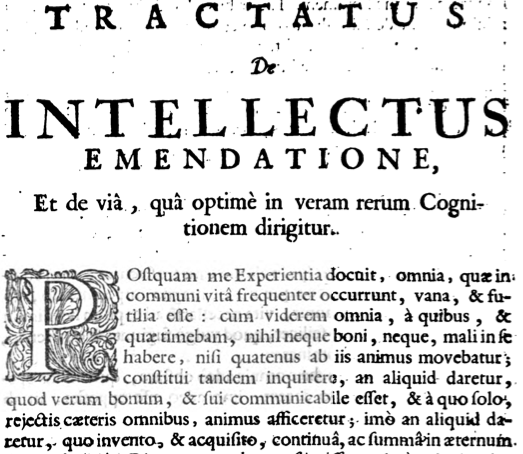
After experience had taught me that all things which frequently take place in ordinary life are vain and futile, and when I saw.that all the things I feared, and which feared me, had nothing good or bad in them save in so far as the mind was affected by them; I determined at last to inquire whether there was anything which might be truly good, and able to communicate its goodness, and by which the mind might be affected, to the exclusion of all other things; I determined, I say, to inquire whether I might discover and attain the faculty of enjoying throughout eternity continual supreme happiness. … I could see the many advantages acquired from honor and riches, and that I should be debarred from acquiring these things if I wished seriously to investigate a new matter. But the more one possesses of either of them, the more the pleasure is increased, and the more one is in consequence, encouraged to increase them; whereas if at any time our hope is frustrated, there arises in us the deepest pain. Fame has also this great drawback, that if we pursue it we must direct our lives in such a way as to please the fancy of men, avoiding what they dislike and seeking what pleases them. … But the love towards a thing eternal and infinite alone feeds the mind with a pleasure secure from all pain. … The greatest good is the knowledge of the union which the mind has with the whole of nature. … The more the mind knows, the better it understands its forces and the order of nature; the more it understands its forces or strength, the better it will be able to direct itself and lay down the rules for itself; and the more it understands the order of nature, the more easily it will be able to liberate itself from useless things; this is the whole method. 

The greatest good is the knowledge of the union which the mind has with the whole of nature. This sounds like the goal of Indian Yoga.

Only knowledge, then, is power and freedom; and the only permanent happiness is the pursuit of knowledge and the joy of understanding. Meanwhile, however, the philosopher must remain a man and a citizen; what shall be his mode of life during his pursuit of truth? Spinoza lays down a simple rule of conduct to which, so far as we know, his actual behavior thoroughly conformed: 

  1. To speak in a manner comprehensible to the people, and to do for them all things that do not prevent us from attaining our ends…. 
  2. To enjoy only such pleasures as are necessary for the preservation of health.
  3. Finally, to seek only enough money … as is necessary for the maintenance of our life and health, and to comply with such customs as are not opposed to what we seek.

Spinoza opts for very simple living in his pursuit of knowledge.

But in setting out upon such a quest, the honest and clear-headed philosopher comes at once upon the problem: How do I know that my knowledge is knowledge, that my senses can be trusted in the material which they bring to my reason, and that my reason can be trusted with the conclusions which it derives from the material of sensation? Should we not examine the vehicle before abandoning ourselves to its directions? Should we not do all that we can to perfect it? “Before all things,” says Spinoza, Baconianly, “a means must be devised for improving and clarifying the intellect.” We must distinguish carefully the various forms of knowledge, and trust only the best. 

Spinoza first concern is to find the criterion that could be applied to test the trustworthiness of knowledge.

First, then, there is hearsay knowledge, by which, for example, I know the day of my birth. Second, vague experience, “empirical” knowledge in the derogatory sense, as when a physician knows a cure not by any scientific formulation of experimental tests, but by a “general impression” that it has “usually” worked. Third, immediate deduction, or knowledge reached by reasoning, as when I conclude to the immensity of the sun from seeing that in the case of other objects distance decreases the apparent size. This kind of knowledge is superior to the other two, but is yet precariously subject to sudden refutation by direct experience; so science for a hundred years reasoned its way to an “ether” which is now in high disfavor with the physicist élite. Hence the highest kind of knowledge is the fourth form, which comes by immediate deduction and direct perception, as when we see at once that 6 is the missing number in the proportion, 2:4::3:x; or as when we perceive that the whole is greater than the part. Spinoza believes that men versed in mathematics know most of Euclid in this intuitive way; but he admits ruefully that “the things which I have been able to know by this knowledge so far have been very few.”

Spinoza concludes that the highest kind of knowledge comes by immediate deduction and direct perception. Compare this to Buddha’s insistence on seeing things as they are.

In the Ethics Spinoza reduces the first two forms of knowledge to one; and calls intuitive knowledge a perception of things sub specie eternitatis—in their eternal aspects and relations,—which gives in a phrase a definition of philosophy. Scientia intuitiva, therefore, tries to find behind things and events their laws and eternal relations. Hence Spinoza’s very fundamental distinction (the basis of his entire system) between the “temporal order”—the “world” of things and incidents—and the “eternal order”—the world of laws and structure. Let us study this distinction carefully: 

It must be noted that I do not understand here by the series of causes and real entities a series of individual mutable things, but rather the series of fixed and eternal things. For it would be impossible for human weakness to follow up the series of individual mutable things, not only because their number surpasses all count, but because of the many circumstances, in one and the same thing, each of which may be the cause of the thing’s existence. For indeed, the existence of particular things has no connection with their essence, and is not an eternal truth. However, there is no need that we should understand the series of individual mutable things, for their essence … is only to be found in fixed and eternal things, and from the laws inscribed in those things as their true codes, according to which all individual things are made and arranged; nay, these individual and mutable things depend so intimately and essentially on these fixed ones that without them they can neither exist nor be conceived.*

*”For although nothing exists In nature except Individual bodies, exhibiting clear individual effects according to particular laws; yet, in each branch of learning, those very laws—their investigation, discovery and development—are the foundation both of theory and of practice.” Fundamentally, all philosophers agree.

Underlying the infinite variables of the universe there are fixed relations in the form of natural laws.

If we will keep this passage in mind as we study Spinoza’s masterpiece, it will itself be clarified, and much in the Ethics that is discouragingly complex will unravel itself into simplicity and understanding. 

.

SPINOZA: The Treatise on Religion and the State

Reference: The Story of Philosophy

This paper presents Chapter IV Section 2 from the book THE STORY OF PHILOSOPHY by WILL DURANT. The contents are from the 1933 reprint of this book by TIME INCORPORATED by arrangement with Simon and Schuster, Inc.

The paragraphs of the original material (in black) are accompanied by brief comments (in color) based on the present understanding.  Feedback on these comments is appreciated.

The heading below is linked to the original materials.

.

II. The Treatise on Religion and the State

Let us study his four books in the order in which he wrote them. The Tractatus Theologico-Politicus is perhaps the least interesting of them to us today, because the movement of higher criticism which Spinoza initiated has made into platitudes the propositions for which Spinoza risked his life. It is unwise of an author to prove his point too thoroughly; his conclusions pass into the currency of all educated minds, and his works no longer have that mystery about them which draws us ever on. So it has been with Voltaire; and so with Spinoza’s treatise on religion and the state. 

The conclusions reached by Spinoza in his first book has now become quite common place.

The essential principle of the book is that the language of the Bible is deliberately metaphorical or allegorical; not only because it partakes of the Oriental tendency to high literary color and ornament, and exaggerated descriptive expressions; but because, too, the prophets and the apostles, to convey their doctrine by arousing the imagination, were compelled to adapt themselves to the capacities and predispositions of the popular mind. “All Scripture was written primarily foran entire people, and secondarily for the whole human race; consequently its contents must necessarily be adapted, as far as possible, to the understanding of the masses.” “Scripture does not explain things by their secondary causes, but only narrates them in the order and style which has most power to move men, and especially uneducated men, to devotion. … Its object is not to convince the reason, but to attract and lay hold of the imagination.” Hence the abundant miracles and the repeated appearances of God. “The masses think that the power and providence of God are most clearly displayed by events that are extraordinary, and contrary to the conception which they have formed of nature. … They suppose, indeed, that God is inactive so long as nature works in her accustomed order; and vice versa, that the power of nature, and natural causes, are idle so long as God is acting; thus they imagine two powers distinct from one another, the power of God and the power of nature.”

(Here enters the basic idea of Spinoza’s philosophy—that God and the processes of nature are one.) Men love to believe that God breaks the natural order of events for them; so the Jews gave a miraculous interpretation of the lengthening of the day in order to impress others (and perhaps themselves) with the conviction that the Jews were the favorites of God; and similar incidents abound in the early history of every people. Sober and literal statements do not move the soul; if Moses had said that it was merely the East wind (as we gather from a later passage) that cleared a path for them through the Red Sea, it would have made little impression on the minds of the masses he was leading. Again, the apostles resorted to miracle stories for the same reason that they resorted to parables; it was anecessary adaptation to the public mind. The greater influence of such men as compared with philosophers and scientists is largely attributable to the vivid and metaphorical forms of speech which the founders of religion by the nature of their mission and their own emotional intensity, are driven to adopt. 

The basic idea of Spinoza’s philosophy is that God and the processes of nature are one. Prophets used miraculous interpretations of events because that move the soul of man, sober and literal statements do not.

Interpreted on this principle, the Bible, says Spinoza, contains nothing contrary to reason. But interpreted literally, it is full of errors, contradictions, and obvious impossibilities—as that the Pentateuch was written by Moses. The more Philosophical interpretation reveals, through the mist of allegory and poetry; the profound thought of great thinkers and leaders, and makes intelligible the persistence of the Bible and its immeasurable influence upon men. Both interpretations have a proper place and function: the people will always demand a religion phrased in imagery and haloed with the supernatural; if one such form of faith is destroyed they will create another. But the philosopher knows that God and nature are one being, acting by necessity and according to invariable law; it is this majestic Law which he will reverence and obey. He knows that in the Scriptures “God is described as a law-giver or prince, and styled just, merciful, etc., merely in concession to the understanding of the people and their imperfect knowledge; that in reality God acts … by the necessity of his nature, and his decrees … are eternal truths.”

The more Philosophical interpretation reveals, through the mist of allegory and poetry, the profound thought of great thinkers and leaders, and makes intelligible the persistence of the Bible and its immeasurable influence upon men.

Spinoza makes no separation between Old and New Testament, and looks upon the Jewish and the Christian religion as one, when popular hatred and misunderstandings are laid aside, and philosophical interpretation finds the hidden core and essence of the rival faiths. “I have often wondered that persons who make boast of professing the Christian religion—namely, love, joy, peace, temperance, and charity to all men—should quarrel with such rancorous animosity, and display daily toward one another such bitter hatred, that this, rather than the virtues which they profess, is the readiest criterion of their faith.” The Jews have survived chiefly because of Christian hatred of them; persecution gave them the unity and solidarity necessary for continued racial existence; without persecution they might have mingled and married with the peoples of Europe, and been engulfed in the majorities with which they were everywhere surrounded. But there is no reason why the philosophic Jew and the philosophic Christian, when all nonsense is discarded, should not agree sufficiently in creed to live in peace and cooperation. 

Spinoza looks upon the Jewish and the Christian religion as one. He sees no reason why the philosophic Jew and the philosophic Christian, when all nonsense is discarded, should not agree sufficiently in creed to live in peace and cooperation. 

The first step toward this consummation, Spinoza thinks, would be a mutual understanding about Jesus. Let improbable dogmas be withdrawn, and the Jews would soon recognize in Jesus the greatest and noblest of the prophets. Spinoza does not accept the divinity of Christ, but he puts him first among men. “The eternal wisdom of God … has shown itself forth in all things, but chiefly in the mind of man, and most of all in Jesus Christ.” “Christ was sent to teach not only the Jews, but the whole human race” ; hence “he accommodated himself to the comprehension of the people … and most often taught by parables.” He considers that the ethics of Jesus are almost synonymous with wisdom; in reverencing him one rises to “the intellectual love of God.” So noble a figure, freed from the impediment of dogmas that lead only to divisions and disputes, would draw an men to him; and perhaps in his name a world torn with suicidal wars of tongue and sword might find a unity of faith and a possibility of brotherhood at last. 

The first step toward this consummation, Spinoza thinks, would be a mutual understanding about Jesus.

.

SPINOZA: Retirement and Death

Reference: The Story of Philosophy

This paper presents Chapter IV Section 1.4 from the book THE STORY OF PHILOSOPHY by WILL DURANT. The contents are from the 1933 reprint of this book by TIME INCORPORATED by arrangement with Simon and Schuster, Inc.

The paragraphs of the original material (in black) are accompanied by brief comments (in color) based on the present understanding.  Feedback on these comments is appreciated.

The heading below is linked to the original materials.

.

I.4 Retirement and Death

He took the excommunication with quiet courage, saying: “It compels me to nothing which I should not have done in any case.” But this was whistling in the dark; in truth the young student now found himself bitterly and pitilessly alone. Nothing is so terrible as solitude; and few forms of it so difficult as the isolation of a Jew from all his people. Spinoza had already suffered in the loss of his old faith; to so uproot the contents of one’s mind is a major operation, and leaves many wounds. Had Spinoza entered another fold, embraced another of the orthodoxies in which men were grouped like kine huddling together for warmth, he might have found in the role of distinguished convert some of the life which he had lost by being utterly outcast from his family and his race. But he joined no other sect, and lived his life alone. His father, who had looked forward to his son’s pre-eminence in Hebrew learning, sent him away; his sister tried to cheat him of a small inheritance;* his former friends shunned him. No wonder there is little humor in Spinoza! And no wonder he breaks out with some bitterness occasionally when he thinks of the Keepers of the Law. 

*He contested the case in court; won it; and then turned over the bequest to the sister. 

After his excommunication, Spinoza joined no other sect, and lived his life alone. 

Those who wish to seek out the causes of miracles, and to understand the things of nature as philosophers, and not to stare at them in astonishment like fools, are soon considered heretical and impious, and proclaimed as such by those whom the mob adore as the interpreters of nature and the gods. For these men know that once ignorance is put aside, that wonderment would be taken away which is the only means by which their authority is preserved.

Spinoza breaks out with some bitterness occasionally when he thinks of the Keepers of the Law.

The culminating experience came shortly after the excommunication. One night as Spinoza was walking through the streets, a pious ruffian bent on demonstrating his theology by murder, attacked the young student with drawn dagger. Spinoza, turning quickly, escaped with a slight wound on the neck. Concluding that there are few places in this world where it is safe to be a philosopher, he went to live in a quiet attic room on the Outerdek road outside of Amsterdam. It was now, probably, that he changed his name from Baruch to Benedict. His host and hostess were Christians of the Mennonite sect, and could in some measure understand a heretic. They liked his sadly kind face (those who have suffered much become very bitter or very gentle), and were delighted when, occasionally, he would come down of an evening, smoke his pipe with them, and tune his talk to their simple strain. He made his living at first by teaching children in Van den Ende’s school, and then by polishing lenses, as if he had an inclination for dealing with refractory material. He had learned the optical trade while living in the Jewish community; it was in accord With Hebrew canon that every student should acquire some manual art; not only because study and honest teaching can seldom make a livelihood, but, as Gamaliel had said, work keeps one virtuous, whereas “every learned man who fails to acquire a trade will at last turn out a rogue.”

Spinoza was attacked in the Jewish community with a drawn dagger. So he went to live in a quiet attic room on the Outerdek road outside of Amsterdam. He made his living at first by teaching children, and then by polishing lenses. 

Five years later (1660) his host moved to Rhynsburg, near Leyden; and Spinoza moved with him. The house still stands, and the road bears the philosopher’s name. These were years of plain living and high thinking. Many times he stayed in his room for two or three days together, seeing nobody, and having his modest meals brought up to him. The lenses were well done, but not so continuously as to earn for Spinoza more than merely enough; he loved wisdom too much to be a “successful” man. Colerus, who followed Spinoza in these lodgings, and wrote a short life of the philosopher from the reports of those who had known him, says, “He was very careful to cast up his accounts every quarter; which he did that he might spend neither more nor less than what, he had to spend for each year. And he would say sometimes, to the people of the house, that he was like the serpent who forms a circle with his tail in his mouth; to denote that he had nothing left at the year’s end.” But in his modest way he was. happy. To one who advised him to trust in revelation rather than in reason, he answered: “Though I were at times to find the fruit unreal which I gather by my natural understanding, yet this would not make me otherwise than content; because in the gathering I am happy, and pass my days not in sighing and sorrow, but in peace, serenity and joy.” “If Napoleon had been as intelligent as Spinoza,” says a great sage, ”he would have lived in a garret and written four books.” 

Spinoza lived frugally with the little he earned. These were years of plain living and high thinking.

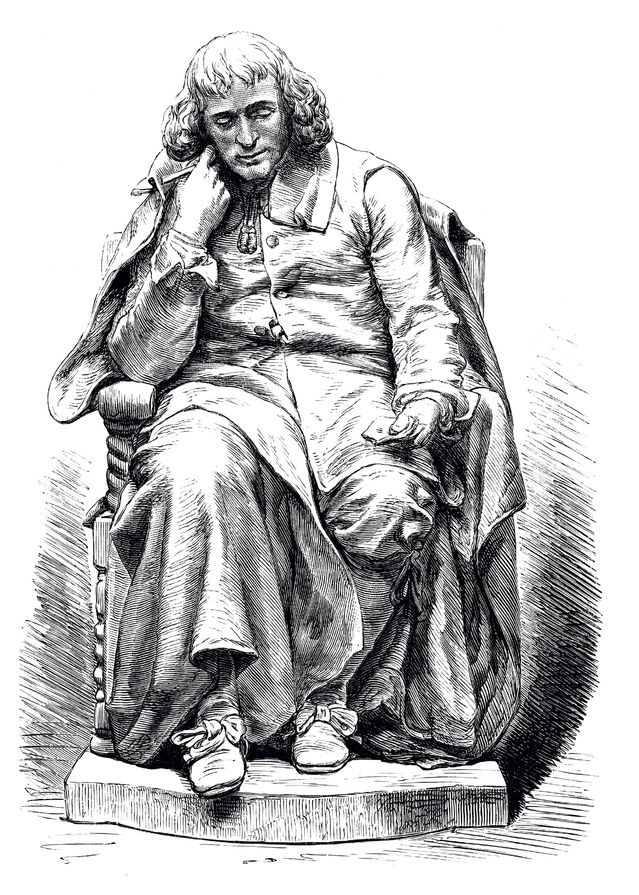
To the portraits of Spinoza which have come down to us we may add a word of description from Colerus. “He was of a middle size. He had good features in his face, the skin somewhat black, the hair dark and curly, the eyebrows long and black, so that one might easily know by his looks that he was descended from Portuguese Jews. As for his clothes, he was very careless of them, and they were not better than those of the meanest citizen. One of the most eminent councillors of state went to see him, and found him in a very untidy morning-gown; whereupon the councillor reproached him for it, and offered him another. Spinoza answered that a man was never the better for having a fine gown, and added, ‘It is unreasonable to wrap up things of little or no value in a precious cover.'”  Spinoza’s sartorial philosophy was not always so ascetic. “It is not a disorderly or slovenly carriage that makes us sages,” he Writes; “for affected indifference to personal appearance is rather evidence of a poor spirit in which true wisdom could find no worthy dwelling-place, and science could only meet with disorder and disarray.” 

Spinoza was of gentle bearing with pleasant features. He dressed in what he could afford. He didn’t accept any favors.

It was during this five years’ stay at Rhynsburg that Spinoza wrote the little fragment “On the Improvement of the Intellect” (De lntellectus Emendatione), and the Ethics Geometrically Demonstrated (Ethica More Geometrico Demonstrata). The latter was finished in 1665; but for ten years Spinoza made no effort to publish it. In 1668 Adrian Koerbagh, for printing opinions similar to Spinoza’s, was sent to jail for ten years; and died there after serving eighteen months of his sentence. When, in 1675, Spinoza went to Amsterdam trusting that he might now safely publish his chef-d’oeuvre, “a rumor was spread about,” as he writes to his friend Oldenburg, “that a book of mine was soon to appear, in which I endeavored to prove that there is no God. This report, I regret to add, was by many received as true. Certain theologians (who probably were themselves the author of the rumor) took occasion upon this to lodge a complaint against me with the prince and the magistrates. … Having received a hint of this state of things from some trustworthy friends, who assured me, further, that the theologians were everywhere lying in wait for me, I determined to put off my attempted publication until such time as I should. see what turn affairs would take.”  

Spinoza started to write his thoughts and philosophy. He put off the publication because he was rumored to deny God. The state of things were not in favor of rational thinking. 

Only after Spinoza’s death did the Ethics appear (1677), along with an unfinished treatise on politics (Tractatus Politicus) and a Treatise on the Rainbow. All these works were in Latin, as the universal language of European philosophy and science in the seventeenth century. A Short Treatise on God and Man, written in Dutch, was discovered by Van Vloten in 1852; it was apparently a preparatory sketch for the Ethics. The only books published by Spinoza in his lifetime were The Principles of the Cartesian Philosophy (1663), and A Treatise on Religion and the State (Tractatus Theologico-Politicus), which appeared anonymously in 1670. It was at once honored with a place in the Index Expurgatorius, and its sale was prohibited by the civil authorities; with this assistance it attained to a considerable circulation under cover of title-pages which disguised it as a medical treatise or an historical narrative. Countless volumes were written to refute it; one called Spinoza “the most impious atheist that ever lived upon the face of the earth”; Colerus speaks of another refutation as “a treasure of infinite value, which shall never perish” ; —only this notice remains of it. In addition to such public chastisement Spinoza received a number of letters intended to reform him; that of a former pupil, Albert Burgh, who had been converted to Catholicism, may be taken as a sample: 

Spinoza’s writings that were published in his lifetime were very controversial.

You assume that you have at last found the true philosophy. How do you know that your philosophy is the best of all those which have ever been taught in the world, are now taught, or shall be taught hereafter? To say nothing of what may be devised in the future, have you examined all those philosophies, both ancient and modern, which are taught here, in India, and all the world over? And even supposing that you have duly examined them, how do you know that you have chosen the best? … How dare you set yourself up above all the patriarchs, prophets, apostles, martyrs, doctors, and confessors of the Church? Miserable man and worm upon the earth that you are, yea, ashes and food for worms, how can you confront the eternal wisdom with your unspeakable blasphemy? What foundation have you for this rash, insane, deplorable, accursed doctrine? What devilish pride puffs you up to pass judgment on mysteries which Catholics themselves declare to be incomprehensible? Etc., etc. 

He was publicly chastised by traditional Catholic mindset.

To which Spinoza replied: 

You who assume that you have at last found the best. religion, or rather the best teachers, and fixed your credulity upon them, how do you know that they are the best among those who have taught religions, or now teach, or shall hereafter teach them? Have you examined all those religions, ancient and modern, which are taught here, and in India, and all the world over? And even supposing that you have duly examined them, how do you know that you have chosen the best?

Apparently the gentle philosopher could be firm enough when occasion called for it. 

Spinoza pointed back to their lack of deep understanding.

Not all the letters were of this uncomfortable kind. Many of them were from men of mature culture and high position. Most prominent of these correspondents were Henry Oldenburg, secretary of the recently established Royal Society of England; Von Tschirnhaus, a young German inventor and nobleman; Huygens, the Dutch scientist; Leibnitz the philosopher, who visited Spinoza in 1676; Louis Meyer, a physician of the Hague; and Simon De Vries, a rich merchant of Amsterdam. The latter so admired Spinoza that he begged him to accept a gift of $1000. Spinoza refused; and later, when De Vries, making his will, proposed to leave his entire fortune to him, Spinoza persuaded De Vries instead to bequeath his wealth to his brother. When the merchant died it was found that his will required that an annuity of $250 should be paid to Spinoza out of the income of the property. Spinoza wished again to refuse saying, “Nature is satisfied with little; and if she is, I am also”; but he was at last prevailed upon to accept $150 a year. Another friend, Jan de Witt, chief magistrate of the Dutch republic, gave him a state annuity of $50. Finally, the Grand Monarch himself, Louis XIV, offered him a substantial pension, with the implied condition that Spinoza should dedicate his next book to the King. Spinoza courteously declined.

Spinoza got recognition and approval from men of mature culture and high position. But he refused all favors.

To please his friends and correspondents, Spinoza moved to Voorburg, a suburb of the Hague, in 1665; and in 1670 to the Hague itself. During these later years he developed an affectionate intimacy with Jan de Witt; and when De Witt and his brother were murdered in the streets by a mob which believed them responsible for the defeat of the Dutch troops by the French, in 1672, Spinoza, on being apprised of the infamy, burst into tears, and but for the force which was used to restrain him, would have sallied forth, a second Antony, to denounce the crime on the spot where it had been committed. Not long afterward, the Prince de Condé, head of the invading French army, invited Spinoza, to his headquarters, to convey to him the offer of a royal pension from France and to introduce certain admirers of Spinoza who were with the Prince. Spinoza, who seems to have been rather a “good European” than a nationalist, thought it nothing strange for him to cross the lines and go to Condé’s camp. When he returned to the Hague the news of his visit spread about, and there were angry murmurs among the people. Spinoza’s host; Van den Spyck, was in fear of an attack upon his House; but Spinoza calmed him, saying: “I can easily clear myself of all suspicion of treason; … but should the people show the slightest disposition to molest you, should they even assemble and make a noise before your house, I will go down to them, though they should serve me as they did poor De Witt.” But when the crowd learned that Spinoza was merely a philosopher they concluded that he must be harmless ; and the commotion quieted down.

Spinoza was a “good European” than a nationalist.

Spinoza’s life, as we see it in these little incidents, was not as impoverished and secluded as it has been traditionally pictured. He had some degree of economic security, he had influential and congenial friends, he took an interest in the political issues of his time, and he was not without adventures that came close to being matters of life and death. That he had made his way, despite excommunication and interdict, into the respect of his contemporaries, appears from the offer which came to him, in 1673, of the chair of philosophy at the University of Heidelberg; an offer couched in the most complimentary terms, and promising “the most perfect. freedom in philosophizing, which His Highness feels assured you would not abuse by calling in question the established religion of the state.” Spinoza replied characteristically: 

Honored sir: Had it ever been my wish to undertake the duties of a professor in any faculty, my desires would have been amply gratified in accepting the position which his Serene Highness the Prince Palatine does me the honor to offer me through you. The offer, too, is much enhanced in value in my eyes by the freedom of philosophizing attached to it. … But I do not know within what precise limits that the same liberty of philosophizing would have to be restrained, so that I would not seem to interfere with the established religion of the principality. … You see, therefore, honored sir, that I do not look for any higher worldly position than that which I now enjoy; and that for love of the quiet which I think I cannot otherwise secure, ‘I must abstain from entering upon the career of a public teacher. …

Spinoza had some degree of economic security. He had influential and congenial friends. He took an interest in the political issues of his time.

The closing chapter came in 1677. Spinoza was now only forty-four, but his friends knew that he had not many years left to him. He had come of consumptive parentage; and the comparative confinement in which he had lived, as well as the dust-laden atmosphere in which he had labored, were not calculated to correct this initial disadvantage. More and more he suffered from difficulty in breathing; year by year his sensitive lungs decayed. He reconciled himself to an early end, and feared only that the book which he had not dared to publish during his lifetime would be lost or destroyed after his death. He placed the MS. in a small writing desk, locked it, and gave the key to his host, asking him to transmit desk and key to Jan Rieuwertz, the Amsterdam publisher, when the inevitable should come. 

At forty-four Spinoza was not in good health and he knew his end was near.

On Sunday, February 20, the family With whom Spinoza lived went to church after receiving his assurance that he was not unusually ill. Dr. Meyer alone remained with him. When they returned they found the philosopher lying dead in the arms of his friend. Many mourned him; for the simple folk had loved him as much for his gentleness as the learned had honored him for his wisdom. Philosophers and magistrates joined the people in following him to his final rest; and men of varied faiths met at his grave. 

When Spinoza passed away he was loved and honored for his gentleness and wisdom.

Nietzsche says somewhere that the last Christian died upon the cross. He had forgotten Spinoza. 

.

SPINOZA: Excommunication

Reference: The Story of Philosophy

This paper presents Chapter IV Section 1.3 from the book THE STORY OF PHILOSOPHY by WILL DURANT. The contents are from the 1933 reprint of this book by TIME INCORPORATED by arrangement with Simon and Schuster, Inc.

The paragraphs of the original material (in black) are accompanied by brief comments (in color) based on the present understanding.  Feedback on these comments is appreciated.

The heading below is linked to the original materials.

.

I.3 Excommunication

These were the mental antecedents of the externally quiet but internally disturbed youth who in 1656 (he had been born in 1632) was summoned before the elders of the synagogue on the charge of heresy. Was it true, they asked him, that he had said to his friends that God might have a body—the world of matter; that angels might be hallucinations; that the soul might be merely life; and that the Old Testament said nothing of immortality? 

When Spinoza was 24 he was summoned before the elders of the synagogue on the charge of heresy.

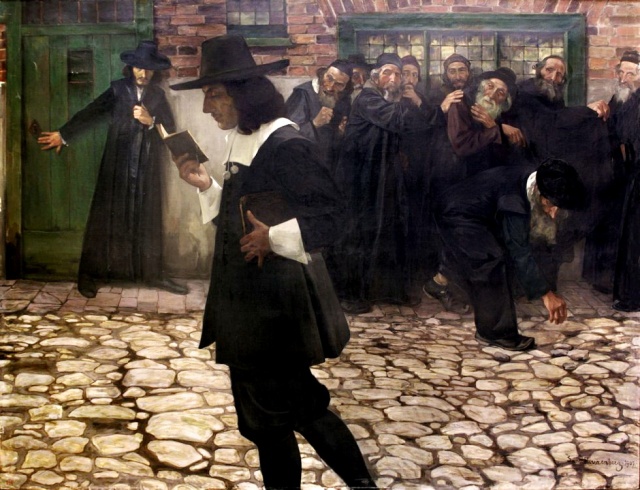
We do not know what he answered. We only know that he was offered an annuity of $500 if he would consent to maintain at least an external loyalty to his synagogue and his faith; that he refused the offer; and that on July 27, 1656, he was excommunicated with all the sombre formalities of Hebrew ritual. “During the reading of the curse, the wailing and protracted note of a great horn was heard to fall in from time to time; the lights, seen brightly burning at the beginning of the ceremony, were extinguished one by one as it proceeded, till at the end the last went out—typical of the extinction of the spiritual life of the excommunicated man—and the congregation was left in total darkness.”

When Spinoza refused to retract what he had said he was excommunicated with all the sombre formalities of Hebrew ritual.

Van Vloten has given us the formula used for excommunication:

The heads of the Ecclesiastical Council hereby make known, that, already well assured of the evil opinions and doings of Baruch de Espinoza, they have endeavored in sundry ways and by various promises to turn him from his evil courses. But as they have been unable to bring him to any better way of thinking; on the contrary, as they are every day better certified of the horrible heresies entertained and avowed by him, and of the insolence with which these heresies are promulgated and spread abroad, and many persons worthy of credit having borne witness to these in the presence of the said Espinoza, he has been held fully convicted of the same. Review having therefore been made of the whole matter before the chiefs of the Ecclesiastical Council, it has been resolved, the Councillors assenting thereto, to anathematize the said Spinoza, and to cut him off from the people of Israel, and from the present hour to place him in Anathema with the following malediction: 

With the judgment of the angels and the sentence of the saints, we anathematize, execrate, curse and cast out Baruch de Espinoza, the whole of the sacred community assenting, in presence of the sacred books with the six-hundred-and-thirteen precepts written therein, pronouncing against him the malediction wherewith Elisha cursed the children, and all the maledictions written in the Book of the Law. Let him be accursed by day, and accursed by night; let him be accursed in his lying down, and accursed in his rising up; accursed in going out and accursed in coming in. May the Lord never more pardon or acknowledge him; may the wrath and displeasure of the Lord burn henceforth against this man, load him with all the curses written in the Book of the Law, and blot out his name from under the sky; may the Lord sever him for evil from all the tribes of Israel, weight him with all the maledictions of the firmament contained in the Book of Law; and may all ye who are obedient to the Lord your God be saved this day. 

Hereby then are all admonished that none hold converse with him by word of mouth, none hold communication with him by writing; that no one do him any service, no one abide under the same roof with him, no one approach within four cubits length of him, and no one read any document dictated by him, or written by his hand.

This formal formula for excommunication seriously condemns and expels one from the Jewish community.

Let us not be too quick to judge the leaders of the synagogue; for they faced a delicate situation. No doubt they hesitated to subject themselves to the charge that they were as intolerant of heterodoxy as the Inquisition which had exiled them from Spain. But they felt that gratitude to their hosts in Holland demanded the excommunication of a man whose doubts struck at Christian doctrine quite as vitally as at Judaism. Protestantism was not then the liberal and fluent philosophy which it now becomes; the wars of religion had left each group entrenched immovably in its own creed, cherished now all the more because of the blood just shed in its defense. What would the Dutch authorities say to a Jewish community which repaid Christian toleration and protection by turning out in one generation an a Costa, and in the next a Spinoza? Furthermore, religious unanimity seemed to the elders their sole means of preserving the little Jewish group in Amsterdam from disintegration, and almost the last means of preserving the unity, and so ensuring the survival, of the scattered Jews of the world. If they had had their own state, their own civil law, their own establishments of secular force and power, to compel internal cohesion and external respect, they might have been more tolerant; but their religion was to them their patriotism as well as their faith, the synagogue was their center of social and political life as well as of ritual and worship; and the Bible whose veracity Spinoza had impugned was the “portable Fatherland” of their people; under these circumstances, they thought, heresy was treason, and toleration suicide. 

It appears that the elders of the community had no other option. They had to excommunicate Spinoza for the survival of their small community in Holland.

One feels that they should have bravely run these risks; but it is as hard to judge another justly as it is to get out of one’s skin. Perhaps Menasseh ben Israel, spiritual head. of the whole Amsterdam community of Jews, could have found some conciliatory formula within which both the synagogue and the philosopher might have found room to live in mutual peace; but the great rabbi was then in London, persuading Cromwell to open England to the Jews. Fate had written that Spinoza should belong to the world. 

Fate had written that Spinoza should belong to the world. 

.