Category Archives: Philosophy

BERTRAND RUSSELL: The Logician

Reference: The Story of Philosophy

This paper presents Chapter X Section 3.1 from the book THE STORY OF PHILOSOPHY by WILL DURANT. The  contents are from the 1933 reprint of this book by TIME INCORPORATED by arrangement with Simon and Schuster, Inc.

The paragraphs of the original material (in black) are accompanied by brief comments (in color) based on the present understanding.

.

III. BERTRAND RUSSELL

1. The Logician

We have kept for the last the youngest and the most virile of the European thinkers of our generation.

When Bertrand Russell spoke at Columbia University in 1914, he looked like his subject, which was epistemology—thin, pale, and moribund; one expected to see him die at every period. The Great War had just broken out, and this tender-minded, peace-loving philosopher had suffered from the shock of seeing the most civilized of continents disintegrate into barbarism. One imagined that he spoke of so remote a subject as “Our Knowledge of the External World” because he knew it was remote, and wished to be as far as possible from actualities that had become so grim. And then, seeing him again, ten years later, one was happy to find him, though fifty-two, hale and jolly, and buoyant with a still rebellious energy. This despite an intervening decade that had destroyed almost all his hopes, loosened all his friendships, and broken almost all the threads of his once sheltered and aristocratic life.

Bertrand Russell spoke at Columbia University in 1914 on epistemology, because being tender-minded and peace-loving, he wished to be as far as possible from actualities of World War I.

For he belongs to the Russells, one of the oldest and most famous families in England or the world, a family that has given statesmen to Britain for many generations. His grandfather, Lord John Russell, was a great Liberal Prime Minister who fought an unyielding battle for free trade, for universal free education, for the emancipation of the Jews, for liberty in every field. His father, Viscount Amberley, was a free-thinker, who did not over-burden his son with the hereditary theology of the West. He is now heir presumptive to the second Earl Russell but he rejects the institution of inheritance, and proudly earns his own living. When Cambridge dismissed him for his pacifism he made the world his university, and became a traveling Sophist (in the original sense of that once noble word), whom the world supported gladly.

Russell belonged to one of the oldest and most famous families in England. He rejected the institution of inheritance, and proudly earned his own living. He was dismissed from Cambridge for his pacifism.

There have been two Bertrand Russells: one who died during the war; and another who rose out of that one’s shroud, an almost mystic communist born out of the ashes of a mathematical logician. Perhaps there was a tender mystic strain in him always; represented at first by a mountain of algebraic formulae; and then finding a distorted expression in a socialism that has the ear-marks rather of a religion than of a philosophy. The most characteristic title among his books is Mysticism and Logic: a merciless attack on the illogicality of mysticism, followed by such a glorification of scientific method as makes one think of the mysticism of logic. Russell inherits the English positivist tradition, and is resolved to be tough-minded, because he knows that he cannot.

Russell inherited the English positivist tradition. He mercilessly attacked the illogicality of mysticism, and praised the scientific method.

Perhaps it was by an over-correction that he emphasized the virtues of logic, and made a divinity of mathematics. He impressed one, in 1914, as cold-blooded, as a temporarily animated abstraction, a formula with legs. He tells us that he never saw a motion-picture till he read Bergson’s cinematographic analogy for the intellect; then he reconciled himself to one performance, merely as a task in philosophy. Bergson’s vivid sense of time and motion, his feeling that all things were alive with a vital impetus; made no impression on Russell; it seemed to him a pretty poem and nothing more; for his part he would have no other god than mathematics. He had no liking for the classics; he argued vigorously, like another Spencer, for more science in education. The world’s woes, he felt, were largely due to mysticism, to culpable obscurity of thought; and the first law of morality should be, to think straight. “Better the world should perish than that I, or any other human being, should believe a lie; … that is the religion of thought, in whose scorching flames the dross of the world is being burnt away.”

Perhaps it was by an over-correction that he emphasized the virtues of logic, and made a divinity of mathematics. Bergson’s feeling that all things were alive with a vital impetus; made no impression on Russell. He had no liking for the classics; he argued for more science in education.

His passion for clarity drove him inevitably to mathematics; he was almost thrilled at the calm precision of this aristocratic science. “Mathematics, rightly viewed, possesses not only truth but supreme beauty—a beauty cold and austere, like that of sculpture, without appeal to any part of our weaker nature, without the gorgeous trappings of painting or music, yet sublimely pure, and capable of a stern perfection such as only the greatest art can show.” He believes that the progress of mathematics was the finest feature of the nineteenth century; specifically, “the solution of the difficulties which formerly surrounded the mathematical infinite is probably, the greatest achievement of which our age can boast.” In one century the old geometry which had held the fortress of mathematics for two thousand years was almost entirely destroyed; and Euclid’s text, the oldest school-book in the world, was at last superseded. “It is nothing less than a scandal that he should still be taught to boys in England.”

His passion for clarity drove him inevitably to mathematics; he was almost thrilled at the calm precision of this aristocratic science. He believed that the progress of mathematics was the finest feature of the nineteenth century.

Perhaps the source of most of the innovations in modern mathematics is the rejection of axioms; and Russell delights in men who challenge “self-evident truths” and insist upon the demonstration of the obvious. He was rejoiced to hear that parallel lines may somewhere meet, and that the whole may be no greater than one of its parts. He likes to startle the innocent reader with such puzzles as this: the even numbers are but half of all numbers, and yet there are just as many of them as there are numbers altogether,—since for every number there is its even double. Indeed, this is the whole point about that hitherto indefinable thing, the mathematical infinite: it is a whole containing parts that have as many terms or items as the whole.—The reader may follow this tangent if the spirit moves him.*

*Not that one would recommend Russell’s mathematical volumes to the lay reader. The Introduction to Mathematical Philosophy sets out with a specious intelligibility, but soon makes demands which only a specialist in mathematics can meet. Even the little book on The Problems of Philosophy, though intended to be popular, is difficult, and unnecessarily epistemological; the larger volume, Mysticism and Logic, is much clearer and closer to the earth. The Philosophy of Leibnitz is a fine exposition of a great thinker, ignored in these limited pages. The twin volumes on The Analysis of Mind and The Analysis of Matter will serve to bring the reader up to date with certain aspects of psychology and physics. The post-war books are easy reading; and though they suffer from the confusion natural to a man whose idealism is slipping into disillusionment, they are interesting and worth while. Why Men Fight? is still the best of these tracts for the times. Roads to Freedom is a genial survey of social philosophies as old as Diogenes, which Russell rediscovers with all the enthusiasm of a Columbus.

Perhaps the source of most of the innovations in modern mathematics is the rejection of axioms; and Russell delighted in men who challenge “self-evident truths” and insist upon the demonstration of the obvious. 

What draws Russell to mathematics is, again, its rigid impersonality and objectivity; here, and here alone, is eternal truth, and absolute knowledge; these a priori theorems are the “Ideas” of Plato, the “eternal order” of Spinoza, the substance of the world. The aim of philosophy should be to equal the perfection of mathematics by confining itself to statements similarly exact, and similarly true before all experience. “Philosophical propositions … must be a priori,” says this strange positivist. Such propositions will refer not to things but to relations, and to universal relations. They will be independent of specific “facts” and events; if every particular in the world were changed, these propositions would still be true. E. g., “if all A’s are B’s, and X is A, then X is a B”: this is true whatever A may be; it reduces to a universal and a priori form the old syllogism about the mortality of Socrates; and it would be true if no Socrates, even if nobody at all, had ever existed. Plato and Spinoza were right: “the world of universals may also be described as the world of being. The world of being is unchangeable, rigid, exact, delightful to the mathematician, the logician, the builder of metaphysical systems, and all who love perfection more than life.” To reduce all philosophy to such mathematical form, to take all specific content out of it, to compress it (voluminously) into mathematics—this was the ambition of this new Pythagoras.

“People have discovered how to make reasoning symbolic, as it is in algebra, so that deductions can be effected by mathematical rules. … Pure mathematics consists entirely of assertions to the effect that if such and such a proposition is true of anything, then such and such another proposition is true of that thing. It is essential not to discuss whether the first proposition is really true, and not to mention what the anything is of which it is supposed to be true. … Thus mathematics may be defined as the subject in which we never know what we are talking about, nor whether what we are saying is true.”

What draws Russell to mathematics is, again, its rigid impersonality and objectivity; here, and here alone, is eternal truth, and absolute knowledge; these a priori theorems are the “Ideas” of Plato, the “eternal order” of Spinoza, the substance of the world. They refer not to things but to universal relations. 

And perhaps (if one may rudely interrupt exposition with opinion) this description does no great injustice to mathematical philosophy. It is a splendid game for those who like it; guaranteed to “kill time” as rapidly as chess; it is a new form of solitaire, and should be played as far as possible from the contaminating touch of things. It is remarkable that after writing several volumes of this learned moonshine, Bertrand Russell should suddenly come down upon the surface of this planet, and begin to reason very passionately about war, and government, and socialism, and revolution,—and never once make use of the impeccable formulae piled like Pelion upon Ossa in his Principia Mathematica. Nor has anyone else, observably, made use of them. To be useful, reasoning must be about things, and must keep in touch with them at every step. Abstractions have their use as summaries; but as implements of argument they require the running test and commentary of experience. We are in danger here of a scholasticism beside which the giant Summa’s of medieval philosophy would be models of pragmatic thought.

But what use are these impeccable formulae in Russell’s Principia Mathematica when they cannot be used to solve the real problems of war, and government, and socialism, and revolution? To be useful, reasoning must be about things, and must keep in touch with them at every step. 

From such a starting point, Bertrand Russell was almost fated to pass into agnosticism. He found so much in Christianity that could not be phrased in mathematics, that he abandoned it all except its moral code. He speaks scornfully of a civilization that persecutes men who deny Christianity, and imprisons those who take it seriously. He can find no God in such a contradictory world; rather, only a humorous Mephistopheles could have produced it, and in a mood of exceptional deviltry. He follows Spencer in his vision of the end of the world, and rises to eloquence in describing the Stoic’s resignation to the ultimate defeat of every individual and every species. We talk of evolution and progress; but progress is an egotistical phrase and evolution is but one half of an unmoral cycle of events terminating in dissolution and death. “Organic life, we are told, has developed gradually from the protozoon to the philosopher; and this development, we are assured, is indubitably an advance. Unfortunately, it is the philosopher; not the protozoon, who gives us this assurance.”  The “free man” cannot comfort himself with childish hopes and anthropomorphic gods; he has to keep his courage up even though he knows that in the end he too must die, that all things must die. Nevertheless, he will not surrender; if he cannot win, he can at least enjoy the fight; and by the knowledge that foresees his own defeat he stands superior to the blind forces that will destroy him. His worship will go not to these brute powers without, that by their aimless persistence conquer him, and tear down every home and every civilization that he builds; but to those creative powers within him that struggle on in the face of failure, and raise for at least some centuries the frail beauty of carved and pictured things, and the majestic ruins of the Parthenon. 

This was the starting point of Russell’s philosophy. The “free man” cannot comfort himself with childish hopes and anthropomorphic gods; he has to keep his courage up even though he knows that in the end he too must die, that all things must die. His worship will go to those creative powers within him that struggle on in the face of failure.

Such was the philosophy of Bertrand Russell-before the war.

.

BENEDETTO CROCE: Criticism

Reference: The Story of Philosophy

This paper presents Chapter X Section 2.3 from the book THE STORY OF PHILOSOPHY by WILL DURANT. The  contents are from the 1933 reprint of this book by TIME INCORPORATED by arrangement with Simon and Schuster, Inc.

The paragraphs of the original material (in black) are accompanied by brief comments (in color) based on the present understanding.

.

II. BENEDETTO CROCE

4. Criticism

All this is as clear as a starless night; and not wiser than it should be. The Philosophy of the Spirit lacks spirit, and discourages a sympathetic exposition. The Philosophy of the Practical is unpractical, and lacks the breath of living reference. The essay On History catches one leg of the truth, by proposing a union of history and philosophy; but it misses the other by failing to see that history can become philosophy only by being not analytic but synthetic; not shredded history (giving in separate books the separate story of the supposedly insulated activities of men—economic, political, scientific, philosophical, religious, literary, and artistic) but what one might call, not too seriously, wedded history,—history in which all the phases of human life in a given period—made as brief as individual frailty may require—shall be studied in their correlation, in their common response to similar conditions, and in their varied mutual influence. That would be the picture of an age, the image of the complexity of man; it would be such history as a philosopher would consent to write.

Croce is simply too logical and analytical. True history, according to Will Durant, would be history in which all the phases of human life in a given period shall be studied in their correlation. That would be the picture of an age.

As to the Esthetic, let others judge. At least one student cannot understand it. Is man an artist as soon as he farms images? Does the essence of art lie only in the conception, and not in the externalization? Have we never had thoughts and feelings more beautiful than our speech? How do we know what the inward image was, in the artist’s mind, or whether the work that we admire realizes or misses his idea? How shall we call Rodin’s “Harlot” beautiful, except because it is the expressive embodiment of an adequate conception?”—conception though it be of an ugly and distressing subject? Aristotle notes that it pleases us to see the faithful images of things that are repugnant to us in reality; why, except that we reverence the art that has so well embodied the idea?

Croce’s Esthetic leaves too many questions unanswered.

It would be interesting, and no doubt disconcerting, to know what artists think of these philosophers who tell them what beauty is. The greatest living artist has abandoned the hope of answering the question. “I believe,” he writes, “that we shall never know exactly why a thing is beautiful.” But the same mellow wisdom offers us a lesson which we learn, usually, too late. “No one has ever been able to show me precisely the right way. … As for me, I follow my feeling for the beautiful. What man is certain of having found a better guide? … If I had to choose between beauty and truth, I should not hesitate; it is beauty I should keep. … There is nothing true in the world except beauty.” Let us hope that we need not choose. Perhaps we shall some day be strong enough and clear enough in soul to see the shining beauty of even the darkest truth.

It would be interesting to know what artists think of these philosophers who tell them what beauty is. Perhaps we shall some day be strong enough and clear enough in soul to see the shining beauty of even the darkest truth.

.

BENEDETTO CROCE: What is Beauty?

Reference: The Story of Philosophy

This paper presents Chapter X Section 2.3 from the book THE STORY OF PHILOSOPHY by WILL DURANT. The  contents are from the 1933 reprint of this book by TIME INCORPORATED by arrangement with Simon and Schuster, Inc.

The paragraphs of the original material (in black) are accompanied by brief comments (in color) based on the present understanding.

.

II. BENEDETTO CROCE

3. What is Beauty?

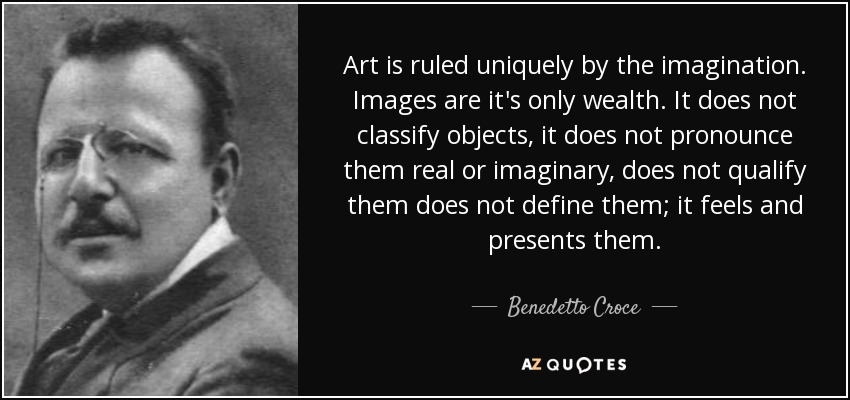
Croce came to philosophy from historical and literary studies; and it was natural that his philosophic interest should be deeply colored by the problems of criticism and esthetics. His greatest book is his Esthetic (1902). He prefers art to metaphysics and to science: the sciences give us utility but the arts give us beauty; the sciences take us away from the individual and the actual, into a world of increasingly mathematical abstractions, until (as in Einstein) they issue in momentous conclusions of no practical importance; but art takes us directly to the particular person and the unique fact, to the philosophical universal intuited in the form of the concrete individual. “Knowledge has two forms: it is either intuitive knowledge or logical knowledge; knowledge obtained through the imagination or knowledge obtained through the intellect; knowledge of the individual or knowledge of the universal; of individual things or of the relations between them; it is the production either of images or of concepts.” The origin of art, therefore, lies in the power of forming images. “Art is ruled uniquely by the imagination, Images are its only wealth. It does not classify objects, it does not pronounce them real or imaginary, does not qualify them, does not define them; it feels and presents them—nothing more.” Because imagination precedes thought, and is necessary to it, the artistic, or image-forming activity of the mind is prior to the logical, concept-forming, activity. Man is an artist as soon as he imagines, and long before he reasons.

Croce prefers art to metaphysics and to science: the sciences give us utility but the arts give us beauty. The origin of art lies in the power of forming images and not concepts. The image-forming activity of the mind is prior to the logical, concept-forming, activity.

The great artists understood the matter so. “One paints not with the hands but with the brain,” said Michelangelo; and Leonardo wrote: “The minds of men of lofty genius are most active in invention when they are doing the least external work.” Everybody knows the story told of da Vinci, that when he was painting the “Last Supper,” he sorely displeased the Abbot who had ordered the work, by sitting motionless for days before an untouched canvas; and revenged himself for the importunate Abbot’s persistent query—When would he begin to work?—by using the gentleman as an unconscious model for the figure of Judas.

One paints not with the hands but with the brain. The minds of men of lofty genius are most active in invention when they are doing the least external work.

The essence of the esthetic activity lies in this motionless effort of the artist to conceive the perfect image that shaIl express the subject he has in mind; it lies in a form of intuition that involves no mystic insight, but perfect sight, complete perception, and adequate imagination. The miracle of art lies not in the externalization but in the conception of the idea; externalization is a matter of mechanical technique and manual skill.

“When we have mastered the internal word, when we have vividly and clearly conceived a figure or a statue, when we have found a musical theme, expression is born and is complete, nothing more is needed. If, then, we open our mouth, and speak or sing, … what we do is to say aloud what we have already said within, to sing aloud what we have already sung within. If our hands strike the keyboard of the pianoforte, if we take up pencil or chisel, such actions are willed” (they belong to the practical, not to the esthetic, activity), “and what we are then doing is executing in great movements what we have already executed briefly and rapidly within.”

The miracle of art lies not in the externalization but in the conception of the idea; externalization is a matter of mechanical technique and manual skill.

Does this help us to answer that baffling question, What is beauty? Here certainly there are as many opinions as, there are heads; and every lover, in this matter, thinks himself an authority not to be gainsaid. Croce answers that beauty is the mental formation of an image (or a series of images ) that catches the essence of the thing perceived. The beauty belongs, again, rather to the inward image than to the outward form in which it is embodied. We like to think that the difference between ourselves and Shakespeare is largely a difference in technique of external expression; that we have thoughts that lie too deep for words. But this is a fond delusion: the difference lies not in the power of externalizing the image but in the power of inwardly forming an image that expresses the object.

Beauty is the mental formation of an image (or a series of images ) that catches the essence of the thing perceived. The difference lies not in the power of externalizing the image but in the power of inwardly forming an image that expresses the object.

Even that esthetic sense which is contemplation rather than creation is also inward expression; the degree in which we understand or appreciate a work of art depends upon our ability to see by direct intuition the reality portrayed,—our power to form for ourselves an expressive image. “It is always our own intuition we express when we are enjoying a beautiful work of art. … It can only be my own intuition when, reading Shakespeare, I form the image of Hamlet or Othello.” Both in the artist creating and in the spectator contemplating beauty, the esthetic secret is the expressive image. Beauty is adequate expression: and since there is no real expression if it be not adequate, we may answer very simply the ancient question, and say, Beauty is expression.

It is always our own intuition we express when we are enjoying a beautiful work of art. It can only be my own intuition when, reading Shakespeare, I form the image of Hamlet or Othello. The esthetic secret is the expressive image.

.

BENEDETTO CROCE: The Philosophy of the Spirit

Reference: The Story of Philosophy

This paper presents Chapter X Section 2.2 from the book THE STORY OF PHILOSOPHY by WILL DURANT. The  contents are from the 1933 reprint of this book by TIME INCORPORATED by arrangement with Simon and Schuster, Inc.

The paragraphs of the original material (in black) are accompanied by brief comments (in color) based on the present understanding.

.

II. BENEDETTO CROCE

2. The Philosophy of the Spirit

His first book, in its original form, was a leisurely series of articles (1895-1900) on Historical Materialism and the Economics of Karl Marx. He had been immensely stimulated by Antonio Labriola, his professor at the University of Rome; under his guidance Croce had plunged into the labyrinths of Marx’s Kapital. “This intercourse with the literature of Marxism, and the eagerness with which for some time I followed the socialistic press of Germany and Italy, stirred my whole being, and for the first time awakened in me a feeling of political enthusiasm, yielding a strange taste of newness to me; I was like a man who, having fallen in love for the first time when no longer young, should observe in himself the mysterious process of the new passion.” But the wine of social reform did not quite go to his head; he soon reconciled himself to the political absurdities of mankind, and, worshipped again at the altar of philosophy.

Croce was inspired by the literature of Marxism. But the wine of social reform did not quite go to his head; he soon reconciled himself to the political absurdities of mankind, and, worshipped again at the altar of philosophy.

One result of this adventure was his elevation of the concept Utility to a parity with Goodness, Beauty and Truth. Not that he conceded to economic affairs the supreme importance given to them in the system of Marx and Engels. He praised these men for a theory which, however incomplete, had drawn attention to a world of data before underrated and almost ignored; but he rejected the absolutism of the economic interpretation of history, as an unbalanced surrender to the suggestions of an industrial environment. He refused to admit materialism as a philosophy for adults or even as a method for science; mind was to him the primary and ultimate reality. And when he came to write his system of thought he called it, almost pugnaciously, “The Philosophy of the Spirit.”

One result of this adventure was his elevation of the concept Utility to a parity with Goodness, Beauty and Truth. But he refused to admit materialism as a philosophy for adults or even as a method for science; mind was to him the primary and ultimate reality.

For Croce is an idealist, and recognizes no philosophy since Hegel’s. All reality is idea; we know nothing except in the form it takes in our sensations and our thoughts. Hence all philosophy is reducible to logic; and truth is a perfect relationship in our ideas. Perhaps Croce likes this conclusion a bit too well; he is nothing if not logical; even in his book on Esthetics he cannot resist the temptation to intrude a chapter on logic. It is true that he calls philosophy the study of the concrete universal, and science the study of the abstract universal; but it is the reader’s misfortune that Croce’s concrete universal is universally abstract. He is, after all, a product of the scholastic tradition; he delights in abstruse distinctions and classifications that exhaust both the subject and the reader; he slides easily into logical casuistry, and refutes more readily than he can conclude. He is a Germanized Italian, as Nietzsche is an ltalianized German.

For Croce, all reality is idea; we know nothing except in the form it takes in our sensations and our thoughts. Hence all philosophy is reducible to logic; and truth is a perfect relationship in our ideas.

Nothing could be more German, or more Hegelian, than the title of the first of the trilogy that makes up the Filosofia dello Spirito—the Logic as the Science of the Pure Concept (1905). Croce wants every idea to be as pure as possible—which seems to mean as ideological as possible, as abstract and unpragmatic as possible; there is nothing here of that passion for clarity and practical content which made William James a beacon-light amid the mists of philosophy. Croce does not care to define an idea by reducing it to its practical consequences; he prefers to reduce practical affairs to ideas, relations, and categories. If all abstract or technical words were removed from his books they would not so suffer from obesity.

Croce wants every idea to be as pure as possible. There is no desire for clarity and practical content. He prefers to reduce practical affairs to ideas, relations, and categories.

By a “pure concept” Croce means a universal concept, like quantity, quality, evolution, or any thought which may conceivably be applied to all reality. He proceeds to juggle these concepts as if the spirit of Hegel had found in him another avatar, and as if he were resolved to rival the reputation of the master for obscurity. By calling all this “logic,” Croce convinces himself that he scorns metaphysics, and that he has kept himself immaculate from it; metaphysics, he thinks, is an echo of theology, and the modern university professor of philosophy is just the latest form of the medieval theologian. He mixes his idealism with a certain hardness of attitude towards tender beliefs: he rejects religion; he believes in the freedom of the will, but not in the immortality of the soul; the worship of beauty and the life of culture are to him a substitute for religion. “Their religion was the whole intellectual patrimony of primitive peoples; our intellectual patrimony is our religion. … We do not know what use could be made of religion by those who wish to preserve it side by side with the theoretic activity of man, with his art, his criticism, and his philosophy. … Philosophy removes from religion all reason for existing. … As the science of the spirit, it looks upon religion as a phenomenon, a transitory historical fact, a psychic condition that can be surpassed.” One wonders if La Gioconda’s smile did not hover over the face of Rome when it read these words.

By a “pure concept” Croce means a universal concept, like quantity, quality, evolution, or any thought which may conceivably be applied to all reality. He calls all this logic and he scorns metaphysics. He substitutes religion by the worship of beauty and the life of culture.

We have here the unusual occurrence of a philosophy that is at once naturalistic and spiritualistic, agnostic and indeterministic, practical and idealistic, economic and esthetic. It is true that Croce’s interest is caught more surely by the theoretical than by the pragmatic aspects of life; but the very subjects he has essayed bear witness to an honorable effort to overcome his scholastic inclinations. He has written an immense volume on The Philosophy of the Practical, which turns out to be in part another logic under another name, and in part a metaphysical discussion of the old problem of free will. And in a more modest tome On History he has achieved the fruitful conception of history as philosophy in motion, and of the historian as one who shows nature and man not in theory and abstraction but in the actual flow and operation of causes and events. Croce loves his Vico, and warmly seconds the earlier Italian’s plea that history should be written by philosophers. He believes that the fetish of a perfectly scientific history has led to a microscopic erudition in which the historian loses the truth because he knows too much. Just as Schliemann exhumed not only one Troy but seven after scientific historians had shown that there had been no Troy at all, so Croce thinks the hypercritical historian exaggerates our ignorance of the past.

I recollect the remark made to me when I was occupied with research work in my young days, by a friend of but slight literary knowledge, to whom I had lent a very critical, indeed hypercritical, history of ancient Rome. When he had finished reading it he returned the book to me, remarking that he had acquired the proud conviction of being ‘the most learned of philologists’: for the latter arrive at the conclusion that they know nothing, as the result of exhausting toil; while he knew nothing without any effort at all, simply as a generous gift of nature.

We have here the unusual occurrence of a philosophy that is at once naturalistic and spiritualistic, agnostic and indeterministic, practical and idealistic, economic and esthetic. Croce thinks the hypercritical historian exaggerates our ignorance of the past.

Croce recognizes the difficulty of finding out the actual past, and quotes Rousseau’s definition of history as “the art of choosing, from among many lies, that one which most resembles the truth.” He has no sympathy with the theorist who, like Hegel, or Marx, or Buckle, distorts the past into a syllogism that will conclude with his prejudice. There is no foreordained plan in history; and the philosopher who writes history must devote himself not to the tracing of cosmic designs, but to the revelation of causes and consequences and correlations. And he will also remember that only that part of the past is of value which is contemporary in its significance and its illumination. History might at last be what Napoleon called it,—“the only true philosophy and the only true psychology”—if historians would write it as the apocalypse of nature and the mirror of man.

Croce recognizes the difficulty of finding out the actual past. He has no sympathy with the theorist who distorts the past into a syllogism that will conclude with his prejudice. The philosopher who writes history must devote himself to the revelation of causes and consequences and correlations.

.

BENEDETTO CROCE: The Man

Reference: The Story of Philosophy

This paper presents Chapter X Section 2.1 from the book THE STORY OF PHILOSOPHY by WILL DURANT. The  contents are from the 1933 reprint of this book by TIME INCORPORATED by arrangement with Simon and Schuster, Inc.

The paragraphs of the original material (in black) are accompanied by brief comments (in color) based on the present understanding.

.

II. BENEDETTO CROCE

1. The Man

From Bergson to Croce is an impossible transition: there is hardly a parallel in all their lines. Bergson is a mystic who translates his visions into deceptive clarity; Croce is a sceptic with an almost German gift for obscurity. Bergson is religiously-minded” and yet talks like a thorough-going evolutionist; Croce is an anti-clerical who writes like an American Hegelian. Bergson is a French Jew who inherits the traditions of Spinoza and Lamarck; Croce is an Italian Catholic who has kept nothing of his religion except its scholasticism and its devotion to beauty.

Bergson and Croce are two very different philosophers.

Perhaps the comparative infertility of Italy in the philosophy of the last hundred years is due in some part to the retention of scholastic attitudes and methods even by thinkers who have abandoned the old theology. (More of it, doubtless, is due to the northward movement of industry and wealth.) Italy might be described as the land that had a Renaissance, but never a Reformation; it will destroy itself for beauty’s sake, but it is as skeptical as Pilate when it thinks of truth. Perhaps the Italians are Wiser than the rest of us, and have found that truth is a mirage, while beauty—however subjective—is a possession and a reality. The artists of the Renaissance (excepting the sombre and almost Protestant Michelangelo, whose brush was the echo of Savonarola’s voice) never worried their heads about morals or theology; it was enough for them that the Church recognized their genius, and paid their bills. It became an unwritten law in Italy that men of culture would make no trouble for the Church. How could an Italian be unkind to a Church that had brought all the world to Canossa, and had levied imperial tribute on every land to make Italy the art-gallery of the world?

Perhaps the comparative infertility of Italy in the philosophy of the last hundred years is due in some part to the retention of scholastic attitudes and methods even by thinkers who have abandoned the old theology.

So Italy remained loyal to the old faith, and contented itself with the Summa of Aquinas for philosophy. Giambattista Vico came, and stirred the Italian mind again; but Vico went, and philosophy seemed to die with him. Rosmini thought for a time that he would rebel; but he yielded. Throughout Italy men became more and more irreligious, and more and more loyal to the Church.

Italy remained loyal to the old faith, and contented itself with the Summa of Aquinas for philosophy. 

Benedetto Croce is an exception. Born in 1866 in a small town in the province of Aquila, and the only son of a well-to-do Catholic and conservative family, he was given so thorough a training in Catholic theology that at last, to restore the balance, he became an atheist. In countries that have had no Reformation there is no half-way house between orthodoxy and absolute unbelief. Benedetto was at first so pious that he insisted on studying every phase of religion, until at last he reached its philosophy and its anthropology; and insensibly his studies were substituted for his faith.

Benedetto Croce is an exception. Benedetto was at first so pious that he insisted on studying every phase of religion, and insensibly his studies were substituted for his faith.

In 1888 life dealt him one of those ruthless blows which usually turn men’s minds back to belief. An earthquake overwhelmed the little town of Casamicciola where the Croces were staying; Benedetto lost both his parents, and his only sister; he himself remained buried for hours under the ruins, with many broken bones. It took him several years to recover his health; but his later life and work showed no breaking of his spirit. The quiet routine of convalescence gave him, or strengthened in him, the taste for scholarship; he used the modest fortune which the catastrophe left him to collect one of the finest libraries in Italy; he became a philosopher without paying the usual penalty of poverty or a professorship; he realized Ecclesiastes’ cautious counsel, that “wisdom is good with an inheritance.”

Croce went through a catastrophe. He used the modest fortune which the catastrophe left him to collect one of the finest libraries in Italy.

He has remained throughout his life a student, a lover of letters and of leisure. It was against his protests that he was drawn into politics and made minister of Public Education, perhaps to lend an air of philosophic dignity to a cabinet of politicians. He was chosen to the Italian senate; and as the rule in Italy is, once a senator always a senator (the office being for life), Croce provides the spectacle, not unusual in ancient Rome, but rather unique in our day, of a man who can be a senator and a philosopher at the same time. He would have interested Iago. But he does not take his politics too seriously; his time goes chiefly to the editing of his internationally famous periodical, La Critica, in which he and Giovanni Gentile dissect the world of thought and belles lettres (beautiful letters).

It was against his protests that Croce was drawn into politics and made minister of Public Education. But he did not take his politics too seriously; his time went chiefly to the editing of his internationally famous periodical, La Critica,

When the war of 1914 came; Croce, angered at the thought that a mere matter of economic conflict should be permitted to interrupt the growth of the European mind, denounced the outbreak as suicidal mania; and even when Italy had, of necessity, thrown in her lot with the Allies, he remained aloof, and became as unpopular in Italy as Bertrand Russell in England or Romain Rolland in France. But Italy has forgiven him now; and all the youth of the land look up to him as their unbiased guide, philosopher, and friend; he has become for them an institution as important as the universities. It is nothing unusual now to hear judgments of him like Giuseppe Natoli’s: “The system of Benedetto Croce remains the highest conquest in contemporary thought.” Let us inquire into the secret of this influence.

Croce denounced the outbreak of the war of 1914, and remained aloof even when Italy had, of necessity, thrown in her lot with the Allies. Although this made him initially unpopular, his reputation was restored after the war. He became for the Italian youth an institution as important as the universities. 

.