Reference: A Course on the Factors
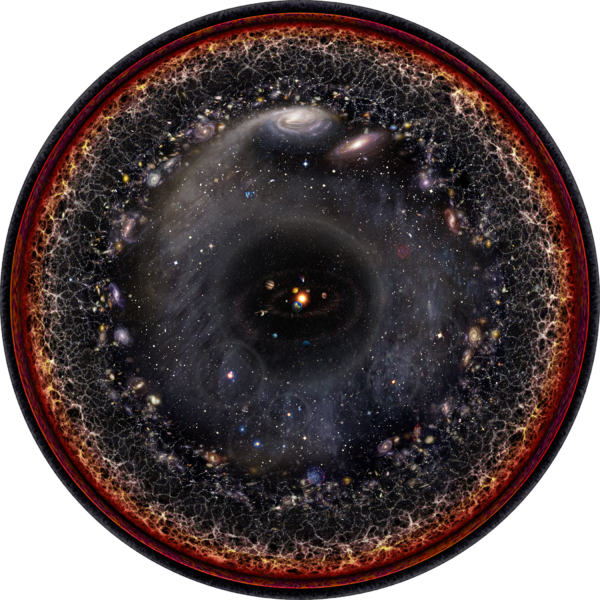
KHTK Factor # 23: The actual universe is represented by the totality of postulates; and not by any single viewpoint.
The postulates are there to approximate the Unknowable. It is the totality of postulates that provides the approximation of the Unknowable. This we may call the universe.
Viewpoints are made up of postulates. There are many different viewpoints. None of those viewpoints provide the approximation of the Unknowable. But each provides an opinion what it might be. These opinions provide a distinct view of the universe.
A viewpoint may build upon its opinion to have its own “universe.” But such a personal universe is an altered version of the actual universe represented by the totality of postulates.
.
Scientology
Compare the above to the following factor in Scientology.
Scientology Factor # 23. The universes, then, are three in number: the universe created by one viewpoint, the universe created by every other viewpoint, the universe created by the mutual action of viewpoints which is agreed to be upheld—the physical universe.
None of the above represents the actual universe; because the viewpoint themselves are part of the actual universe.
.
Logic
The actual universe is represented by the totality of postulates.
.
Reference: A Course on the Factors
KHTK Factor # 22: And thus there is a universe.
The principle of oneness is reflected in the word “universe.” The root meaning of the word UNIVERSE is “entire, all, literally, turned into one.” At any time there is only one universe and not many.
The universe represents an approximation of the unknowable. Different viewpoints of the universe means such approximation of the Unknowable is being viewed differently. They simply indicate that there are anomalies to be resolved in that approximation.
They do not mean that there are many Unknowables; nor do they mean that there are many universes.
.
Scientology
Compare the above to the following factor in Scientology.
Scientology Factor # 22. And there are universes.
It appears that there is only one universe; though people have different ideas about that universe.
.
Logic
The principle of oneness is reflected in the word “universe.”
.
Reference: A Course on the Factors
KHTK Factor # 21: There is oneness of all postulates, beingness, viewpoints and dimension points as they change, and thus there is time.
All changes are regulated by the principle of oneness, and this provides the sense of time. Neither the changes nor the sense of time is arbitrary.
The overriding principle of oneness is what brings us closer to the knowledge of the Unknowable.
.
Scientology
Compare the above to the following factor in Scientology.
Scientology Factor # 21. From this comes a consistency of viewpoint of the interaction of dimension points and this, regulated, is TIME.
Hubbard replaces the Unknowable by his postulated Theta-MEST theory. So it all become “Knowable” to him. Hubbard ignores the anomalies in his Theta-MEST theory.
.
Logic
The overriding logic is the principle of oneness that is expressed through the sense of time.
.
Reference: A Course on the Factors
KHTK Factor # 20: All viewpoints and dimension points are dependent on each other because of the constraint of oneness.
The postulates are there to approximate the Unknowable. Reasoning expands upon the postulates to bring the approximation closer to the Unknowable. This requires a consistency (oneness) to be maintained among all postulates. All viewpoints and dimension points are connected that way.
This makes all the viewpoints and the forms of the universe dependent on each other. This is just another way of describing the Specific conditionality and Dependent origination of Buddha.
.
Scientology
Compare the above to the following factor in Scientology.
Scientology Factor # 20. And the many viewpoints, interacting, become dependent upon one another’s forms and do not choose to distinguish completely the ownership of dimension points and so comes about a dependency upon the dimension points and upon the other viewpoints.
Hubbard could never bring himself to accept the principle of oneness as it conflicted with his idea of eternal human beingness. Buddha denied the possibility of eternal beingness.
.
Logic
The prime principle is that all postulates is ONE because the postulates, together, approximate the Unknowable.
This oneness is expressed as the continuity, consistency and harmony of reality. Any violation of such reality appears as an anomaly.
.
Reference: A Course on the Factors
KHTK Factor # 19: Neither the forms nor the viewpoints are imperishable.
Our viewpoints are made of postulates and our dimension points are made of our considerations. Both can change. They are not imperishable.
Considerations depend on reasoning. Throughout our life our considerations are changing and so are the forms that appear before us.
Postulates also disperse upon death and recombine in a new life. So, the viewpoint definitely changes from one life to the next. But it can change during one’s life too.
So, neither the form nor the viewpoint is eternal in the sense that it is unchanging.
.
Scientology
Compare the above to the following factor in Scientology.
Scientology Factor # 19. And the viewpoint can never perish; but the form can perish.
For a viewpoint to never perish is to have a viewpoint that is unchanging and eternal. A viewpoint is an expression of person’s individuality or beingness. The beingness is a system of postulates. A system can always have postulates changing within it.
.
Logic
There is nothing in this universe that is unchanging and eternal.
.