Beingness is the ability to postulate and to be aware. It is expressed through every being. This is the ’Self’ of the Vedas (written with the upper case ‘S’).
A being is a package of postulated goals and behavior characteristics. It is subject to birth and death. This is the ’self’ of the Vedas (written with the lower case ’s’).
The nature of ‘Self’ is same for everybody. But the ‘self’ is characteristically different from person to person. Yet all ‘selves’ are part of one consistent whole per the principle of oneness.
We are all connected with each other at some level. None of us is absolute and by itself.
.
Scientology
Compare the above to the following factor in Scientology.
Scientology Factor # 2. In the beginning and forever is the decision and the decision is TO BE.
In Scientology, the beingness is identified with Cause. The ‘Self’ is seen as theta, and the ‘self’ is seen as thetan. The thetans are considered to be individuals and independent of each other. Each thetan is also considered to be immortal, or absolute in itself.
.
Logic
Per the principle of oneness, all thetans should be part of a consistent whole, and no individual thetan can be absolute. So, this is an anomaly in Scientology.
Chapter 14: MIRRORS, LENSES AND OPTICAL INSTRUMENTS
.
KEY WORD LIST
Image, Real Image, Virtual Image, Plane Mirror, Magnification, Left-Right Handedness, Concave and Convex Mirrors, Principle Axis, Focal Point, Paraxial Rays, Aberration, Extended Objects, Thin Lens, Converging Lens, Diverging Lens, Lensmaker’s Equation, Magnifying Glass, Angular Magnification, Camera, f – Number, The Eye, Myopic, Hyperopic, Reflex Action, Projector, Microscope, Telescope, Reflecting Telescopes.
.
GLOSSARY
For details on the following concepts, please consult Chapter 14.
IMAGE When the rays of light from an object reach the eye, each of those that enter is moving in a slightly different direction. The eye has the physiological ability to trace these rays back to where they meet, and then assumes that the object is at that point of intersection. In most cases, this will give the true location of the source of light. However, if somehow the directions of the rays have been altered before they reach the eye, then the backward tracing that is done by the eye will result in an intersection of the rays at some different point, not at the actual source. This results in an “image” which is not at the position of the actual “object.”
REAL IMAGE In the case of a real image, rays from an object have been bent to actually converge on a point in space, and then to spread out again as they pass that point until they reach the eye. In that case, the rays really come from that point, although the original source (the object) is not at that point.
VIRTUAL IMAGE For a virtual image, the eye traces the rays back to a point through which no rays actually pass. This is the case for the source under water. Light from a source under water seems to come from an “apparent depth” which is nearer the surface than the actual source.
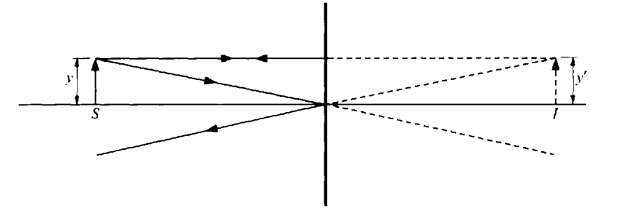
PLANE MIRROR When light from a source reaches a mirror it is reflected back into the region from which it came. None of the light reaches the region behind the mirror.
The region to the left of the mirror is the “object” region since the light originates in that region. It is also the “image” region, since any real image will be formed there as a result of the reflection from the mirror into that region. If an image is formed in the region to the right of the mirror, that image would have to be a “virtual” image, since the light never actually was found in that region. We will, in fact, find that a plane mirror normally forms a virtual image.
MAGNIFICATION We define the ratio of the image height to the object height as the magnification, defined as:
M = y’/y
where the heights are positive if they are above the base line and negative if they are below the base line. Thus, an upright image has a positive magnification, and an inverted image has a negative magnification. For the plane mirror y’ = y, and the magnification is one.
LEFT-RIGHT HANDEDNESS In the following, the image of the child is facing the child, with the front of the head nearer the mirror than the back. We note, however, that the right hand of the child is the left hand of the image. Thus, the image has a reversed appearance concerning right and left handedness. Letters are therefore reversed and difficult to read when viewed in a mirror.
CONCAVE AND CONVEX MIRRORS These are mirrors that are shaped to be part of the surface of a sphere of some radius R. These spherical mirrors can be “concave” if the center of the sphere is on the object side so that the inside surface of the sphere reflects light from the object, or “convex” if the center of the sphere is on the “negative” side so that the outside surface of the sphere reflects light from the object.
PRINCIPLE AXIS The imaginary line through the center of the sphere and the center of the mirror is called the principal axis.
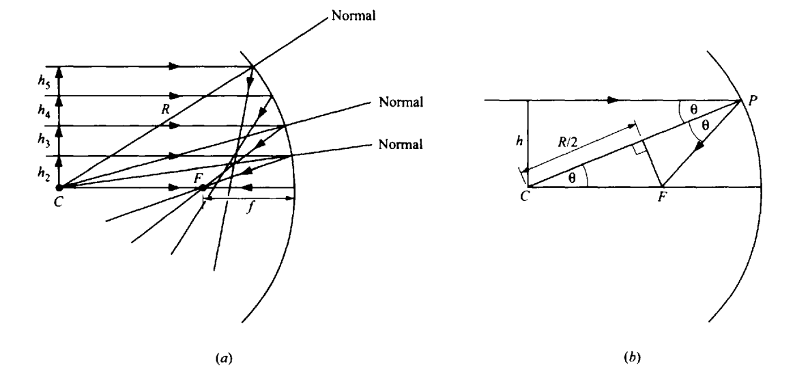
FOCAL POINT Consider a series of incident rays that are parallel to the principal axis and hence to each other. We take each incoming ray and equate the angle of reflection to the angle of incidence to get the reflected ray. We note that the parallel rays closest to the principal axis have reflected rays that intersect at nearly the same point on the axis. The common point where the rays near the principal axis meet is called the focal point, and labeled F.
PARAXIAL RAYS These are all the parallel rays near the central ray, that are reflected through nearly the same point, the focal point. For small θ, f = R/2. For a convex mirror, the paraxial rays, when reflected from the mirror, project back to a point at a distance f behind the mirror. The reverse process is also true. If rays approach the mirror at small angles to the principal axis so as to pass through the focal point (concave mirror) or to have virtual projections through the virtual focal point (convex mirror) the corresponding reflected rays are all parallel to the principal axis.
ABERRATION If a mirror is large enough that the rays further away cannot be neglected, then the mirror will not give us the imaging properties that we want, and the mirror is said to have “aberrations”. To avoid aberrations due to these non-paraxial rays, we would need a mirror formed in the shape of a paraboloid rather than a sphere. Such mirrors are used in large telescopes.
EXTENDED OBJECTS We can show the images of extended objects to be formed as follows. The image is real for a convex mirror, but virtual for convex mirror.
When the object is between the focal point and the concave mirror, the image formed is virtual and magnified as follows.
THIN LENS By this we mean a thin piece of transparent material such as glass or plastic, with two spherical surfaces generally of different radii and a common principal axis. Light is incident on the lens from one side, called the object side, and is refracted at each of the two surfaces and emerges on the other side, called the image side.
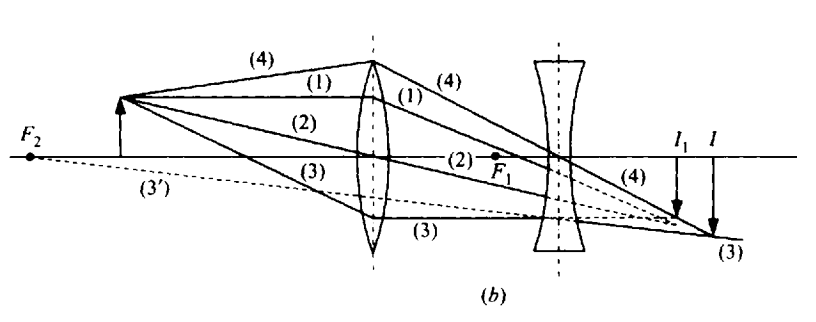
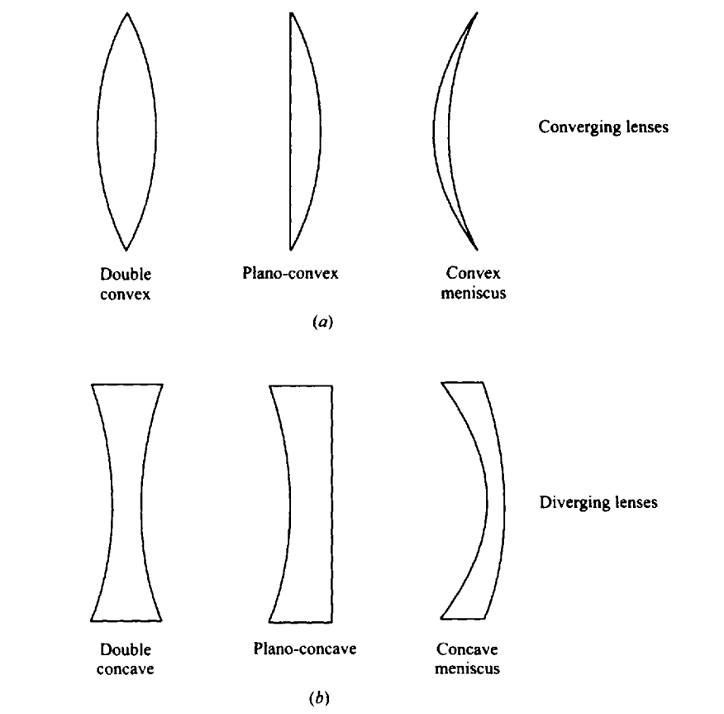
CONVERGING LENS If rays of light are incident on the lens at some angle, the converging lens will bend the transmitted light toward the principal axis. The rays coming from a point on an object and passing through the lens, converge (are focused) to a common point beyond the lens. For a converging lens, the lens is wider at the center than at the ends.
DIVERGING LENS If rays of light are incident on the lens at some angle, the diverging lens will bend the transmitted light away from the principal axis. For a diverging lens rays from a point on the object diverge when they pass through the lens, but if we trace these rays back through the lens they appear to be coming from a common point on the object side, i.e. from a virtual image. For a diverging lens, the lens is wider at the ends than at the center.
LENSMAKER’S EQUATION For a thin lens in air, made of material with an index of refraction n, and having radii R1 and R2:
where we assume light travels from left to right and radii are positive when light hits a convex surface and negative when light hits a concave surface. This is known as the Lensmaker’s equation.
MAGNIFYING GLASS A magnifying glass generally consists of a converging lens, with the object (a printed page, for instance) placed closer to the lens than the focal point. A converging lens produces a larger, virtual and upright image whenever the object distance is less than the focal length. Therefore, a person looking at written material through a converging lens will see the writing behind the magnifying glass without inversion.
ANGULAR MAGNIFICATION The magnification of magnifiers is usually expressed in terms of the “angular magnification”. If the angle subtended at the eye by the magnified image of an object is θ’, and the largest angle that the object can subtend at the naked eye and still be in focus is θ, then for small angles θ, θ’ (less than about15°) the angular magnification is expressed as θ/θ’. Angular magnification is a better measure of human perception of size increase than ordinary magnification because the size of an object, as seen by the eye, depends on the distance of the object from the eye.
CAMERA A camera basically consists of a converging lens that forms a real image on a film placed at a certain distance from the lens. Once the focal length of the lens has been chosen, the lens will form this image only for objects at the appropriate distance from the camera. By moving the lens back and forth slightly one can arrange to focus on objects at the desired distance in front of the lens. Most good cameras have multiple lenses in order to avoid some of the aberrations due to dispersion etc.
f – NUMBER The camera is often characterized by an “f-number”, such as f/8 (f number of 8), which is the ratio of the focal length to the diameter of the diaphragm. The f-number is a key factor in determining the proper exposure time needed to produce a good image on a given quality film.
THE EYE The eye is very similar to a camera in the sense that a real image is formed by a lens on the retina, where nerve endings transform the light into impulses that are transmitted to the brain for analysis. The lens of the eye is attached to muscles that can stretch the lens and change the radii of its surface, thus altering the focal length. The eye automatically and rapidly changes this focal length, as needed, within its capacity to change. This capacity generally allows a healthy eye to focus on objects from a far point (nearly infinite) to a near point (about 25 cm).
MYOPIC If the eye cannot focus on a point infinitely far away because the lens is too converging, then the eye is called myopic (nearsighted). In this case the far point has been decreased from infinity to some point nearer the eye.
HYPEROPIC If the eye cannot focus on objects too near the eye because the lens is insufficiently converging, then the eye is called hyperopic (farsighted). In this case the near point has moved too far away, as generally happens with age.
REFLEX ACTION The eye adjusts for different light intensities by automatically decreasing or increasing the diameter of the exposed portion of the lens. This is caused by reflex action to protect the eye from sudden changes in intensity.
PROJECTOR The projector is the reverse of a camera. In a camera, light from a large object is focused by a lens onto a photographic plate to form a real, inverted and smaller image. In the case of a projector, light from a slide is focused onto a screen to form a real, inverted and larger image. The slide is placed upside down in the projector. Usually a powerful light source is used to shine light through the slide. The focusing, in the case of a projector, is accomplished by moving the projection lens closer to or further away from the slide.
MICROSCOPE To increase the magnification, one can use a “compound microscope”, often called microscope for short, which consists of two or more lenses significantly separated from each other. In effect, we use a regular magnifying glass as an “eyepiece”, and a converging lens of relatively small focal length as a pre-magnifier (closer to the object) to form a larger real image that serves as the object for the eyepiece. This latter converging lens is called the “objective,” and forms an image very near the focal point of the eyepiece. The eyepiece is then used to examine this real image and form a virtual image of it near infinity, which is then viewed by the eye placed against the eyepiece. The microscope is focused by moving both the objective and the eyepiece.
TELESCOPE A telescope is generally used for viewing objects that are very distant. Because of their distance, they appear very small to the naked eye, and subtend a small angle. In order to be able to distinguish features of the object one tries to magnify this angle so that the object will appear larger. Generally, the telescope, like the microscope, is composed of two optical elements. One is the eyepiece (also called the ocular) which is a magnifying glass. The element which first receives the light from the object is again called the objective, which forms a real image of this distant object. Since the object is distant, this image is formed at nearly the focal point of the objective. This image is then magnified by the ocular and viewed by the observer, either directly or on some recording material. Telescopes with converging lenses as objectives are called refracting telescopes.
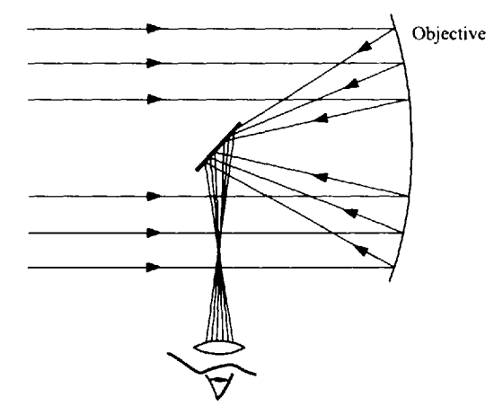
REFLECTING TELESCOPES In reflecting telescopes, the objective is a concave mirror, since large mirrors are more easily constructed than large solid lenses. We want a large diameter objective in order to gather lots of light to the image and to be able to see faint objects. In order to avoid problems with the need for paraxial rays, large telescopes usually employ parabolic surfaces. A small 45° flat mirror is used to allow the image to be observed by the ocular at 90° and out of the way of the incoming light.
In this world, there are many experts, who explain and elucidate their own doctrines, but disparage, debunk, revile and vilify the doctrines of others. So, there is perplexity and doubt as to which of these experts speak truth and which speak falsehood.
It is natural in such a situation for perplexity and doubt to exist. The situation arises from anomalies in:
Oral traditions
Lineage of teaching
Hearsay
Collection of scriptures
Logical reasoning
Inferential reasoning
Reflection of reasons
Acceptance of a view after pondering it
The seeming competence of a speaker
Regarding the speaker as your teacher
Note: An anomaly is any violation of the integrity of reality, such as, discontinuity (missing data), inconsistency (contradictory data), or disharmony (arbitrary data).
One should isolate the anomalies, and discover for oneself those things that are unwholesome. These things, if undertaken and practiced, lead to harm and suffering. Then one should abandon them. For example, Buddha himself had found that the practice of self-mortification lead to harm and suffering. Therefore, he abandoned it.
From our own direct experience we know that greed, hatred, and delusion are the three unwholesome roots, which underlie all immoral conduct and all defiled states of mind. Our aim should be the destruction of greed, hatred and delusion from within ourselves.
The practice of the following four “divine abidings” leads to wholesome conduct:
Loving-kindness: the wish for the welfare and happiness of all beings.
Compassion: empathy with those afflicted by suffering.
Altruistic joy: rejoicing in the success and good fortune of others.
Equanimity: an attitude of neutrality or impartiality towards beings.
Such a person has won the following four assurances in this very life:
One shall arise in a good destination, in a heavenly world after death, if there is another world.
If there is no other world, I shall live happily, free of enmity and ill will right here, in this very life.
Suppose evil befalls the evil-doer; then, as I do not intend evil for anyone, and do no evil deed, suffering cannot afflict me.
Suppose evil does not befall the evil-doer. Then right here I see myself purified in both respects.
.
Posted in Buddhism|Comments Off on AN 3.65 Kalama Sutta: To the Kalamas
KHTK Factor # 23: The actual universe is represented by the totality of postulates; and not by any single viewpoint.
The postulates are there to approximate the Unknowable. It is the totality of postulates that provides the approximation of the Unknowable. This we may call the universe.
Viewpoints are made up of postulates. There are many different viewpoints. None of those viewpoints provide the approximation of the Unknowable. But each provides an opinion what it might be. These opinions provide a distinct view of the universe.
A viewpoint may build upon its opinion to have its own “universe.” But such a personal universe is an altered version of the actual universe represented by the totality of postulates.
.
Scientology
Compare the above to the following factor in Scientology.
Scientology Factor # 23. The universes, then, are three in number: the universe created by one viewpoint, the universe created by every other viewpoint, the universe created by the mutual action of viewpoints which is agreed to be upheld—the physical universe.
None of the above represents the actual universe; because the viewpoint themselves are part of the actual universe.
.
Logic
The actual universe is represented by the totality of postulates.
The principle of oneness is reflected in the word “universe.” The root meaning of the word UNIVERSE is “entire, all, literally, turned into one.” At any time there is only one universe and not many.
The universe represents an approximation of the unknowable. Different viewpoints of the universe means such approximation of the Unknowable is being viewed differently. They simply indicate that there are anomalies to be resolved in that approximation.
They do not mean that there are many Unknowables; nor do they mean that there are many universes.
.
Scientology
Compare the above to the following factor in Scientology.
Scientology Factor # 22. And there are universes.
It appears that there is only one universe; though people have different ideas about that universe.
.
Logic
The principle of oneness is reflected in the word “universe.”