Author Archives: vinaire

I am originally from India. I am settled in United States since 1969. I love mathematics, philosophy and clarity in thinking.

Looking at Hallucinations

Hallucination

Looking is simply noticing what the perceptions provide in terms of sight, sound, smell, taste, touch, thought, feeling, etc. To learn to look is to learn to differentiate one thing from another. Looking is followed by a recognition of what is there.

It seems that the first level of differentiation would be in terms of senses. What is being perceived? Is it a sight, a sound, a smell, a taste, a touch, a thought or a feeling. However, a level before that might be, ‘Is it out there, or is it in the mind?’

Sometimes it is hard to make the differentiation, ‘Is it out there, or is it in the mind?’ This is especially so when nobody is around to confirm or deny it. Doubt may still persist even when somebody is around agreeing or disagreeing. Lately there have been many movies on this subject.

There is hallucination. Dictionary tells us that it is a sensory experience of something that does not exist outside the mind. The root meaning of the word ‘hallucination’ is ‘a wandering of the mind’.

Let me put this question out there,

“When the technique of ‘looking’ is applied to spot inconsistencies what happens to hallucinations?”

Or, maybe someone could provide an alternate question.

.

The Eight-Fold Path to Nirvana

Reference: The Fourth Noble Truth: Magga

The path to Nirvana is neither through the pleasures of the senses, nor through self-mortification in different forms of asceticism. The path to Nirvana is through the following actions.

(A) Wisdom

1.  Right Understanding (seeing a thing in its true nature, without name and label)

(a) The nature of life is Dukkha (suffering)

(b) The origin of Dukkha is ‘thirst’ (desire)

(c) Nirvana (the Absolute Truth) is the cessation of Dukkha

(d) The path to Nirvana

 2.  Right Thought (extended to all beings)

(a) Thoughts of selfless renunciation or detachment

(b) Thoughts of love

(c) Thoughts of non-violence

  .

(B) Ethical Conduct

 3.  Right Speech

(a) Abstain from telling lies

(b) Abstain from backbiting and slander and talk that may bring about hatred, enmity, disunity, and disharmony among individuals or groups of people.

(c) Abstain from harsh, rude, impolite, malicious and abusive language.

(d) Abstain from idle, useless and foolish babble and gossip.

(e) Do not speak carelessly: speech should be at the right time and place.

(f) If one cannot say something useful, one should keep ‘noble silence’.

 4.  Right Action

(a) Abstain from destroying life, from stealing, from dishonest dealings, and from illegitimate sexual intercourse.

(b) Always aim at promoting moral, honorable and peaceful product.

(c) Help others to lead a peaceful and honorable life in the right way.

 5.  Right Livelihood

(a) Abstain from making living through a profession that brings harm to others, such as

  • Trading in arms and lethal weapons,
  • Intoxicating drinks,
  • Poisons,
  • Killing animals,
  • Cheating, etc.

(b) Live by a profession which is honorable, blameless and innocent of harm to others.

  .

(C) Mental Discipline

 6.  Right Effort (energetic will)

(a) To prevent evil and unwholesome states of mind from arising

(b) To get rid of such evil and unwholesome states that have already arisen within a man

(c) To produce, to cause to arise, good and wholesome states of mind not yet arisen

(d) To develop and bring to perfection the good and wholesome states of mind already present in a man.

 7.  Right Mindfulness (to be diligently aware, mindful and attentive with regard to)

(a) The activities of the body.

  • Be clearly aware of breathing
  • Whether it is deep or shallow
  • Of how it appears and disappears within the body

 (b) Sensations or feelings.

  • Be clearly aware of all forms of feelings and sensations
  • Whether pleasant, unpleasant and neutral
  • Of how they appear and disappear within oneself

 (c) The activities of the mind

  • Whether one’s mind is lustful or not, given to hatred or not, deluded or not, distracted or concentrated, etc.
  • All movements of mind, how they arise and disappear.

 (d) Ideas, thoughts, conceptions and things

  • One should know their nature
  • How they appear and disappear
  •  How they are developed
  •  How they are suppressed, and destroyed, and so on

8.  Right Concentration

(a) First Stage

  • Passionate desires and certain unwholesome thoughts like sensuous lust, ill-will, languor, worry, restlessness, and skeptical doubt are discarded
  • Feelings of joy and happiness are maintained, along with certain mental activities.

(b) Second Stage

  • All intellectual activities are suppressed
  • Tranquility and ‘one-pointedness’ of mind is developed
  • The feelings of joy and happiness are still retained.

(c) Third Stage

  • The feeling of joy, which is an active sensation, also disappears
  • The disposition of happiness still remains
  • Mindful equanimity remains

(d) Fourth Stage

  • All sensations, even of happiness and unhappiness, of joy and sorrow, disappear
  • Only pure equanimity and awareness remains

This path needs to be explained in different ways in different words to different people, according to the stage of their development and their capacity to understand and follow it. These eight categories or divisions of the Path are to be developed more or less simultaneously, as far as possible according to the capacity of each individual.

.

The 2012 Transit of Venus

The 2012 Transit of Venus

A Trip Across the Solar System

.

The Third Noble Truth – The Cessation of Dukkha

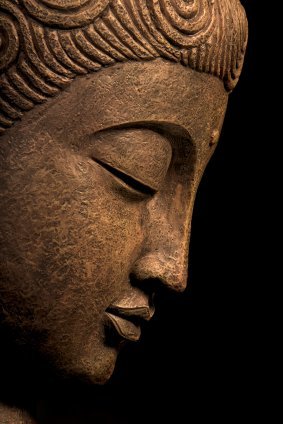
Buddha profile
[Reference: Chapter 4: The Third Noble Truth: The Cessation of Dukkha]

According to Buddha, it is possible to attain freedom from suffering, from the continuity of dukkha. This possibility may be realized with the attainment of Nirvāna. The real nature of Nirvāna is hard to describe. It can neither be perceived by the sense-organs, nor can it be conceived by the mind. Language is limited in what it can convey.

Nirvāna may be approximated by saying that it is an absence of desire or thirst, but that does not describe it fully. It may also be approximated as an absence of attachment, conditioning, illusion, hatred, conceit, etc.

No continuity of anything remains in Nirvāna. There is only the unborn, ungrown, and unconditioned.

Nirvāna may only be expressed in negative terms as neti, neti (not this, not that), because it is not something. But Nirvāna is neither negative nor positive. It is definitely no annihilation of self, because there is no self to annihilate.

Nirvāna is freedom from all evil, freedom from craving, hatred and ignorance, freedom from all terms of duality, relativity, time and space.

 .

The book “What the Buddha Taught” relates a sutta by Buddha describing approach to Nirvana as follows:

1.1       A man is composed of six elements: solidity, fluidity, heat, motion, space and consciousness. He analyses them and finds that none of them is ‘mine’, or ‘my self’.

1.2       He understands how consciousness appears and disappears, how pleasant, unpleasant and neutral sensations appear and disappear. Through this knowledge his mind becomes detached.

1.3       Then he finds within him a pure equanimity, which he can direct towards the attainment of any high spiritual state, and he knows that thus this pure equanimity will last for a long period.

1.4       But then he thinks:

(a)      ‘If I focus this purified and cleansed equanimity on the Sphere of Infinite Space and develop a mind conforming thereto, that is a mental creation.

(b)     ‘If I focus this purified and cleansed equanimity on the Sphere of Infinite Consciousness… on the Sphere of Nothingness … or on the Sphere of Neither-perception nor Non-perception and develop a mind conforming thereto, that is a mental creation.’

1.5       Then he neither mentally creates nor wills continuity and becoming, or annihilation. As he does not construct or does not will continuity and becoming, or annihilation, he does not cling to anything in the world.

1.6       As he does not cling, he is not anxious; as he is not anxious; he is completely calmed within (fully blown out within). And he knows: ‘Finished is birth, lived is pure life, what should be done is done, nothing more is left to be done.’

1.7       Now, when he experiences a pleasant, unpleasant or neutral sensation, he knows that it is impermanent, that it does not bind him, that it is not experienced with passion. Whatever may be the sensation, he experiences it without being bound to it.

1.8       He knows that all those sensations will be pacified with the dissolution of the body, just as the flame of a lamp goes out when oil and wick give out.

1.9       Buddha says, ‘Therefore, O bhikkhus, a person so endowed is endowed with the absolute wisdom, for the knowledge of the extinction of all dukkha is the absolute noble wisdom.

1.10    This deliverance, founded on Truth, is unshakable. This is Nirvana.

 .

According to Buddhism,

2.1       The Absolute Truth is that there is nothing absolute in the world, that everything is relative, conditioned and impermanent, and that there is no unchanging, everlasting, absolute substance like Self, Soul, or Ātman within or without.

2.2       The realization of this Truth (to see things as they are without illusion or ignorance is the extinction of craving ‘thirst’ of dukkha) is Nirvāna. But Nirvāna is not the result of the extinction of craving, or of anything else.

2.3       Nirvāna is beyond logic and reasoning. However much we may engage in highly speculative discussions regarding Nirvāna or Ultimate Truth or Reality, we shall never understand it that way.

2.4       Nirvāna is beyond cause and effect. TRUTH IS. NIRVĀNA IS. The only thing you can do is to see it, to realize it.

2.5       One lives the holy life with Nirvāna as its final plunge, as its goal, as its ultimate end.

2.6       “Nobody” realizes Nirvāna. There is simply an arising and cessation of existence. It is the thought that thinks. It is the realization that realizes. There is no external power that produces the arising and the cessation of dukkha.

2.7       Nirvāna is not some state, nor realm, nor position in which there is some sort of existence. There is no such thing as ‘entering into Nirvāna’. Nirvāna means complete extinction.

2.8       Wisdom, when cultivated, sees the secret. The forces which feverishly produce the continuity then become calm and incapable of producing any more karma-formations.

2.9       Nirvāna can be realized in this very life; it is not necessary to wait till you die to ‘attain’ it.

2.10    He who has realized the Truth, Nirvana, is the happiest being in the world. He is free from all ‘complexes’ and obsessions, the worries and troubles that torment others. His mental health is perfect. He does not repent the past, nor does he brood over the future. He lives fully in the present. Therefore he appreciates and enjoys things in the purest sense without self-projections. He is joyful, exultant, enjoying the pure life, his faculties pleased, free from anxiety, serene and peaceful. As he is free from selfish, desire, hatred, ignorance, conceit, and all such ‘defilements’, he is pure and gentle, full of universal love, compassion, kindness, sympathy, understanding and tolerance. His service to others is of the purest, for he has no thought of self. He gains nothing, accumulates nothing, not even anything spiritual, because he is free from the illusion of Self, and the ‘thirst’ for becoming.

 .

Questions on Buddhism

Buddha

I just received some questions on Buddhism by a student who is working on her final project for her class on Religion. These are very good questions. I would like to post these questions and answers here:

1. In your perspective, what is the way of the Buddha?

From my perspective Buddha’s way is an effort to enable a person to overcome suffering. The core of his teaching is to look at things just as they are without assuming anything.

2. What made you decide to practice Buddhism?

I am an engineer and knowledge has always fascinated me. I have studied all major religions and have looked closely at their actual applicability. I am simply practicing what makes sense to me, and what is useful. It happens to be the core ideas expressed in Buddhism. But I must say that these ideas overlap with ideas from other religions. In short, knowledge cannot be limited to any particular label.

3. Was Buddhism a natural part of your life or did you seek it out?

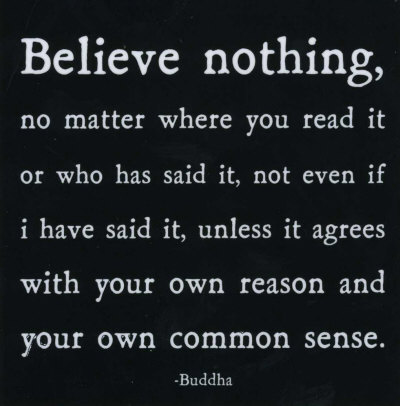
My natural tendency has always been to question what is inconsistent and to seek out consistency in understanding. This has led me to Buddhism. But even in Buddhism there are many different interpretations. I am generating my own understanding of Buddhism that appears consistent to me. Actually this is exactly what Buddha recommended. One must develop one’s own understanding.

4. What are the benefits of Buddhism to a person’s peace, soul, happiness, compassion, empathy, health, perceptions and impacts of this world?

The following is a quote from the book “BUDDHA” by Karen Armstrong,
“If you look at things just as they are, you gradually gain the insight that makes the suffering more tolerable. It does not prevent the suffering that comes from growing old, getting sick, etc., but you can be peaceful in its presence. Following those insights you naturally develop a conduct that enhances peace and happiness.”

5. How is Buddhism taught to its followers?

Buddhism is a major religion, which is now 2600 years old. At first it was taught by Buddha giving sermons to his disciples. After Buddha’s death all his teachings were written down and were made available through well-organized “sanghas.” A sangha is a community of Buddhist monks.

Today, one may study Buddhism by oneself.  There is excellent literature available on Buddhism in all different media. Buddhism is not faith based. It is knowledge-based. There is no faith-conversion required in Buddhism. A person may study Buddhism because it appeals to him or her. The person does not have to believe in Buddhism. He is not required to follow any rituals.

6. How do people worship?

There is no worship per se, because there is no God in Buddhism. There is only respect for knowledge and understanding. Buddha is revered as the founder of Buddhism. There are monasteries and temples, but these are there only to facilitate study and practice of Buddhism.

7. What does one need to do if they are interested in learning Buddhism?

There is a lot of literature available on Buddhism in its original Pali language, which is also translated in most other languages. There are many commentaries written on Buddhism. For beginners I shall recommend reading the following two books.

What the Buddha taught by Walpola Rahula
Buddha by Karen Armstrong

8. Does Buddhism proselytize?

No.

9. Are there any inconsistencies in Buddhism, such as prejudices?

None that I know of.

10. What is the success rate for those wanting to follow the Buddhist path?

At its peak Buddhism is said to have civilized three-quarters of the population of the world. Buddhism has influenced many religions that have followed since. Buddhism is a path of peace, and it has been very successful in bringing about that peace  on a social basis as well as on an individual basis.

11. How does one reach enlightenment?

One reaches enlightenment by understanding the four Noble Truths of Buddha. The fourth Noble Truth lays out an eight-fold path to follow. The following e-book describes it in simple terms:

What the Buddha taught by Walpola Rahula

.