Author Archives: vinaire

I am originally from India. I am settled in United States since 1969. I love mathematics, philosophy and clarity in thinking.

PREFACE: Basic Definitions (old)

Please see PREFACE: Basic Definitions

Preface

This book explores the universe through basic concepts, such as, matter, energy, space and time, and their definitions. These definitions are meant as propositions that offer clarifications to the basic concepts used in physics. They do not change the mathematics of the physical theories.

These definitions interpret empirical observations based on the logic of Oneness. This logic comes from the need to build a complete picture of the universe. It may be described as the constraint of continuity, consistency, and harmony in defining all universal phenomena. This logic was insisted upon by Michael Faraday in his paper, ON THE CONSERVATION OF FORCE, available at the Proceedings of the Royal Institution, Vol. II. p. 352.

Faraday postulated “lines of force” that spread from the centers of the atoms to the far reaches of space. The highly concentrated lines of force at the core of the atom appeared as MASS. The continually lessening concentration of lines of force beyond that core appeared as ENERGY.

Faraday’s concept of FORCE describes how the universe interfaces with our senses. To us, anything substantial enough to be sensed constitutes SUBSTANCE. Thus, Faraday looked at both energy and mass as forms of substance.

Einstein admired Faraday greatly. Fifty years after Faraday implied the equivalence of mass and energy, Einstein established that equivalence mathematically with his theory of relativity. Faraday’s concept of lines of force is still with us in the form of quantum fields.

Presently, we have two fundamental theories in physics:

  1. Einstein’s theory of General Relativity
  2. Standard Model of Particle Physics.

These two theories are highly successful in explaining the universe; but they are considerably at variance mathematically, when it comes to explaining the phenomenon of gravity. A possibility of resolving this variance exists if we explore Faraday’s notion of the conservation of force.

To Faraday, gravity was inconvertible in its nature and unchangeable in its manifestation. The force of gravity attested to the presence of substance. He was extending the concept of “force” beyond the mathematical definition given to it by Newton. He was expressing it as “oneness of substance.” All force is there. Only the missing force needs to be discovered.

At present, physicists have been wondering about the gravitational phenomena of dark energy and dark matter. We have no clue as to their nature; but since they are detectable as force, the dark energy and dark matter must be some form of substance.

Faraday’s concept of force, makes us see that “thought” is no less a substance than energy and matter. The notion of the “conservation of force,” or the “oneness of substance,” may then be expanded to include “thought.” Thus, thought, energy and matter may be viewed as different forms of substance.

This idea of recognizing “thought” as a substance has far-reaching implications. It opens the door to exciting new investigations.

It is highly recommend that one reads Faraday’s paper, “On the Conservation of Force.” This paper may be found at “https://vinaire.me/2017/10/27/comments-on-faradays-principle-of-force/” with comments.

.

The Attention

Reference: Subject Clearing Beingness

Attention helps us become aware of things. It is a natural attraction toward anomalies, which, when resolved, leads to better awareness.

.

Definition of ATTENTION

Attention has to do with the natural tendency toward oneness. When left to itself, attention flows towards the area which needs clarification. Such an area could be missing information. It may consist of contradictions. Or, it may have disharmony. Such conditions are called anomalies. Once an anomaly is resolved, the attention moves to another anomaly. 

Attention is said to be the “concentration of awareness” because awareness has to do with giving meaning to things. In other words, attention is the natural focus on things that require better definition for further clarification. Free attention is a powerful indicator of anomalies that needs to be resolved first.

.

Misconceptions

Attention is not just looking at something attractive. Beyond that attraction, there is always some anomaly waiting to be resolved.

.

The Neutron

Reference: Subject Clearing Universe

NOTE: The subject of Physics treats these fundamental particles mathematically, and it does not provide a proper visualization for them. The effort on this blog is to provide a visualization that is consistent with what is known. It does not change the mathematics of Physics.

The charged proton layer exists at the surface of the nucleus. The subsequent layers in the interior of the nucleus are uncharged. They get more condensed as they get closer to the center of the nucleus.

.

Definition of NEUTRON

Beyond the outer proton layer, the inner layers of the nucleus are uncharged and more condensed. The neutrons that are ejected from these inner layers also have a precise vortex configuration. They have slightly more mass than the protons. The mass of a free neutron is measured as 1.675 × 10⁻²⁷ kilograms. It has no charge.

Like the electron and the proton, the neutron does not exist as an independent particle within the atom because it is integrated with rest of the atom into layers of condensing substance. Therefore, it is an error to visualize neutrons as “particles” within the atom.

.

Misconception

1. It is a misconception to think that neutrons exist as independent “particles” within the atom. Neutrons form the layers very condensed substance in the interior of the nucleus. 

The Proton

Reference: Subject Clearing Universe

NOTE: The subject of Physics treats these fundamental particles mathematically, and it does not provide a proper visualization for them. The effort on this blog is to provide a visualization that is consistent with what is known. It does not change the mathematics of Physics.

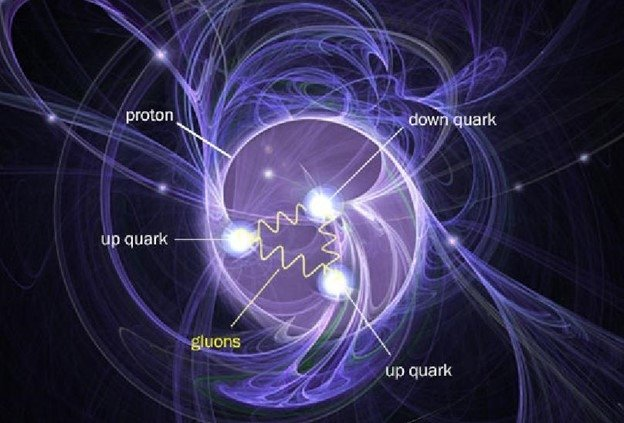
Proton refers to that consistency of substance that is under the tension to evaporate from mass back into electronic liquidity. This tension is seen as positive charge.

.

Definition of PROTON

Protons form the surface layer of the nucleus. The charge of the proton comes from the fact that it is the substance that has condensed  into mass from the electronic substance, and it can evaporate back into its previous electronic consistency. This proton layer is in equilibrium with the layer of the electronic substance immediately surrounding it.

The charge exists, because we have two very different consistencies in equilibrium, such that, the substance is being continuously exchanged between them. The exchanged substance appears as transitory particles listed under Leptons and Baryons.

When the proton layer separates itself from the atom it appears as its own little vortex called a proton. A proton has a precise configuration as well. It has the limiting consistency of mass, which is measured as 1.673 × 10⁻²⁷ kilograms. This is 1836 times more condensed than the nearest electronic layer. It is considered to have a unit positive charge measured as 1.602 × 10⁻¹⁹ coulombs. This is equal and opposite to the charge of an electron.

The proton, too, does not exist as an independent particle within the atom because it is integrated with rest of the atom into layers of condensing substance. Therefore, it is an error to visualize protons as “particles” within the atom.

.

Misconception

1. It is a misconception to think that protons exist as independent “particles” within the atom. Protons form the first layer of mass in the nucleus that is still increasing in consistency as neutrons toward the center. Proton is the first layer of the nucleus that is formed after the last electronic layer condenses.

.

The Electromagnetic Radiation

Reference: Subject Clearing Universe

NOTE: The subject of Physics treats these fundamental particles mathematically, and it does not provide a proper visualization for them. The effort on this blog is to provide a visualization that is consistent with what is known. It does not change the mathematics of Physics.

The free flowing radiant energy is called electromagnetic radiation because it is found to consist of electric and magnetic fields. It has a whole range of properties as expressed through an electromagnetic spectrum. 

.

Definition of ELECTROMAGNETIC RADIATION

Electromagnetic radiation, such as, light, is free flowing energy that has not yet condensed into spinning vortices. The consistency of the radiation is represented by its assigned “frequency.” 

The electromagnetic spectrum presents different ranges of frequencies of radiation. From lowest to highest, these ranges are called radio waves, microwaves, terahertz radiation, Infrared radiation, visible radiation, ultraviolet radiation, X-rays and Gamma rays. Gamma rays have the highest consistency. As this consistency increases the gamma rays are likely to coalesce into spinning vortices, such as, the electrons. 

The configuration of the atom exists in equilibrium with the electromagnetic spectrum. The gamma rays are seen to be emitted by the nucleus, and X-rays from inner electrons. Other frequencies of the spectrum may be seen to be emitted from the upper electronic region of the atom.

An electromagnetic radiation has a certain frequency. Any effort to change that frequency activates a restoring force similar to the inertia of matter. In an electromagnetic field, force exists because different frequencies exist side-by-side. The higher is the gradient of frequencies, the higher is the force.

.

Misconceptions

1. It is not perceived in Physics that the electromagnetic radiation is a part of the spectrum of substance. At the upper end of the electromagnetic spectrum is the spectrum of the quantum particles and matter. Below the electromagnetic spectrum is the spectrum of thought substance in the form of space.

.