Monthly Archives: April 2019

Einstein 1938: Outside and Inside the Lift

Reference: Evolution of Physics

This paper presents Chapter III, section 11 from the book THE EVOLUTION OF PHYSICS by A. EINSTEIN and L. INFELD. The contents are from the original publication of this book by Simon and Schuster, New York (1942).

The paragraphs of the original material (in black) are accompanied by brief comments (in color) based on the present understanding.  Feedback on these comments is appreciated.

The heading below is linked to the original materials.

.

Outside and Inside the Lift

The law of inertia marks the first great advance in physics; in fact, its real beginning. It was gained by the contemplation of an idealized experiment, a body moving forever with no friction nor any other external forces acting. From this example, and later from many others, we recognized the importance of the idealized experiment created by thought. Here again, idealized experiments will be discussed. Although these may sound very fantastic, they will, nevertheless, help us to understand as much about relativity as is possible by our simple methods.

We had previously the idealized experiments with a uniformly moving room. Here, for a change, we shall have a falling lift.

Imagine a great lift at the top of a skyscraper much higher than any real one. Suddenly the cable supporting the lift breaks, and the lift falls freely toward the ground. Observers in the lift are performing experiments during the fall. In describing them, we need not bother about air resistance or friction, for we may disregard their existence under our idealized conditions. One of the observers takes a handkerchief and a watch from his pocket and drops them. What happens to these two bodies? For the outside observer, who is looking through the window of the lift, both handkerchief and watch fall toward the ground in exactly the same way, with the same acceleration. We remember that the acceleration of a falling body is quite independent of its mass and that it was this fact which revealed the equality of gravitational and inertial mass (p. 37). We also remember that the equality of the two masses, gravitational and inertial, was quite accidental from the point of view of classical mechanics and played no role in its structure. Here, however, this equality reflected in the equal acceleration of all falling bodies is essential and forms the basis of our whole argument.

The acceleration of a falling body is quite independent of its mass. It is based on the gravitational field. This reveals the equality of gravitational and inertial mass.

Let us return to our falling handkerchief and watch; for the outside observer they are both falling with the same acceleration. But so is the lift, with its walls, ceiling, and floor. Therefore: the distance between the two bodies and the floor will not change. For the inside observer the two bodies remain exactly where they were when he let them go. The inside observer may ignore the gravitational field, since its source lies outside his CS. He finds that no forces inside the lift act upon the two bodies, and so they are at rest, just as if they were in an inertial CS. Strange things happen in the lift! If the observer pushes a body in any direction, up or down for instance, it always moves uniformly so long as it does not collide with the ceiling or the floor of the lift. Briefly speaking, the laws of classical mechanics are valid for the observer inside the lift. All bodies behave in the way expected by the law of inertia. Our new CS rigidly connected with the freely falling lift differs from the inertial CS in only one respect. In an inertial CS, a moving body on which no forces are acting will move uniformly for ever. The inertial CS as represented in classical physics is neither limited in space nor time. The case of the observer in our lift is, however, different. The inertial character of his CS is limited in space and time. Sooner or later the uniformly moving body will collide with the wall of the lift, destroying the uniform motion. Sooner or later the whole lift will collide with the earth, destroying the observers and their experiments. The CS is only a “pocket edition” of a real inertial CS.

In a freely falling lift, bodies remain exactly where they are, when they are let go. They act as if they are in an inertial frame.
Within a freely falling lift the acceleration cancels out the gravitational field
.

This local character of the CS is quite essential. If our imaginary lift were to reach from the North Pole to the Equator, with the handkerchief placed over the North Pole and the watch over the Equator, then, for the outside observer, the two bodies would not have the same acceleration; they would not be at rest relative to each other. Our whole argument would fail! The dimensions of the lift must be limited so that the equality of acceleration of all bodies relative to the outside observer may be assumed.

With this restriction, the CS takes on an inertial character for the inside observer. We can at least indicate a CS in which all the physical laws are valid, even though it is limited in time and space. If we imagine another CS, another lift moving uniformly, relative to the one falling freely, then both these CS will be locally inertial. All laws are exactly the same in both. The transition from one to the other is given by the Lorentz transformation.

Let us see in what way both the observers, outside and inside, describe what takes place in the lift.

The outside observer notices the motion of the lift and of all bodies in the lift, and finds them in agreement with Newton’s gravitational law. For him, the motion is not uniform, but accelerated, because of the action of the gravitational field of the earth.

However, a generation of physicists born and brought up in the lift would reason quite differently. They would believe themselves in possession of an inertial system and would refer all laws of nature to their lift, stating with justification that the laws take on a specially simple form in their CS. It would be natural for them to assume their lift at rest and their CS the inertial one.

It is impossible to settle the differences between the outside and the inside observers. Each of them could claim the right to refer all events to his CS Both descriptions of events could be made equally consistent.

We see from this example that a consistent description of physical phenomena in two different CS is possible, even if they are not moving uniformly, relative to each other. But for such a description we must take into account gravitation, building, so to speak, the “bridge” which effects a transition from one CS to the other. The gravitational field exists for the outside observer; it does not for the inside observer. Accelerated motion of the lift in the gravitational field exists for the outside observer, rest and absence of the gravitational field for the inside observer. But the “bridge”, the gravitational field, making the description in both CS possible, rests on one very important pillar: the equivalence of gravitational and inertial mass. Without this clue, unnoticed in classical mechanics, our present argument would fail completely.

We see from this example that a consistent description of physical phenomena in two different CS is possible, even if they are not moving uniformly, relative to each other. But for such a description we must take into account gravitation, building the “bridge” which effects a transition from one CS to the other. This rests on the equivalence of gravitational and inertial mass.
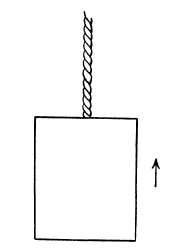
Now for a somewhat different idealized experiment. There is, let us assume, an inertial CS, in which the law of inertia is valid. We have already described what happens in a lift resting in such an inertial CS. But we now change our picture. Someone outside has fastened a rope to the lift and is pulling, with a constant force, in the direction indicated in our drawing. It is immaterial how this is done. Since the laws of mechanics are valid in this CS, the whole lift moves with a constant acceleration in the direction of the motion. Again we shall listen to the explanation of phenomena going on in the lift and given by both the outside and inside observers.

The outside observer: My CS is an inertial one. The lift moves with constant acceleration, because a constant force is acting. The observers inside are in absolute motion, for them the laws of mechanics are invalid. They do not find that bodies, on which no forces are acting, are at rest. If a body is left free, it soon collides with the floor of the lift, since the floor moves upward toward the body. This happens exactly in the same way for a watch and for a handkerchief. It seems very strange to me that the observer inside the lift must always be on the “floor”, because as soon as he jumps the floor will reach him again.

The inside observer: I do not see any reason for believing that my lift is in absolute motion. I agree that my CS, rigidly connected with my lift, is not really inertial, but I do not believe that it has anything to do with absolute motion. My watch, my handkerchief, and all bodies are falling because the whole lift is in a gravitational field. I notice exactly the same kinds of motion as the man on the earth. He explains them very simply by the action of a gravitational field. The same holds good for me.

These two descriptions, one by the outside, the other by the inside, observer, are quite consistent, and there is no possibility of deciding which of them is right. We may assume either one of them for the description of phenomena in the lift: either non-uniform motion and absence of a gravitational field with the outside observer, or rest and the presence of a gravitational field with the inside observer.

The outside observer may assume that the lift is in “absolute” non-uniform motion. But a motion which is wiped out by the assumption of an acting gravitational field cannot be regarded as absolute motion.

There is, possibly, a way out of the ambiguity of two such different descriptions, and a decision in favour of one against the other could perhaps be made. Imagine that a light ray enters the lift horizontally through a side window and reaches the opposite wall after a very short time. Again let us see how the path of the light would be predicted by the two observers.

The outside observer, believing in accelerated motion of the lift, would argue: The light ray enters the window and moves horizontally, along a straight line and with a constant velocity, toward the opposite wall. But the lift moves upward, and during the time in which the light travels toward the wall the lift changes its position. Therefore, the ray will meet at a point not exactly opposite its point of entrance, but a little below. The difference will be very slight, but it exists nevertheless, and the light ray travels, relative to the lift, not along a straight, but along a slightly curved line. The difference is due to the distance covered by the lift during the time the ray is crossing the interior.

The inside observer, who believes in the gravitational field acting on all objects in his lift, would say: there is no accelerated motion of the lift, but only the action of the gravitational field. A beam of light is weightless and, therefore, will not be affected by the gravitational field. If sent in a horizontal direction, it will meet the wall at a point exactly opposite to that at which it entered.

It seems from this discussion that there is a possibility of deciding between these two opposite points of view as the phenomenon would be different for the two observers. If there is nothing illogical in either of the explanations just quoted, then our whole previous argument is destroyed, and we cannot describe all phenomena in two consistent ways, with and without a gravitational field.

But there is, fortunately, a grave fault in the reasoning of the inside observer, which saves our previous conclusion. He said: “A beam of light is weightless and, therefore, will not be affected by the gravitational field.” This cannot be right! A beam of light carries energy and energy has mass. But every inertial mass is attracted by the gravitational field, as inertial and gravitational masses are equivalent. A beam of light will bend in a gravitational field exactly as a body would if thrown horizontally with a velocity equal to that of light. If the inside observer had reasoned correctly and had taken into account the bending of light rays in a gravitational field, then his results would have been exactly the same as those of an outside observer.

The gravitational field of the earth is, of course, too weak for the bending of light rays in it to be proved directly, by experiment. But the famous experiments performed during the solar eclipses show, conclusively though indirectly, the influence of a gravitational field on the path of a light ray.

It follows from these examples that there is a well-founded hope of formulating a relativistic physics. But for this we must first tackle the problem of gravitation.

We saw from the example of the lift the consistency of the two descriptions. Non-uniform motion may, or may not, be assumed. We can eliminate “absolute” motion from our examples by a gravitational field. But then there is nothing absolute in the non-uniform motion. The gravitational field is able to wipe it out completely.

In this experiment the light may appear to bend with respect to the lift either due to the non-uniform motion, or due to the presence of a gravitational field. A famous experiment performed during the solar eclipses show, conclusively though indirectly, the influence of a gravitational field on the path of a light ray. The light bends because it has some inertia. This shows that all external forces may be replaced by equivalent gravitational fields.

The ghosts of absolute motion and inertial CS can be expelled from physics and a new relativistic physics built. Our idealized experiments show how the problem of the general relativity theory is closely connected with that of gravitation and why the equivalence of gravitational and inertial mass is so essential for this connection. It is clear that the solution of the gravitational problem in the general theory of relativity must differ from the Newtonian one. The laws of gravitation must, just as all laws of nature, be formulated for all possible CS, whereas the laws of classical mechanics, as formulated by Newton, are valid only in inertial CS.

The problem of the general relativity theory is closely connected with that of gravitation because both motion and gravitation are the result of equilibrium of inertia for the system.

.

Final Comment

.

OT 1948: The Character of Engrams

Reference: DIANETICS: The Original Thesis

This paper presents Chapter 8 from the book DIANETICS: THE ORIGINAL THESIS by L. RON HUBBARD. The contents are from the original publication of this book by The Hubbard Dianetic Foundation, Inc. (1948).

The paragraphs of the original material (in black) are accompanied by brief comments (in color) based on the present understanding.  Feedback on these comments is appreciated.

The heading below is linked to the original materials.

.

The Character of Engrams

There are several general types of engrams. It must be understood that the mind possesses a time track of one sort or another and that this track is a specific thing. The time track of an individual will include all those things available to his analytical mind when in a light trance or during regression. However, a person can be regressed and the data which he can easily contact along his time track is definitely not engramic even if it possesses an emotional charge. Everything on this track will be rational or justified experience. It will not include engrams. It may include locks—which is to say that it may include moments of mental anguish or antagonism and may even include instants of unconsciousness which have some slight engramic command value.

The matrix model of mindfulness is more comprehensive than the time track model of Dianetics. All data merged into the mental matrix is analytical and it is available to the individual. Dianetics uses regression but there is no need for regression in mindfulness meditation. Data relevant to contemplation comes up automatically when the mind is not interfered with, and allowed to unwind at its own pace. Well-focused attention is adequate.

The content of the aberrated node is not significant. What is significant is the inconsistency which that node presents to rest of the mental matrix. In other words, the significant aspect is anything that does not make sense. As the mind sorts out the inconsistencies, charge (tension) blows off. Locks-secondary-engram is simply the gradient in which inconsistencies present themselves to be resolved. Resolution comes about as the node under attention unwinds. The contents of the node then assimilate into the matrix.

An engram has several specific, positive characteristics. It is received by the individual at some moment of physical pain. It is not available to the analyzer and it includes conceived or actual antagonism to the survival of the organism. Certain mechanics such as “forget it” may swerve a minimumly painful or unconscious experience off the time track. In that case it becomes possessed of engramic command value.

All engrams with power to derange the analytical mind and aberrate the physical body, lie off the time track and are not available to the analytical mind.

By reason of its disorganization during the moment the engram was received, or because it has been forcibly instructed that the data in the engram is not to be recalled, the analyzer cannot reach the engram by ordinary means because the data has been erroneously labelled “dangerous,” “important,” or “too painful to touch.” The engram then, by a bypass circuit, feeds hidden commands into the analyzer. By a direct instantaneous circuit it is permanently connected to the motor controls, all perceptic channels, the glands, and heart. It is awaiting a moment of low general tone, weariness, or injury when the analytical mind has reduced powers. It is also awaiting the perception of one or more of the engram’s restimulators in the environment of the organism.

At the root of engram is a shock or pain that translates as intense confusion to the mind. When the engram is received the mind is unable to process that confusion on the spot. This confusion releases when there is adequate attention and enough time to let it unwind. An individual should never be forced into the engram, especially when he is weak and tired. That will only bring the “hypnotic” effects of the engram into play.

Continuous restimulation of the engrams can, in itself, cause a low general tone which in its turn permits more engrams to become restimulated. As the reactive mind comes into a more or less completely chronic state of restimulation, the individual becomes more and more governed by this mind. His thought becomes more and more engramic and he can be seen to drop in general tone on the tone scale down to the break point which may be arbitrarily placed somewhere between 2 and 2.5 and below which lies the region of insanity.

If a person is low on the Tone Scale, and he is behaving irrationally then he has many engrams that are in an activated state. He may not be able to concentrate on them and let his mind unwind.

Engramic thought is irrational identity-thought by which the mind is made to conceive identities where only vague similarities may exist. It is necessary that the auditor thoroughly understand engramic thought, for it is with this complete irrationality of identity that he will basically deal. As he works with any preclear, he must continually employ in the bulk of his computation on the case the equation of engramic thinking.

Engramic thinking can be stated by: A equals A equals A equals A equals A.

The engram, when one or more of its restimulators is perceived in the environment during a moment of low general tone, may dramatize. The dramatization is the precise content of the engram. The aberration is the precise content of the engram. The reaction of an individual’s analytical mind when an engram is reactivated is justification.

There is reason to believe that part of this survival mechanism consists of the axiom: The analyzer must never permit an incorrect solution. The engram brings about many incorrect solutions. The analyzer may very well become entirely involved with the attempt to discover and deliver to a society, or to itself, adequate rational reasons for the behavior of the organism.

A person is irrational to the degree he is unable to differentiate among things. Since he is unable to perceive his irrationality he justifies his behavior. His irrationality may be traced through his justifications.

The analytical mind, though working from the command of the engram itself, is unaware of the source of the command. Not being able to discover the source, it introverts more and more in an effort to solve a problem which contains danger to the organism. The analytical mind tends to find the danger without and within the organism.

When a person senses that something is wrong with him, and he can’t find the reason, then he increasingly introverts.

There are five ways that the organism can react to a danger in its vicinity. It can attack it, avoid it, neglect it, run from it, or succumb to it. In just these ways can the analytical mind, which, it must be remembered, is possessed of self-determinism and will power, react to the reactive mind. As the general tone lowers, as the analytical mind becomes less and less powerful through weariness, continual reverses in general health, etc., the more and more heed it must give to the problems unsolved in the reactive mind. These are in essence unsolved problems. As such, they contain their own solutions. The analytical mind, unable to reach them, justifies the organism’s reaction to them (succumbs to them), causes the organism to attempt to flee from them, apathetically may neglect them (as in prefrontal lobotomy), avoids them in many intricate ways, or attacks them. The analytical mind is not only not certain where the experience lies on the time track, it also does not know whether the menace is within the organism or without it. So it can become entirely indiscriminate, and eventually it may achieve highly irrational solutions by which it seeks to solve the problems of the highly irrational reactive mind.

There are five ways that a person deals with a threat: attack it, avoid it, neglect it, run from it, or succumb to it. His handling of threat may become highly irrational too.

The deep sensory perception channel entering the mind is evidently equipped with an “appreciator” which sorts according to the momentary general tone or potential of the analytical mind. The higher the general tone or potential of the analytical mind the better the data in the appreciator is sorted. The appreciator circuits are evidently fully apprised of engramic content in the reactive mind and evaluate restimulators perceived in the environment against the general tone of the analytical mind. When that is low, restimulators route more or less directly to the reactive mind which instantly responds by fixed connections into the motor controls. Commands to the various members, muscles, glands and organs of the body may be sporadic or constant, producing a high variety of responses in the body. Entire vocabularies are fed into the voice circuits directly from the reactive mind when an engram is restimulated. Orders to be active or inactive are fed to other portions. The individual time track of the engram spaces the commands to the organism and a dramatization is accomplished which may contain a portion or all of the content of the engram as governed by the situation. Psychosomatic ills, hysterias, rages, tantrums, criminal acts and any and all content prejudicial to the survival of the organism in which the organism is seen to be indulging has as its source the reactive mind.

The sole and only content of the reactive mind is what exterior sources have done to the organism.

None of the content of the reactive mind is self-motivated. The auditor is then interested only in what is done to the person, not what the person himself has done, since, for purposes of auditing, the acts of the organism in its society can be discounted beyond diagnosis. Even then they are of small importance to the auditor.

The engramic node short circuits the mind when activated. Its content causes psychosomatic illnesses as well as irrational behavior. It is a systemic problem. The person cannot be blamed for it. What needs to be resolved is why the person is behaving the way he is.

An organism possessed of an analytical mind, not victimized by incapacitating disease or injury (and unimpeded) will commit no act knowingly prejudicial to the survival of the organism or other facets within the dynamics. It will combat only those dangers in society, which are actual menaces.

Whatever may be the status of the “innate moral sense,” the basic intent of the basic personality is to further various energy forms along the dynamics toward the goal. Only moments of actual dispersal of the awareness of the analytical mind permit data to be received which is prejudicial to the intent of the dynamics. Only from these “unconscious” moments can the basically stable and enormously powerful and able analytical mind be aberrated through the implantation of unanalyzed, painfully administered, and antagonistic information. It is the purpose of the auditor to find and exhaust these moments from the life of the individual. Dianetic auditing includes therefore, as its basic principle, the exhaustion of all the painfully unconscious moments of a subject’s life. By eradicating pain from the life of an individual, the auditor returns the individual to complete rationality and sanity.

The auditor should never be content with merely bringing the person back to normal. He should achieve with the person a tone 4 even though this is far in advance of the average state of society at this time. A tone 4 with his drives intact and powerful, with his rationality and intelligence increased to the optimum, becomes extremely valuable to the society, whatever his past.

Knowing this the auditor can expect a maximum result of lasting duration with any preclear not physically hopeless.

Dianetics proposes to remove all the painfully unconscious moments of a person’s life. Mindfulness focuses on the removal of all confusions. When one does the latter all painfully unconscious moments also come out in the wash. The outcome is a person who is way above normal.

The entire purpose of the auditor is to rehabilitate the basic dynamic and the normal purpose or profession of the individual whom he audits. Anything implanted by positive suggestion or “education” in the course of auditing is harmful and must be cancelled if delivered. Only the basic personality of the individual can decide and evaluate things in his environment. Therefore, hypnotism as practiced with positive suggestions should be shunned since any and all hypnotic commands with the attendant forgetter mechanisms are no more than artificially implanted engrams. Indeed, it is quite usual for the auditor to have to exhaust hypnotically implanted material received either from some hypnotist or from the analytical mind itself when the person has been operating under auto-control. Hypnotism as such does not work, and a study and short practice in Dianetics will reveal exactly why.

Any “positive suggestion” implanted in the mind through hypnotism, indoctrination or education is harmful to the individual, as it bypasses understanding and is not fully integrated into the mental matrix.

The auditor is attempting to delete the reactive mind from the individual. This reactive mind is an infestation of foreign, careless and unreasoning commands which disrupt the self-determinism of the individual to such an extent that he no longer has charge, through his analytical mind, of the organism itself but finds himself under the continual and chronic orders of unseen, never reviewed exterior forces, often and usually antipathetic to the survival of the organism.

Engrams deal with identities where no identities exist. They therefore pose many strange and irrational problems which are seen as aberrations in preclears. If a human being has been born, he can be supposed to have at least one engram. Anyone who has a birth which has not been cleared by therapy has therefore a reactive mind. There is no disgrace attached to having a reactive mind since it was thrust without his consent and without his knowledge upon an unconscious and helpless individual. Sometimes this was done by persons with the best of imaginable intentions. A person not possessed of a rational mind cannot be rationally considered to be morally responsible, no matter the demands of the current society which hitherto lacked any method of determining responsibility.

The process of birth may result in an engramic node.

The pain contained in the reactive mind is normally severe. The usual parental punishments, family complications, reprimands, minor accidents and the battle of the individual with his environment, influence but do not cause a reactive mind, nor do these things have the power to change materially the reactions of an individual.

In the background of any individual exist many hidden personalities contained in the reactive mind. Dealing in identities, the reactive mind often confuses identities of individuals. Therefore, irrational attachments and antipathies are formed by aberrated individuals who can often find no reason for such attachments or antipathies in their contemporary environment.

The content of an engram is literally interpreted, not as it was stated to the “unconscious” subject, but as it was received in its most literal phraseology and perception.

The organism possesses many inherent mechanisms and abilities by which it can learn or preserve or forward itself along the dynamics. Any one of them may be exaggerated by engrams to a point where it becomes an actual threat to the organism or impedes it. Engrams can and do aberrate all the sensory perceptions, any and all parts of the body, and the mind itself. By demanding suicide the engram can destroy the entire organism.

The error of the reactive mind was introduced by the evolution of speech, for which the basic mechanism was not designed. When all perceptics save speech formed the reactive mind, it was to some degree serviceable. With speech came such complexities of perception and such interchanges of ideas that a whole series of illusions and delusions could be derived from the reactive mind’s necessity to determine identities for purposes of emergency.

With speech the reactive mind came to possess far more power and extensive content. The analytical mind, being a delicate mechanism in some respects no matter how rugged and capable in others, then could become subjected to delusions and illusions which, however shadowy and unreal, must nevertheless be obeyed. By stripping the reactive mind of its past painful content the analytical mind may be placed in complete command of the organism.

The evolution of speech has greatly contributed to the aberrations generated by the engramic node.

The moment a man or a group becomes possessed of this ability, it becomes possessed of self-determinism. So long as these possess reactive minds, irrationalities will persist. Because it contains literal speech, no reactive mind can be conceived to be of any value whatsoever to the rational organism since the methods of that reactive mind remain intact and will continue to act to preserve the organism in times of “unconsciousness” of the analytical mind. There is no residual good in any reactive mind. It is capable of any illusion. It has no assist power along the dynamics save only to cancel or modify other reactive mind content. The source of the individual’s power and purpose is not derived from the reactive mind but from the Basic Dynamic and its eight divisions. Any auditor will establish this to his own satisfaction after he has run a very few cases.

When an individual during auditing is attempting to “hold on to his aberrations,” the auditor may be assured that that person has as part of the content of the reactive mind such phrases as, “don’t dare get rid of it,” which, identically translated, apparently applies to aberrations. It may, in fact, apply in an engram containing an attempted abortion.

The identity factor in the reactive mind may cause the analytical mind to respond irrationally in auditing and to justify the aberrations in many irrational ways. Whatever means he uses or statements he makes to avoid the exhaustion of his reactive mind is contained exactly in the reactive mind as a positive suggestion and has no application whatsoever in rational thought.

Individuality (if by that is meant a man’s desires and habits) is not traced to the reactive mind save when by individuality is meant those flagrant eccentricities which pass in Dickens for characters.

A man is much more an individual after his reactive mind has been cleared.

An individual becomes himself or herself after the confusions and flaws in the mind are cleared.

.

Final Comments

KEY WORDS: Time Track, Locks, Black Panther mechanism, birth.

The Dianetic theory says that engrams (perceptions congealed due to shock and pain and stored) are the source of all aberrations. Engram resolves when one becomes aware of its contents. Engramic content may be accessed by guessing and mimicking it. The Dianetic approach tries to dig into the mind and is dangerous. It can have unintended consequences resulting in mental conditioning.

Mindfulness says that all aberrations are caused by perceptions that could not be assimilated into the mental matrix. Such perceptions remain as unassimilated nodes, among which are engramic nodes. Such nodes may be assimilated by letting the mind unwind without interfering with it. The mindfulness approach is a more gradient approach.

Shock corrupts the functioning of the mind by congealing the perceptions of painful experience into engramic nodes. Such nodes take time to unwind. But with mindfulness approach combined with intense focus these engramic nodes may be diffused relatively quickly.

.

Einstein 1938: General Relativity

Reference: Evolution of Physics

This paper presents Chapter III, section 10 from the book THE EVOLUTION OF PHYSICS by A. EINSTEIN and L. INFELD. The contents are from the original publication of this book by Simon and Schuster, New York (1942).

The paragraphs of the original material (in black) are accompanied by brief comments (in color) based on the present understanding.  Feedback on these comments is appreciated.

The heading below is linked to the original materials.

.

General Relativity

There still remains one point to be cleared up. One of the most fundamental questions has not been settled as yet: does an inertial system exist? We have learned something about the laws of nature, their invariance with respect to the Lorentz transformation, and their validity for all inertial systems moving uniformly, relative to each other. We have the laws but do not know the frame to which to refer them.

An inertial system is a coordinate system where objects not subject to forces move in straight lines at constant speed. This aligns with Newton’s first law and forms the foundation of special relativity. In the theory of relativity, the laws of nature are consistent with Lorentz transformation. This means that neither space nor time are absolute. And that points to changes in both velocity and inertia according to some law that we need to discover.

In order to be more aware of this difficulty, let us interview the classical physicist and ask him some simple questions:

“What is an inertial system?”

“It is a CS in which the laws of mechanics are valid. A body on which no external forces are acting moves uniformly in such a CS This property thus enables us to distinguish an inertial CS from any other.”

“But what does it mean to say that no forces are acting on a body?”

“It simply means that the body moves uniformly in an inertial CS

Here we could once more put the question: “What is an inertial CS?” But since there is little hope of obtaining an answer differing from the above, let us try to gain some concrete information by changing the question:

“Is a CS rigidly connected with the earth an inertial one?”

“No, because the laws of mechanics are not rigorously valid on the earth, due to its rotation. A CS rigidly connected with the sun can be regarded for many problems as an inertial CS; but when we speak of the rotating sun, we again understand that a CS connected with it cannot be regarded as strictly inertial.”

“Then what, concretely, is your inertial CS, and how is its state of motion to be chosen?”

“It is merely a useful fiction and I have no idea how to realize it. If I could only get far away from all material bodies and free myself from all external influences, my CS would then be inertial.”

“But what do you mean by a CS free from all external influences?”

“I mean that the CS is inertial.”

Once more we are back at our initial question!

Our interview reveals a grave difficulty in classical physics. We have laws, but do not know what frame to refer them to, and our whole physical structure seems to be built on sand.

This interview reveals that the definition of inertial system needs to be expanded for a system of bodies, because no body is totally isolated.

We can approach this same difficulty from a different point of view. Try to imagine that there is only one body, forming our CS, in the entire universe. This body begins to rotate. According to classical mechanics, the physical laws for a rotating body are different from those for a non-rotating body. If the inertial principle is valid in one case, it is not valid in the other. But all this sounds very suspicious. Is it permissible to consider the motion of only one body in the entire universe? By the motion of a body we always mean its change of position in relation to a second body. It is, therefore, contrary to common sense to speak about the motion of only one body. Classical mechanics and common sense disagree violently on this point. Newton’s recipe is: if the inertial principle is valid, then the CS is either at rest or in uniform motion. If the inertial principle is invalid, then the body is in non-uniform motion. Thus, our verdict of motion or rest depends upon whether or not all the physical laws are applicable to a given CS.

Take two bodies, the sun and the earth, for instance. The motion we observe is again relative. It can be described by connecting the CS with either the earth or the sun. From this point of view, Copernicus’ great achievement lies in transferring the CS from the earth to the sun. But as motion is relative and any frame of reference can be used, there seems to be no reason for favouring one CS rather than the other.

We can differentiate the CS of sun from the CS of earth on the basis of their respective inertia. The forward velocity of earth shall be greater than the forward velocity of sun on an absolute basis because the inertia of sun is obviously greater than the inertia of earth. Einstein falsely believes, “But as motion is relative and any frame of reference can be used, there seems to be no reason for favouring one CS rather than the other.”

Physics again intervenes and changes our commonsense point of view. The CS connected with the sun resembles an inertial system more than that connected with the earth. The physical laws should be applied to Copernicus’ CS rather than to Ptolemy’s. The greatness of Copernicus’ discovery can be appreciated only from the physical point of view. It illustrates the great advantage of using a CS connected rigidly with the sun for describing the motion of planets.

No absolute uniform motion exists in classical physics. If two CS are moving uniformly, relative to each other, then there is no sense in saying, “This CS is at rest and the other is moving”. But if two CS are moving non-uniformly, relative to each other, then there is very good reason for saying, “This body moves and the other is at rest (or moves uniformly).” Absolute motion has here a very definite meaning. There is, at this point, a wide gulf between common sense and classical physics. The difficulties mentioned, that of an inertial system and that of absolute motion, are strictly connected with each other. Absolute motion is made possible only by the idea of an inertial system, for which the laws of nature are valid.

The common sense fourth coordinate of a CS shall be it rigidity or inertia by which the CS is centered in space. This is represented by time. Absolute uniform motion shall be based on zero motion for infinite inertia. Unfortunately, this is not directly recognized by the theory of relativity. It may be hidden under the math of relativity.

It may seem as though there is no way out of these difficulties, as though no physical theory can avoid them. Their root lies in the validity of the laws of nature for a special class of CS only, the inertial. The possibility of solving these difficulties depends on the answer to the following question. Can we formulate physical laws so that they are valid for all CS, not only those moving uniformly, but also those moving quite arbitrarily, relative to each other? If this can be done, our difficulties will be over. We shall then be able to apply the laws of nature to any CS. The struggle, so violent in the early days of science, between the views of Ptolemy and Copernicus would then be quite meaningless. Either CS could be used with equal justification. The two sentences, “the sun is at rest and the earth moves”, or “the sun moves and the earth is at rest”, would simply mean two different conventions concerning two different CS.

Could we build a real relativistic physics valid in all CS; a physics in which there would be no place for absolute, but only for relative, motion? This is indeed possible!

Einstein seems to think that an absolute measure of velocity is not possible; but, the theory of relativity does make it possible by using the velocity of light as an absolute reference point in reverse. A more straightforward absolute reference point shall be zero velocity at infinite inertia. Such a reference point shall be a black hole at the center of a galaxy.

We have at least one indication, though a very weak one, of how to build the new physics. Really relativistic physics must apply to all CS and, therefore, also to the special case of the inertial CS. We already know the laws for this inertial CS. The new general laws valid for all CS must, in the special case of the inertial system, reduce to the old, known laws.

The problem of formulating physical laws for every CS was solved by the so-called general relativity theory; the previous theory, applying only to inertial systems, is called the special relativity theory. The two theories cannot, of course, contradict each other, since we must always include the old laws of the special relativity theory in the general laws for an inertial system. But just as the inertial CS was previously the only one for which physical laws were formulated, so now it will form the special limiting case, as all CS moving arbitrarily, relative to each other, are permissible.

The special theory of relativity applies to inertial systems only; but the general theory of relativity formulates physical laws for all CS moving arbitrarily, relative to each other.

This is the programme for the general theory of relativity. But in sketching the way in which it was accomplished we must be even vaguer than we have been so far. New difficulties arising in the development of science force our theory to become more and more abstract. Unexpected adventures still await us. But our final aim is always a better understanding of reality. Links are added to the chain of logic connecting theory and observation. To clear the way leading from theory to experiment of unnecessary and artificial assumptions, to embrace an ever-wider region of facts, we must make the chain longer and longer. The simpler and more fundamental our assumptions become, the more intricate is our mathematical tool of reasoning; the way from theory to observation becomes longer, more subtle, and more complicated. Although it sounds paradoxical, we could say: Modern physics is simpler than the old physics and seems, therefore, more difficult and intricate. The simpler our picture of the external world and the more facts it embraces, the more strongly it reflects in our minds the harmony of the universe.

The way the general theory of relativity is accomplished is quite vague and abstract. Einstein says, “The simpler and more fundamental our assumptions become, the more intricate is our mathematical tool of reasoning.” But our final aim is always a better understanding of reality.

Our new idea is simple: to build a physics valid for all CS. Its fulfilment brings formal complications and forces us to use mathematical tools different from those so far employed in physics. We shall show here only the connection between the fulfilment of this programme and two principal problems: gravitation and geometry.

The new idea in general theory of relativity is to build a physics valid for all CS. But the way it is achieved is very abstract at the moment.

.

Final Comment

.

OT 1948: The Tone Scale

Reference: DIANETICS: The Original Thesis

This paper presents Chapter 7 from the book DIANETICS: THE ORIGINAL THESIS by L. RON HUBBARD. The contents are from the original publication of this book by The Hubbard Dianetic Foundation, Inc. (1948).

The paragraphs of the original material (in black) are accompanied by brief comments (in color) based on the present understanding.  Feedback on these comments is appreciated.

The heading below is linked to the original materials.

.

The Tone Scale

The tone scale denotes numerically, first the status of an engram in the reactive mind, next its erasure or reduction, and provides a measure for sanity in an individual.

The derivation of this scale is clinical and is based upon observation of engrams being worked. When an engram is located and developed, the extreme range it can follow begins with apathy, develops into anger (or the various facets of antagonism), proceeds into boredom, and arrives at last in cheerfulness or vanishes utterly.

The tone scale is essentially an assignation of numerical value by which individuals can be numerically classified. It is not arbitrary but will be found to approximate some actual governing law in nature.

Zero is equivalent to death. An individual with a zero tone would be dead.

Ranging upwards from zero to one then is that emotional bracket which may be denoted as apathy along its graduated scale from death to the beginnings of apathetic resentment.

From one to two is the range of antagonism, including suspicion, resentment, and anger.

Boredom and its equivalents, by which is denoted minor annoyance, begin at two and end at three.

From three to four are the emotions which range from carelessness to cheerfulness.

The term tone four denotes a person who has achieved rationality and cheerfulness.

Each engram residual in the reactive mind has its own independent tonal value. Serious engrams will be found in the apathy range. Dangerous engrams will be found in the anger range. Above two point five an engram could not be considered to have any great power to affect the analytical mind. Each engram in the reactive mind then can be said to possess a tone value. The composite sum of these engrams will give, if added, a numerical value to the reactive mind.

Engrams can be computed as they lie along the dynamics, and to each dynamic may be assigned a tone. The sum of the tones of the dynamics, divided by the number of the dynamics, will give a potential numerical value for an individual. This, of course, is variable depending on the existence of restimulators in his environment to reactivate the engrams.

The probable average of mankind at this writing may be in the vicinity of 3.0. Complete rationality depends upon exhaustion of the reactive mind and complete rationality is invariably the result of reaching tone four.

The initial diagnosis is done by the assignation of a general tone to denote the condition of an individual’s reactive mind. His methods of meeting life, his emotional reaction to the problems in his environment, can be evaluated by the use of the tone scale.

In auditing, as will be covered later, an engram normally can be expected to run from its initial value in the apathy or anger range to tone four. Very shortly after it reaches tone four it should vanish. If it vanishes without attaining the laughter of tone four it can be assumed that the individual’s basic engram has not been erased.

The tone scale has value in auditing and should be thoroughly understood.

.

Final Comments

KEY WORDS: Tone, Tone Scale, Tone Four.

A person’s tone generally changes in the following sequence as he improves:

0 to 1 ………. Range of Apathy
1 to 2 ………. Range of Antagonism
2 to 3
………. Range of Boredom
3 to 4 ………. Range of Cheerfulness

A dead person is assigned a tone level of 0. A person who has achieved rationality and cheerfulness is assigned the tone level of 4. In general, a person has a chronic tone level somewhere between 0 and 4. His actual tone fluctuates around this chronic tone level. The chronic tone level can be improved with mindfulness meditation. Dianetics auditing is a form of guided meditation.

When you are handling an engramic node in meditation or in auditing, your tone may reflect the tone of the painful experience but it will soon discharge with the real tone taking its place. The more the tones from the painful incidents are discharged, the greater is the improvement in the real tone. Progress may be measured by the improvement in the real tone.

.

Einstein 1938: The Time-Space Continuum

Reference: Evolution of Physics

This paper presents Chapter III, section 9 from the book THE EVOLUTION OF PHYSICS by A. EINSTEIN and L. INFELD. The contents are from the original publication of this book by Simon and Schuster, New York (1942).

The paragraphs of the original material (in black) are accompanied by brief comments (in color) based on the present understanding.  Feedback on these comments is appreciated.

The heading below is linked to the original materials.

.

The Time-Space Continuum

“The French revolution began in Paris on the 14th of July 1789.” In this sentence the place and time of an event are stated. Hearing this statement for the first time, one who does not know what “Paris” means could be taught: it is a city on our earth situated in long. 2° East and lat. 49° North. The two numbers would then characterize the place, and “14th of July 1789” the time, at which the event took place. In physics, much more than in history, the exact characterization of when and where an event takes place is very important, because these data form the basis for a quantitative description.

For the sake of simplicity, we considered previously only motion along a straight line. A rigid rod with an origin but no end-point was our CS Let us keep this restriction. Take different points on the rod; their positions can be characterized by one number only, by the co-ordinate of the point. To say the co-ordinate of a point is 7.586 feet means that its distance is 7.586 feet from the origin of the rod. If, on the contrary, someone gives me any number and a unit, I can always find a point on the rod corresponding to this number. We can state: a definite point on the rod corresponds to every number, and a definite number corresponds to every point. This fact is expressed by mathematicians in the following sentence: all points on the rod form a one-dimensional continuum. There exists a point arbitrarily near every point on the rod. We can connect two distant points on the rod by steps as small as we wish. Thus the arbitrary smallness of the steps connecting distant points is characteristic of the continuum.

All points on the rod form a one-dimensional continuum. The arbitrary smallness of the steps connecting distant points is characteristic of the continuum.

Now another example. We have a plane, or, if you prefer something more concrete, the surface of a rectangular table. The position of a point on this table can be characterized by two numbers and not, as before, by one. The two numbers are the distances from two perpendicular edges of the table. Not one number, but a pair of numbers corresponds to every point on the plane; a definite point corresponds to every pair of numbers. In other words: the plane is a two-dimensional continuum. There exist points arbitrarily near every point on the plane. Two distant points can be connected by a curve divided into steps as small as we wish. Thus the arbitrary smallness of the steps connecting two distant points, each of which can be represented by two numbers, is again characteristic of a two-dimensional continuum.

The plane is a two-dimensional continuum.

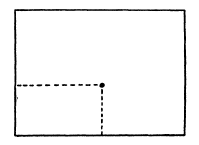
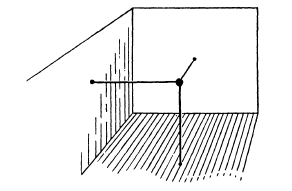
One more example. Imagine that you wish to regard your room as your CS This means that you want to describe all positions with respect to the rigid walls of the room. The position of the end-point of the lamp, if the lamp is at rest, can be described by three numbers: two of them determine the distance from two perpendicular walls, and the third that from the floor or ceiling. Three definite numbers correspond to every point of the space; a definite point in space corresponds to every three numbers. This is expressed by the sentence: Our space is a three-dimensional continuum. There exist points very near every point of the space. Again the arbitrary smallness of the steps connecting the distant points, each of them represented by three numbers, is characteristic of a three-dimensional continuum.

Our space is a three-dimensional continuum.

But all this is scarcely physics. To return to physics, the motion of material particles must be considered. To observe and predict events in nature we must consider not only the place but also the time of physical happenings. Let us again take a very simple example.

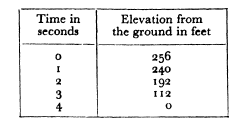
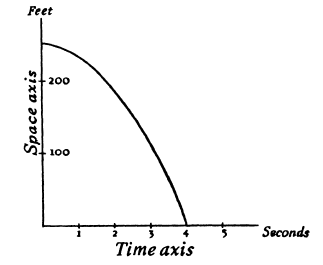
A small stone, which can be regarded as a particle, is dropped from a tower. Imagine the tower 256 feet high. Since Galileo’s time we have been able to predict the co-ordinate of the stone at any arbitrary instant after it was dropped. Here is a “timetable” describing the positions of the stone after 0, 1,2, 3, and 4 seconds. Five events are registered in our “timetable”, each represented by two numbers, the time and space coordinates of each event. The first event is the dropping of the stone from 256 feet above the ground at the zero second. The second event is the coincidence of the stone with our rigid rod (the tower) at 240 feet above the ground. This happens after the first second. The last event is the coincidence of the stone with the earth.

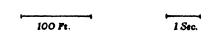
We could represent the knowledge gained from our “timetable” in a different way. We could represent the five pairs of numbers in the “timetable” as five points on a surface. Let us first establish a scale. One segment will correspond to a foot and another to a second. For example:

We then draw two perpendicular lines, calling the horizontal one, say, the time axis and the vertical one the space axis. We see immediately that our “timetable” can be represented by five points in our time-space plane.

The distances of the points from the space axis represent the time co-ordinates as registered in the first column of our “timetable”, and the distances from the time axis their space co-ordinates.

Exactly the same thing is expressed in two different ways: by the “timetable” and by the points on the plane. Each can be constructed from the other. The choice between these two representations is merely a matter of taste, for they are, in fact, equivalent.

Let us now go one step farther. Imagine a better “timetable” giving the positions not for every second, but for, say, every hundredth or thousandth of a second. We shall then have very many points on our time-space plane. Finally, if the position is given for every instant or, as the mathematicians say, if the space co-ordinate is given as a function of time, then our set of points becomes a continuous line. Our next drawing therefore represents not just a fragment as before, but a complete knowledge of the motion.

If the space co-ordinate is given as a function of time, then our set of points becomes a continuous line.

The motion along the rigid rod (the tower), the motion in a one-dimensional space, is here represented as a curve in a two-dimensional time-space continuum. To every point in our time-space continuum there corresponds a pair of numbers, one of which denotes the time, and the other the space, co-ordinate. Conversely: a definite point in our time-space plane corresponds to every pair of numbers characterizing an event. Two adjacent points represent two events, two happenings, at slightly different places and at slightly different instants.

The motion in a one-dimensional space is represented as a curve in a two-dimensional time-space continuum.

You could argue against our representation thus: there is little sense in representing a unit of time by a segment, in combining it mechanically with the space, forming the two-dimensional continuum from the two one-dimensional continua. But you would then have to protest just as strongly against all the graphs representing, for example, the change of temperature in New York City during last summer, or against those representing the changes in the cost of living during the last few years, since the very same method is used in each of these cases. In the temperature graphs the one-dimensional temperature continuum is combined with the one-dimensional time continuum into the two-dimensional temperature-time continuum.

Here we have formed a two-dimensional continuum from two one-dimensional continua.

Let us return to the particle dropped from a 256-foot tower. Our graphic picture of motion is a useful convention since it characterizes the position of the particle at an arbitrary instant. Knowing how the particle moves, we should like to picture its motion once more. We can do this in two different ways.

We remember the picture of the particle changing its position with time in the one-dimensional space. We picture the motion as a sequence of events in the one-dimensional space continuum. We do not mix time and space, using a dynamic picture in which positions change with time.

But we can picture the same motion in a different way. We can form a static picture, considering the curve in the two-dimensional time-space continuum. Now the motion is represented as something which is, which exists in the two-dimensional time-space continuum, and not as something which changes in the one-dimensional space continuum.

Both these pictures are exactly equivalent, and preferring one to the other is merely a matter of convention and taste.

Nothing that has been said here about the two pictures of the motion has anything whatever to do with the relativity theory. Both representations can be used with equal right, though classical physics favoured rather the dynamic picture describing motion as happenings in space and not as existing in time-space. But the relativity theory changes this view. It was distinctly in favour of the static picture and found in this representation of motion as something existing in time-space a more convenient and more objective picture of reality. We still have to answer the question: why are these two pictures, equivalent from the point of view of classical physics, not equivalent from the point of view of the relativity theory?

The answer will be understood if two CS moving uniformly, relative to each other, are again taken into account.

The relativity theory favors motion as existing in time-space, rather than the dynamic picture of motion as happenings in space.

According to classical physics, observers in two CS moving uniformly, relative to each other, will assign different space co-ordinates, but the same time coordinate, to a certain event. Thus in our example, the coincidence of the particle with the earth is characterized in our chosen CS by the time co-ordinate “4” and by the space co-ordinate “0”. According to classical mechanics, the stone will still reach the earth after four seconds for an observer moving uniformly, relative to the chosen CS But this observer will refer the distance to his CS and will, in general, connect different space co-ordinates with the event of collision, although the time co-ordinate will be the same for him and for all other observers moving uniformly, relative to each other. Classical physics knows only an “absolute” time flow for all observers. For every CS the two-dimensional continuum can be split into two one-dimensional continua: time and space. Because of the “absolute” character of time, the transition from the “static” to the “dynamic” picture of motion has an objective meaning in classical physics.

According to classical physics, observers in two CS moving uniformly, relative to each other, will assign different space co-ordinates, but the same time coordinate, to a certain event. For every CS the two-dimensional continuum can be split into two one-dimensional continua: time and space.

But we have already allowed ourselves to be convinced that the classical transformation must not be used in physics generally. From a practical point of view it is still good for small velocities, but not for settling fundamental physical questions.

According to the relativity theory the time of the collision of the stone with the earth will not be the same for all observers. The time co-ordinate and the space co-ordinate will be different in two CS, and the change in the time co-ordinate will be quite distinct if the relative velocity is close to that of light. The two-dimensional continuum cannot be split into two one-dimensional continua as in classical physics. We must not consider space and time separately in determining the time-space co-ordinates in another CS The splitting of the two-dimensional continuum into two one-dimensional ones seems, from the point of view of the relativity theory, to be an arbitrary procedure without objective meaning.

According to the relativity theory the time of the collision of the stone with the earth will not be the same for all observers. The two-dimensional continuum cannot be split into two one-dimensional continua as in classical physics.

It will be simple to generalize all that we have just said for the case of motion not restricted to a straight line. Indeed, not two, but four, numbers must be used to describe events in nature. Our physical space as conceived through objects and their motion has three dimensions, and positions are characterized by three numbers. The instant of an event is the fourth number. Four definite numbers correspond to every event; a definite event corresponds to any four numbers. Therefore: The world of events forms a four-dimensional continuum. There is nothing mysterious about this, and the last sentence is equally true for classical physics and the relativity theory. Again, a difference is revealed when two CS moving relatively to each other are considered. The room is moving, and the observers inside and outside determine the time-space co-ordinates of the same events. Again, the classical physicist splits the four-dimensional continua into the three-dimensional spaces and the one-dimensional time-continuum. The old physicist bothers only about space transformation, as time is absolute for him. He finds the splitting of the four-dimensional world-continua into space and time natural and convenient. But from the point of view of the relativity theory, time as well as space is changed by passing from one CS to another, and the Lorentz transformation considers the transformation properties of the four-dimensional time-space continuum of our four-dimensional world of events.

From the point of view of the relativity theory, time as well as space is changed by passing from one CS to another, and the Lorentz transformation considers the transformation properties of the four-dimensional time-space continuum of our four-dimensional world of events.

The world of events can be described dynamically by a picture changing in time and thrown on to the background of the three-dimensional space. But it can also be described by a static picture thrown on to the background of a four-dimensional time-space continuum. From the point of view of classical physics the two pictures, the dynamic and the static, are equivalent. But from the point of view of the relativity theory the static picture is the more convenient and the more objective.

Even in the relativity theory we can still use the dynamic picture if we prefer it. But we must remember that this division into time and space has no objective meaning since time is no longer “absolute”. We shall still use the “dynamic” and not the “static” language in the following pages, bearing in mind its limitations.

It is the integrated relationship between space and time that is unique in the theory of relativity.

.

Final Comment

It is not clear what is meant by a material object or an observer moving at the speed of light. The only thing that can move at the speed of light is a photon of light that has no mass. Massive objects cannot move at the speed of light because of their inertia. On the other hand, a massless object cannot be pushed to a higher velocity by any amount of external force because it would yield immediately.

The unique aspect of theory of relativity is the integrated relationship between space and time. This essentially is equivalent to the integrated relationship between velocity and inertia. The partial success of the theory of relativity comes from the fact that it indirectly establishes a linear relationship between inertia and velocity by extrapolating between very high and near constant inertia of matter and very high and near constant velocity of light. Awareness of observer has no part in it.

.