Rāmcharitmānas: Verses 1 – 100

Reference: Rāmcharitmānas: Introduction

This paper comments on Verses 1 – 100, from the translation of Śrī Rāmacaritamānasa. This translation is printed and published by Gita Press, Gorakhpur—273005 (INDIA) (a unit of Gobind Bhavan-Karyalaya, Kolkata).

.

Verses 1-10

Tulsidas starts his epic by talking about this dualistic world that consists of both pious and wicked souls. The world is an intermixture of good and evil. All have to play their part. Blessed are those who delight with compassion at the sight of others regardless of who or what they are. 

Contact with pious souls is the root of joy and blessings; it constitutes the very fruit and fulfillment of all endeavors. The wicked burn with jealousy and they give agonizing torment during their meeting; but they are born from this same universe as are the pious souls. Knowing this, you make loving entreaties to them with joined palms that they too must not fail to do their part. This is a remarkable sentiment—you view and accept the world as it is. 

.

Verses 11-20

According to Tulsidas, the story of Sri Rama teaches the deepest philosophy of the Vedas, and provides the ultimate support. He wants to bring the elevating story of Sri Rama to the common folks who are not part of the cultured class. He prays that he is up to the task.

Tulsidas is against discrimination by caste of those who are good. He sees asceticism as a path to spiritual attainments. Rama as a mantra brings one to the understanding of the essence of the Vedas. Here we see the charm of Bhakti as it uses stories and illustrations to explain difficult spiritual concepts. The names and forms are many, but the object itself can be grasped only with good intelligence.

.

Verses 21-30

Tulsidas describes unqualified and qualified divinity, both of which are without beginning and without parallel. The unqualified divinity is like the fire that is latent in the wood; while the qualified divinity is like the fire that is externally visible. This divinity is one, all-pervading and imperishable. It is the truth, consciousness and bliss. It is revealed through correct knowledge (complete assimilation of mental matrix). This can be attained by chanting the name of Sri Rama with total devotion and sincerity.

Jnana yoga brings swiftest results but it is the most difficult yoga. Other yogas are less difficult but take longer in terms of results. But the easiest of all is the chanting the name ‘Rāma’. When chanting the name ‘Rama’ proceed to recount the virtues of Sri Rāma. One should be fully cognizant of one’s own merits and demerits without holding anything back, while continuing to uphold the highest ideals in one’s mind. This dispels all doubts, errors and delusions and serves as a boat for crossing the stream of mundane existence. It shatters the fear of birth and death and puts an end to hell.

.

Verses 31-40

Tulsidas proceeds to tell the story of Sri Rāma as it was conceived by Siva and told to Parvati. Rāma represents the infinite universe. His virtues represent the unblemished laws of nature. The story is centered on a guileless heart and pure love. It helps one overcome the evil ways, fallacious reasoning, mischievous practices, deceit, hypocrisy and heresy prevailing in Kali Yuga. The impulses of lust, arrogance and hypocrisy positively disappear from the mind of those who hear this story. It is named Råmacaritamånasa because it is the character of Rama to be treasured in one’s mind. 

Tulsidas invokes Siva and Parvati before narrating Råmacaritamånasa. Råmacaritamånasa consists of seven books that describe spiritual enlightenment, dispassion and reason; the four ends of human existence; the reasoned exposition of Jnåna and vijnåna; the nine sentiments of poetry; Japa, austerity, Yoga and detachment from the world; and much more. It does talk about pleasure of the senses. It does not mention various occupations and entanglements of domestic life. It does not encourage infatuation, arrogance and pride. It does not deal with sophism. Those who keep bad company cannot obtain the thrill of joy that this narrative provides.

One should have piety and must enjoy the company of saints.  If not, then one would suffer from drowsiness and stupor, and not benefit from the study of Rāmacaritamānasa. He would just become critical, and suffers agony of the fiercest kind.

.

Verses 41-50

Tulsidas explains how the Divine took the mortal form of Sri Rama with the purpose to kill Ravana, the demon king of Lanka. In truth, Sri Rama is no other than the Supreme Eternal who is all-pervading and ever free, who is the Ruler of all the worlds and the Lord of Måyå. The formula for grasping this Supreme Eternal is “neti neti” (neither this, nor that).

Various events in Sri  Rama’s story are associated with the seasons of the year. The story teaches that gratification lies in pursuit of spiritual freedom, and not in pursuit of sensuous pleasure. 

.

Verses 51-60

Tulsidas narrates the story when a lesser divinity doubted the ultimate divinity of Sri Rama. She used charmed deception to test Rama, but Rama not only could readily see through that deception, but he could create wonderful and bewildering Maya of his own. The divinity testing Rama was totally ashamed. The lesson is that devotion must be total, or it is not devotion. There must not be any pretensions or self-deception to suppress one’s doubts. Any feelings of guilt and regret can be overcome through deep meditation.

The characters of such stories live for many thousands of years indicating that they represent natural principals and the relationships among them. For example, spearheading bold initiatives is represented by male energy, and the organization that follows is represented by female energy.

.

Verses 61-70

Tulsidas narrates the story of Sati whose parents didn’t like her consort Shiva. Sati gave her life by jumping into fire in protest against her parents. The story seems to express the cry of spiritualism against materialism because Shiva represents detached wisdom (Jnana Yoga) to which materialism is opposed. Sati was reborn as Parvati. Parvati took the difficult path Jnana yoga, which was rare among the women of her time. Her parents, though anxious, cooperated with her wishes to follow such a path of austerity. The rebirth of Sati as Parvati seems to represent the resurgence of spirituality in ancient India.

.

Verses 71-80

Austerities are both mental and physical. They involve concentration and constant practice for long, long time. Actions responsible for creation, sustenance and dissolution require strict discipline. Such discipline comes from completely willing practice of austerities. Such practice becomes easier when one has support. With austerities one’s body may become emaciated, but that does not cause any difficulty to the person or bother him in some way.

A person knows when he has attained the ultimate freedom through Samadhi. Doubts may be there but he mostly knows the right thing to do next. You must have faith in the words of your guru; then you can easily attain happiness or success. The universe is completely devoted to its nature. All that is natural is that way because that is the only way it can be. 

.

Verses 81-90

Lust or the passion of love is so strong that when it is triggered no discrimination is left. When it takes hold of the mind the sense of discrimination is swept away even in sages and the yogis. Under the thrall of lust nobody can remain self-possessed except those protected by the ultimate absorption of Yoga. Shiva represents the highest attainment of Yoga, and it was Parvati’s aim to attain it. Parvati and Siva together present the dichotomy of the presence of Maya and the contemplation and overcoming of it.

.

Verses 91-100

Tulsidas narrates the story of Shiva’s wedding with Parvati. The third eye of Shiva represents the ability to see things as they are, because when you do that, the maya (illusion) disappears and you are confronted with the actual reality. Shiva’s procession full of attendants of strange shapes and forms seems to represent the actual reality that must be confronted. Gods disappeared from Shiva’s procession, may be because they provide a pleasant outward appearance. On Parvati’s parents city everything was pleasant and perfect as you would expect in a King and Queen’s wedding.

It is maya (illusion) that makes reality bearable. As one approaches the ultimate reality through yoga it take much courage to confront it. The ultimate reality could be so unexpected and horrifying that the yogi may go into doubt even about his aspirations. The attachment to the universe hides the reality and directs blame elsewhere. The highest truth lies in the attainment of the ultimate reality. 

Tulsidas uses the the utopia of the ancient Indian culture to describe Shiva and Parvati’s wedding. This beautiful appearance of the universe is Maya. But within that Maya is the deep aspiration to see things as they are. This is the meaning of the wedding of Parvati to Shiva.

.
Rāmcharitamānas

[From Wikipedia]

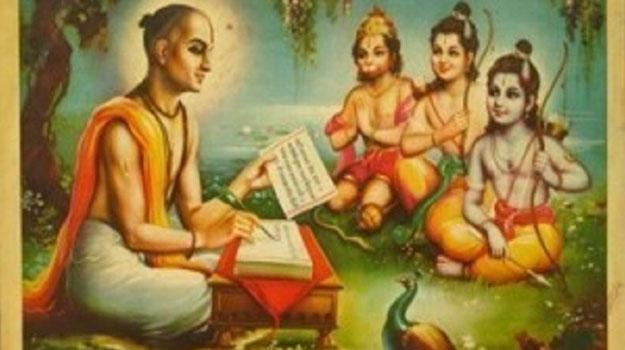
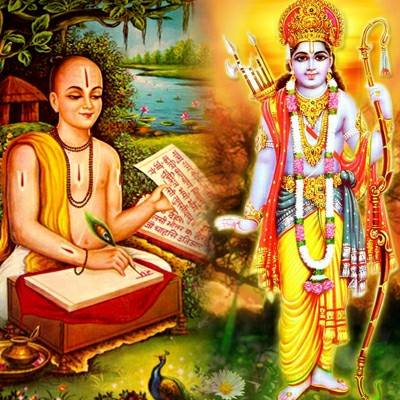
Ramcharitmanas (Devanagari: श्रीरामचरितमानस Rāmacaritamānasa), is an epic poem in the Awadhi language, composed by the 16th-century Indian bhakti poet Tulsidas (c. 1532–1623). (This work is also called, in popular parlance, Tulasi Ramayana.) The word Ramcharitmanas literally means “Lake of the deeds of Rama”. It is considered one of the greatest works of Hindu literature. The work has variously been acclaimed as “the living sum of Indian culture”, “the tallest tree in the magic garden of medieval Indian poetry”, “the greatest book of all devotional literature” and “the best and most trustworthy guide to the popular living faith of the Indian people”.

Tulsidas was a great scholar of Sanskrit. However, he wanted the story of Rama to be accessible to the general public, as many Apabhramsa languages had evolved from Sanskrit and at that time few people could understand Sanskrit. In order to make the story of Rama as accessible to the layman as to the scholar, Tulsidas chose to write in Awadhi. Tradition has it that Tulsidas had to face a lot of criticism from the Sanskrit scholars of Varanasi for being a bhasha (vernacular) poet. However, Tulsidas remained steadfast in his resolve to simplify the knowledge contained in the Vedas, the Upanishads and the Puranas to the common people. Subsequently, his work was widely accepted.

Ramcharitmanas, made available the story of Rama to the common man to sing, meditate and perform on. The writing of Ramcharitmanas also heralded many a cultural tradition, most significantly that of the tradition of Ramlila, the dramatic enactment of the text. Ramcharitmanas is considered by many as a work belonging to the Saguna school of the Bhakti movement in Hindi literature.

.

Comments on the Introduction by Tulsidas

Tulsidas paints a picture of the universe and its key attributes using the concrete figures from the story of Rama and the Hindu pantheon of Gods. Lord Hari represents the source of all the laws of nature. Illusion resides in how we perceive these laws and their manifestations. Such manifestation comprise of both gods and demons. The only reality comes from the intuitive understanding of these laws of nature and their source (Lord Hari).

Tulsidas is describing the gods and demons in terms of the nature existing inside and outside of human beingness. It is this nature when understood and followed can restore all abilities, even when it sounds impossible. Tulsidas prays for the understanding to arise within his bosom, so he can be one with the nature. This is Bhakti Yoga.

Devotion starts with the veneration of the Guru whose instructions about the story of Sri Rama have opened the eyes of Tulsidas to wondrous realizations. You cannot learn from a Guru unless you trust him fully and revere him. Tulsidas uses the analogy of healing with the realizations from learning. The story of Rama somehow helped to dispel all his doubts. He finally understood what a pious soul is.

.

  1. Rāmcharitmānas Verses: 1 – 100
  2. Rāmcharitmānas Verses: 101 – 200
  3. . . .

.

SADHGURU 2016: Sadhana (1-5:1)

Reference: Inner Engineering (Content)

This paper presents the summary of Part one, chapter 5.1, from the book, INNER ENGINEERING By Sadhguru. The contents are from the first edition (2016) of this book published in the United States by Spiegel & Grau, an imprint of Random House, a division of Penguin Random House LLC, New York.

The summary of the original material (in black) is accompanied by brief comments (in color) based on the present understanding.

.

Sadhana

“Don’t simply believe what you are reading. The only way to find out whether something is true or untrue is to experiment with it. Stop the internal debate and simply put it to the test. The yogic path is not a path of inherited belief; it is the path of experiment. 

“Here’s a practical way to begin. 

“When you have your next meal, do not talk to anyone around you for the first fifteen minutes. Just be in active conscious response to the food that you eat, the air that you breathe, the water that you drink. 

“As I have said earlier, your entire system is responding anyway. Just become conscious of it. This apple, this carrot, this piece of bread—don’t take them lightly. If you do not eat for a couple of days, you won’t think about God. You will only think about food. This is what is nourishing you and making your life right now. This is the very substance of your body. Respond to food absolutely, with total attention. 

“This fruit, this egg, this bread, this vegetable—they are all a part of life themselves, but they are willing to become you. Would you be willing to do this for anyone? You are not willing to lose your identity and merge into anyone. You are not even willing to surrender your little finger for someone else. Momentarily, you surrender just a little, usually when you need something. Your love affairs are the product of very calculated surrender. But food, which is a life unto itself, gives itself up completely to become a part of you.”

The instruction here is that you become conscious, in real time, of the food you eat, willingly merging into your body. 

NOTE: All drills are done in sitting position with the back straight upright, and the palms resting on the knees facing upwards. As you start the drill relax your body by taking three deep breaths and exhaling them slowly. Then, scan your body from toe to head, and head to toe, until any tenseness is minimized.

The drills are performed using japa (Sanskrit: जप), which is the meditative repetition of a mantra or a divine name. The mantra or name may be spoken softly, loud enough for the practitioner to hear it, or it may be recited silently within the practitioner’s mind. Each sitting for the drill should be at least 20 minutes long.

DRILL: Do japa using the name of the main item you ate in your last meal. Become conscious of that food item merging into your body. [See Note below.]

.

“Later, without even uttering the sentence aloud, take the simple idea—“My responsibility is limitless; if I am willing, I can respond to everything”—into the entire day. Be conscious of it until the last moment before you fall asleep and remind yourself of it the first thing when you wake up. 

“If you sustain this awareness of your limitless nature for just one full minute, you will achieve a tremendous transformation. A minute may seem very simple, but you will see it will take a certain level of application to arrive at this. Just one minute can elevate you to a different dimension of experience and function. Right now, your awareness is erratic: this moment you are aware and the next moment, you are gone. It is okay. Every hour, remind yourself. Experiment with this awareness, allow it to deepen and see what happens. 

“Conscious response brings you to a profound and enduring state of connectedness with life—not as an idea or an emotion, but life as life is. In this willing, active involvement with life, you are embraced by it and that embrace takes you to the very source of creation. 

“That is all it takes to touch the Creator—just willingness, nothing else.”

The instruction here is that you become willing to respond, in real time, to everything that appears in your environment. 

DRILL: Pick up an item, or situation, from your environment that is grabbing your attention. Do japa: “My responsibility is limitless; if I am willing, I can respond to _______ .” Do this until you feel you are willing to respond to that item, then move to another item. 

.

SADHGURU 2016: No Boundary, No Burden

Reference: Inner Engineering (Content)

This paper presents the summary of Part one, chapter 5, from the book, INNER ENGINEERING By Sadhguru. The contents are from the first edition (2016) of this book published in the United States by Spiegel & Grau, an imprint of Random House, a division of Penguin Random House LLC, New York.

The summary of the original material (in black) is accompanied by brief comments (in color) based on the present understanding.

.

No Boundary, No Burden 

Who is responsible? It’s a big question. Responsibility does not mean taking on the burdens of the world. Responsibility simply means your ability to respond. The quality of our lives is determined by our ability to respond to the varied complex situations that we encounter. If you decide, “I am responsible,” you will have the ability to respond. If you decide, “I am not responsible,” you will not have the ability to respond. It is as simple as that.

Your physical existence is possible only because of your body’s seamless ability to respond to the entire universe. It is only your thoughts and emotions that need to become conscious of the fact. Taking responsibility simply means consciously responding to the situation. Once you take responsibility, you will look for solutions; and you will become secure within yourself. 

You become angry or stressed only when you compulsively react to a situation. Then your very chemistry is altered, and your system turns toxic. Your memories of past adversities distort your perception of the present, and your thoughts, emotions, and actions become disproportionate to the stimulus. But, if you take one hundred percent responsibility for the way you are now, it is possible to transform the greatest adversity into a stepping-stone for personal growth. 

Many believe that taking responsibility compromises their freedom. Your logical mind tells you, “Give up all responsibility and you will be free.” But in your experience of life, the more you are able to respond to everything around you, the freer you are! The ability to respond gives you the freedom to act; it offers you the choice of action. If you are willing, you can respond to just about anything. But your action has to be judiciously performed, depending on a careful analysis of resources.

Responsibility is about being and not about doing. When it comes to response, it is just a question of willingness. If you are willing to respond, you will explore various options. When it comes to action, capability could play a role; but responsibility does not mean capability. Life is a moment-to-moment dialogue with the universe. You don’t have to work at making it that way. You just have to see it the way it is. 

Every subatomic particle in your body is responding in a limitless way to the great dance of energies that is the cosmos. But the mind is resisting it because it is crippled by its own limited logic. Any limitation is only on the level of biology. On the level of human consciousness, you are like a bird in a cage without a door. It is only out of long aeons of habit that you are refusing to fly free. 

The possibility of ultimate freedom may seem deeply threatening to many. It doesn’t have to be this way. “I am not responsible” makes you unwilling to get along with anyone—until you can’t even get along with yourself. It often comes to a point when you believe you are not even responsible for what is happening within yourself! What the mind forgets is that the ability to respond is the basis of life.

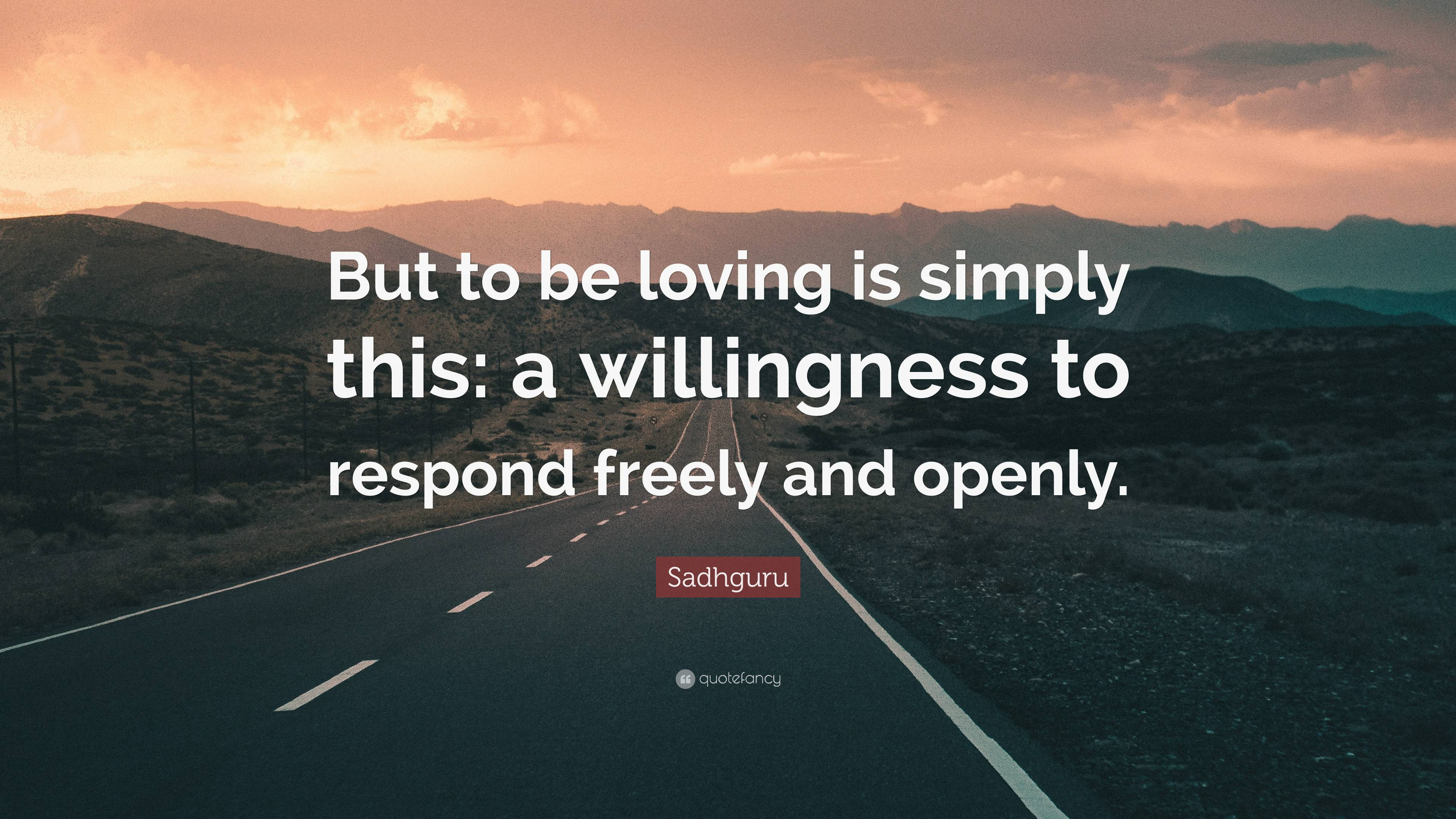
Like responsibility, to be loving is also a willingness to respond freely and openly. Right now, it may be limited to one or two people in your lives. But it is possible to extend this ability to embrace the entire world. Love is not something you do; it is just the way you are. Love has nothing to do with someone else. You are only using the other person as a key to open up what is already within you. Once you experience this inner freedom of love, you will never experience insecurity in your life again.

A fundamental step would be to recognize consciously just this: “My ability to respond is limitless, but my ability to act is limited. I am one hundred percent responsible for everything I am and everything I am not, for my capacities and my incapacities, for my joys and my miseries. I am the one who determines the nature of my experience in this life and beyond. I am the maker of my life.” 

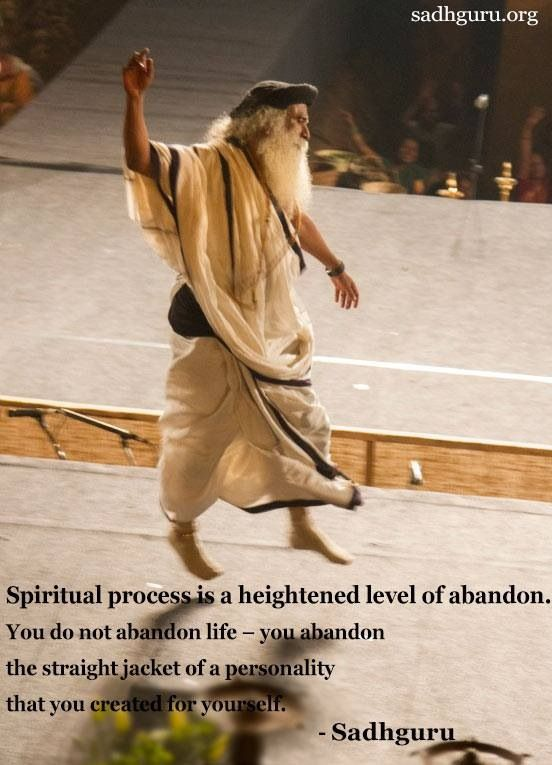
“God,” means that, which is responsible for everything in the universe. Therefore, taking unlimited responsibility is the simplest and easiest way for you to express your own divinity. The aim is to unshackle yourself from the limited identity you have forged, as a result of your own ignorance. Everything is here and now; and it lies only in one’s ability to respond

Limited responsibility is a way of drawing boundaries. Boundaries are burdensome. But if your responsibility is limitless, there is no boundary and no burden. Once you choose to become conscious of this simple fact—my ability to respond is limitless—suddenly life within you reorganizes itself in a completely different way. The inner revolution is about moving from unwillingness to willingness. You don’t have to do anything in particular. You just need to become a willing piece of life in this glorious living cosmos. 

Infinite responsibility is infinite willingness to perceive what is there. Then you can choose among the options available to you to act.

.

Durant 1926: Conclusion

Reference: The Story of Philosophy

This paper presents Chapter XI Section 3.3 from the book THE STORY OF PHILOSOPHY by WILL DURANT. The  contents are from the 1933 reprint of this book by TIME INCORPORATED by arrangement with Simon and Schuster, Inc.

The paragraphs of the original material (in black) are accompanied by brief comments (in color) based on the present understanding.

.

Conclusion

If the reader will now summarize for himself these three philosophies, he will perhaps see more justice than at first in that disregard of chronology which placed Santayana before James and Dewey. It is clearer, in retrospect, that the most eloquent and subtle of our living thinkers belongs almost wholly to the cultural traditions of Europe; that William James, though attached in many ways to that tradition, caught the spirit of at least the Eastern America in his thinking, and the spirit of all America in his style; and that John Dewey, product of East and West alike, has given philosophic form to the realistic and democratic temper of his people. It becomes evident that our ancient dependence on European thought is lessening, that we are beginning to do our own work in philosophy, literature and science, and in our own way. Merely beginning, of course: for we are still young, and we have not yet learned to walk entirely without the assistance of our European ancestry. But if we find it hard to surpass ourselves, and are sometimes discouraged with our own superficiality, our provincialism, our narrowness and our bigotry, our immature intolerance and our timid violence against innovation and experiment—let us remember that England needed eight hundred years between her foundation and her Shakespeare; and that France needed eight hundred years between her foundation and her Montaigne. We have drawn to us from Europe, and selected for survival and imitation among ourselves, rather the initiative individualist and the acquisitive pioneer than the meditative and artistic souls; we have had to spend our energies in clearing our great forests and tapping the wealth of our soil; we have had no time yet to bring forth a native literature and a mature philosophy.

It is evident that the ancient dependence on European thought is lessening, that Americans are beginning to do their own work in philosophy, literature and science, and in their own way.

But we have become wealthy, and wealth is the prelude to art. In every country where centuries of physical effort have accumulated the means for luxury and leisure, culture has followed, as naturally as vegetation grows in a rich and watered soil. To have become wealthy was the first necessity; a people too must live before it can philosophize. No doubt we have grown faster than nations usually have grown; and the disorder of our souls is due to the rapidity of our development. We are like youths disturbed and unbalanced, for a time, by the sudden growth and experiences of puberty. But soon our maturity will come; our minds will catch up with our bodies, our culture with our possessions. Perhaps there are greater souls than Shakespeare’s, and greater minds than Plato’s, waiting to be born. When we have learned to reverence liberty as well as wealth, we too shall have our Renaissance.

To have become wealthy was the first necessity; a people too must live before it can philosophize. When we have learned to reverence liberty as well as wealth in America, we too shall have our Renaissance.

.