Author Archives: vinaire

I am originally from India. I am settled in United States since 1969. I love mathematics, philosophy and clarity in thinking.

CHAPTER 7: Assistance for the Dying

Reference: DEATH: An Inside Story

“A bodiless being is a completely defenseless life. That is why that aspect of life must be conducted with utmost responsibility. When someone gives this being a little bit of help at the last moment, it will go a long way. Most of their sadhana for the next time will be taken care of at that moment itself.” ~ Sadhguru

7.1 The Importance of the Last Moments of Life

DISEMBODIED STATE
Right now, when you are in the body, you are like a river, going in one direction. When you become disembodied, it is like you evaporated and became like a cloud. Whichever way the wind blows, you will go that way. Leaving the body and losing the discretionary mind is like that. Once you die, you are just fluff, floating around according to your karmic tendencies.

BEING HUMAN
The significance of being a human is that you have the ability to discriminate and choose the course of your life. If you don’t employ that, then you are not much of a human being.

LOSING BODY
When you lose the body, your ability to discriminate is gone. All the memory and other mind-stuff are still there; only the discriminatory process is lost. The moment of death is a significant factor because whatever is the content of one’s mind at that moment— pleasantness or unpleasantness—it could multiply manifold because of the lack of discriminatory mind. Even when in the body, someone who loses their discrimination will stay depressed for long periods of time if they get into depression, while pleasant experiences will turn into addictions.

MOMENT OF DYING
In Indian culture, when someone is dying, he is supposed to chant the name of God, and not cry in distress. The idea is to generate some thought to think beyond oneself. This last dimension of thought and emotion that you create becomes the major tendency in that being. You must create an appropriate atmosphere and see how he can die peacefully. This is because these tendencies will go on for lifetimes. This is a tremendous opportunity to enhance someone’s life. 

REBIRTH
A bodiless being is a completely defenseless life. When someone gives this little being a little bit of help at this last moment, it will go a long way. When you help a person die well, all his struggles are washed off, just like that. You can make them earn what they did not earn all their life. All this can be accomplished if you can create the right situation for them and help them to die well. This is a huge contribution to that being’s life. He is born with the right quality. This is the simplest way to ensure a being is reborn pleasant.

7.2 Helping Suffering People Die

PROLONGED SUFFERING
We are seeing more and more people surviving as vegetables here for a long time. This prolonged suffering would not be there if you did not unnecessarily interfere with the process of life and go on medically pushing death. Without this, no one will stay beyond their natural time. If there is a 100 per cent medical prognosis that there is no way to recover, they can withdraw the medication.

MERCY KILLING
If you are afraid of old age and suffering, start doing some sadhana now to prepare yourself so that you can leave when you want to. You do not want to wait for that moment and ask to be given poison. You live as long as it is effective and you leave gracefully when you have to leave, not through mercy killing. If you are really progressive, you should advocate empowering individuals with the power to shed their body at will through sadhana.

PROJECTION OF LIFE
Inward projection of life energies gives you organic unity and stability of life. Outward projection gives you a strong presence and expression of life. This see-saw is naturally happening with all life, including human beings. It is always life which makes the decision to stay because the body is still hospitable. It is best to let life take its course, rather than allow people to issue a death certificate for the living.

PALLIATIVE CARE
There is need to go through pain if there is no medical need to suffer it. But if the painkillers are overly sedative and you are not even barely conscious, then it is not the best way to leave.

7.3 About Dying at Home

There is much care and effort to inform people about choking while eating; but there is nothing done on how to handle death. People think by not talking about it, by not preparing for it, it is not going to happen.

It is time we prepared ourselves to do at least a few things to ensure that this person who is dying does not have to go through unnecessary suffering. Death happens slowly; so there are certain preparations that can be made to reduce the choppiness of the moment and assist the withdrawal of life during that time. 

If you are dying at home, it is best you withdraw into a clean, white room with mild-blue light. No photographs, nothing. If there is a tinge of blue around you, this will help you to die well. Another simple thing you can do to help is to have a lamp burning twenty-four hours of the day, next to that person. A ghee lamp is preferable, but you can also use butter. This creates a certain aura so that the choppy nature of withdrawal can be regulated to some extent.

Next, you can have a chant or something with the right kind of sounds going on. These should be the kind of sounds that will touch the fundamentals of who you are. It would be even better if they are consecrated sounds or chants or mantras. And better still if you have internalized it beforehand. Internalizing a chant can be a very powerful tool in life and in death.

NOTE: This section must be read in full because there is lot of practical information here.

7.4 Rituals from Death to the Disposal of the Body

Declaring Dead
You do not diagnose someone as dead, you declare that they are dead. When you declare them dead, it is only for you that they are dead. As far as that person is concerned, in a way, all that has happened is that he or she is disembodied—they have lost their body.

The Laying Out of the Body
Even after death has happened, it is good to place the body in a north–south alignment, with the head to the north. Once you do this, certain changes happen more quickly in the physiology of the body that has been discarded. The being realizes that it is futile to hang around that particular body because it cannot access it any more. A certain distance arises between the being and the body, which is very conducive for what has to happen next for the being.

Tying the Big Toes Together
The next thing to do after death is to tie the big toes together. This will tightly close the anal outlet and Muladhara Chakra. Once this happens the being cannot get in and repossession of the body cannot happen. This will also protect the body from being used by people who are into occult practices.

Washing and Clothing the Body
The next thing to do is wash the body with water. The idea is not to just clean the body, but to facilitate the complete withdrawal of life from the body as running water has the ability to clear many aspects off the body. Now, once again, you lay the body in north–south alignment in an open space. The body is kept naked, with just a white cloth covering it.

Things Not to Do around a Dead Body
One thing is that you should not sleep near a dead body. Another thing is that one should not cook or eat near a dead body. One should also avoid unnecessary touching of the dead body. One more thing is that you do not leave the dead body alone. In India, if someone close to you dies, you are supposed to keep a ghee, butter or sesame-oil lamp burning near the body. People are supposed to sit and watch—no one leaves a dead body alone.

Paying Respects to the Dead
In almost all parts of the world, if someone is dead, people who knew the person come and pay their respects for who he or she was. But in India, a dead person is generally treated as a Divine being and one bows down to them. This is life. This is the basis of life, and with that you don’t argue. You don’t question its wisdom. You just bow down because it is way beyond you.

The Belongings of the Dead Person
When a person is dead, the articles of clothing that have been intimately in touch with their body, such as the underclothes, must be burned immediately. Other clothes, jewellery and other articles are distributed not just to one person but among many people within three days.

To Burn or Bury
If someone exits their body consciously, or even if not consciously, they at least left gently or seeped out of the system, then you can bury them. But if they were jolted out of the system, you must burn the body. If someone dies when they are still young and vibrantly alive, it is better to cremate them. Only if someone dies of old age, you can bury them. You will see if someone very dear to you is dead and their body is there, you will keep on hallucinating, ‘Maybe they are just sleeping, maybe they will sit up, maybe some miracle will happen. Maybe something else will happen.’ You know, this will go on unnecessarily. You will see people crying and a big emotional drama happening. But the moment the body is cremated, you will see everyone becomes silent. Always.

Bringing Home the Body
People have this strong sentiment that wherever the person died, his or her body should be brought home for burial or cremation. Today, we eat things which come from around the world or at least around the country and, moreover, we are loitering all over the planet. So where you are buried does not matter so much any more. It is more an emotional thing.

Cleansing the House
Whenever a death occurs in a place or a dwelling, generally, there are some cleansing processes that are to be done. This is not just for some hygiene reasons; you want to wipe off that energy completely from that place. You can do Pooja, or you can also cleanse the energy by taking a vibrant fire, like a camphor fire, all over the house. Doing some chants in that space also could be very beneficial.

Tonsuring the Head after Cremation
A common after-death Hindu ritual is tonsuring of the head of the male relatives of the deceased. This shaving of the head came into practice when people generally kept a lot of hair on their head. Long hair used to gather an aura of death. It is not necessary today for people whose hair are short.

Spreading the Ashes
After the death has happened, it can take up to forty days for the being to completely leave the body. Even if you have burned the physical body, they will look for certain elements of the body like the ash or maybe their used clothes or something that belonged to them. It could be the sweat or smell of the body because, still the realization has not come that it is over. This is not desirable, so we want to eliminate it. One of the things that is done for this is to scatter the ashes as widely as possible. The effort is to do everything possible to make the being understand that it is over. This is also for the living to understand that it is all over.

7.5 Is It All Right to Donate Organs

Even if you have not lived your life in a useful manner, in death at least you could be useful! So if someone can use the dead body, it is fine. If one has died in a certain way, by consciously exiting the body, then it is not good to dismember one’s body. But if people have died in normal ways, it is all right to do it. It has nothing to do with spirituality. It is only an emotional problem. If something is useful for someone, if they can see or live making use of it, it is okay. Moreover, for a person to die with the intention—‘Let my body be useful to ten people’—is a good thing.

7.6 Dematerializing the Body

All the after-death rituals are mainly for the right disposal of the physical body and for assisting the being in its future journey. However, there are people who help themselves and do not require any assistance from anybody for this. These are highly accomplished yogis—they not only leave their body at will, they also dematerialize it. Essentially, this body is a play of five elements: 72 per cent of it is water, 12 per cent is earth, 6 per cent is air, 4 per cent is fire and the rest is aakash. With aakash, you don’t have to do anything. If you know how to dematerialize these other things, especially the earth, you will evaporate right here. 

.
Physics II: Chapter 17

Reference: Beginning Physics II

Chapter 17: PARTICLES OF LIGHT AND WAVES OF MATTER

.

KEY WORD LIST

Localization, Interference, Energy Flow, Quantization, Light, Black Body Radiation, Photo-Electric Effect, Production of X-rays, Compton Scattering, Matter Waves, Probability Distribution, Maxwell’s Wave Equation, Schrödinger’s Equation, Dirac’s Equation, Wave Function, ­­­­Wave Packet, Uncertainty Principle, Zero Point Energy, Tunnelling.

(From KHTK) Particle, Quantum, Motion.

.

GLOSSARY

For details on the following concepts, please consult Chapter 17.

LOCALIZATION
A particle is defined as a “point”. The properties of velocity and acceleration are attributed to the whole particle. There is certainly no possibility of considering any one particle as being simultaneously at many different positions in space. A wave is defined as a disturbance that is spread over a fairly sizable area. A pure sinusoidal wave is spread out from plus to minus infinity. A pulse wave has a definite extent in space at any instance. One generally thinks of a wave as being a disturbance located simultaneously at many points of space. Therefore, the particle and wave picture differ on the question of localization.

INTERFERENCE
The interference or diffraction phenomenon is observed with waves but not with particles.

ENERGY FLOW
Both waves and particles carry energy and momentum. But there is a big difference in the mechanism of that energy flow. A wave carries this energy in a continuous fashion without discontinuous jumps in energy flow, even if the energy is greatly decreased. However, in case of particles, the energy comes in discontinuous pulses, with each pulse bringing a discrete amount of energy. The flow of energy is not uniform or continuous. This difference leads to the idea of quantization.

QUANTIZATION
In case of light, a continuously flowing wave seems to transport quantized units of energy.

LIGHT
Although the experiments on interference show that light behaves as a wave, the photo-electric effect provides the most convincing evidence that light must be considered to consist of particles. This apparent anomaly between wave and particle nature is resolved in the definitions from KHTK provided below.

BLACK BODY RADIATION
This radiation is emitted over a continuous spectrum of frequencies. It increases rapidly at lower frequencies reaching a maximum and then starts to decline. Maxwell equations explain the distribution only at lower frequencies when it is increasing rapidly. They are unable to explain the rest of the distribution. But the whole distribution can be explained when energy is seen to be radiating in quanta that are proportional to frequency.

PHOTO-ELECTRIC EFFECT
In the photo-electric effect, a beam of light is shone on a metal, with the result that electrons are emitted from the metal. However, the maximum kinetic energy of the electrons emitted is found to depend on the frequency of the incident light and not on its intensity. This means that light energy has to be absorbed in quanta in the interaction that frees the electrons.

PRODUCTION OF X-RAYS
X-rays can be produced by taking energetic electrons and letting them strike a metal plate. When these electrons stop in the metal, they emit electromagnetic radiation over a large range of wavelengths.  The surprising experimental fact is that there is a minimum wavelength that can be emitted for each V (energy of the electrons). This minimum wavelength varies inversely with V but is not affected by the electron current density. These results cannot be explained by a wave theory of light.

COMPTON SCATTERING
The X-ray beam, after it is scattered by electrons, suffers a definite reduction in frequency. Compton showed that energy of the photon, as given by its frequency, is reduced by the same amount that the kinetic energy of the recoil electron is increased. Thus, the photon is a momentum carrying corpuscle that can transfer its momentum in a given direction to the atom. The Compton effect also implies that the electron must be treated as a wave and not as a particle.

MATTER WAVES
To conform with the case of electromagnetic waves, De Broglie hypothesized that the frequency and wavelength for electrons should be determined by the same basic relations used for photons. If De Broglie’s hypothesis is true, then the electrons represented by these waves should exhibit interference and diffraction appropriate to the wavelengths associated with the electron. When experiments were performed using crystals as diffraction gratings, this diffraction was indeed seen. Similar predictions for the wavelengths of more massive particles, such as protons and neutrons, have also been experimentally verified. Thus, at small scales, there is dualism in nature between waves and particles. The velocity of the particles is equal to the group velocity of its associated wave. Planck showed that energy is connected to frequency, E = hf. De Broglie then showed that momentum is connected to wavelength, p = h/λ. This is a fundamental relation of the Quantum Theory.

PROBABILITY DISTRIBUTION
The interference of waves in the double slit experiment creates a distribution of the intensity of light. Quantum mechanics interprets this as a probability distribution of “point” particles called photons. This concept, that the only thing that we can predict is the probability of a photon’s location, is a basic concept of quantum mechanics.

MAXWELL’S WAVE EQUATION
Thus in the case of a photon, Maxwell’s wave equation gives the probability amplitude for finding a photon. This equation has to be solved to predict the behavior of the photon.

SCHRÖDINGER’S EQUATION
This is a similar equation that provides the probability amplitude for finding a non-relativistic electron.

DIRAC’S EQUATION
This equation provides the probability amplitude for finding a relativistic electron.

WAVE FUNCTION
The central idea is that there is some wave equation which has to be solved to predict the behavior of a particle. When this equation is solved for a particular case, the resulting wave (called a wave function) gives an amplitude which, when squared, is proportional to the probability distribution of the particles.

­­­­WAVE PACKET
Pulses of waves can be obtained by superposing a large number of regular traveling waves of different wavelengths. Such a pulse is called a “wave packet.” Such a packet traveling through space indeed resembles a localized particle.

UNCERTAINTY PRINCIPLE
The uncertainty principle states that if one wants to describe a particle (at a given time) as being localized in a region ∆x (i.e. have a spatial uncertainty ∆x), then that particle must have an uncertainty in its x direction momentum, ∆p, which is at least as large as h/x. Similarly, if one wants the x direction momentum to be known to within ∆p, then there must be an uncertainty in the position of the particle which is at least as large as ∆x = h/p. Of course, if p is uncertain, so is v and the kinetic energy.

ZERO POINT ENERGY
This means that particles of matter, even if the temperature is at absolute zero where there is no thermal energy, must still have an average kinetic energy related to this range of momenta. This kinetic energy at a temperature of absolute zero, is called the “zero-point energy”, and there is no way to avoid having this minimum amount of energy.

TUNNELLING
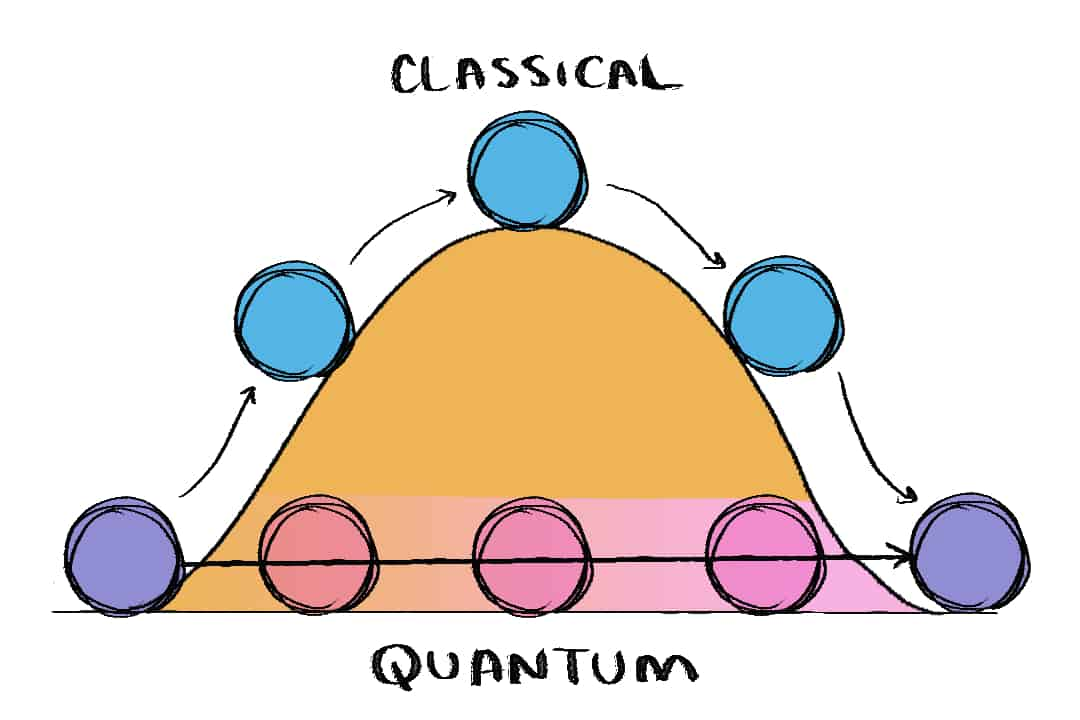
Energy uncertainty of a particle allows it to surmount the barrier from the inside to the outside of the well for the short time needed to travel and escape from the well. This process is called tunneling, since the particle appears to have dug a hole through the wall of the well and emerged on the outside. This process actually occurs in the radioactive decay of nuclei.

.

The following definitions are from the philosophy of KHTK:

PARTICLE
A particle is not a “point,” but it has a volume that is filled with substance. The substance within a particle has uniform consistency throughout. The more condensed is the substance, the smaller is the size of the particle. This predicts the relative sizes of a proton and an electron in a hydrogen atom. The size of the electron is equivalent to the size of the hydrogen atom. On the other hand, the size of the proton is roughly 2000 times smaller because its substance is that much condensed. This provides a proper visualization of the hydrogen atom, where an extremely small proton exists at the center of the only electron there is. A very condensed particle, like proton, may appear to be spherical in shape; but as the consistency of substance decreases, as in the electron, the particle is likely to expand in size and flatten into the shape of a disk.

QUANTUM
This quantum is the amount of energy involved in the process of radiating and getting absorbed. It does not necessarily mean that this energy exists in space in a pulse form. In space it may simply appear as a certain consistency (a degree of condensation) of energy.

MOTION
When the difference in condensations is very large, the condensed substance may appear as a particle next to the uncondensed substance. But if the difference in condensation is comparable, the two substances may appear as waves when set next to each other. Therefore, ‘wave’ and ‘particle’ is a matter of looking at substance at different scale of condensation. If you greatly magnify a particle, you may see waves inside it as a disturbance. The wave inside a particle may have a ‘motion’ commensurate with the condensation of its substance. This may appear to give the particle its relative speed compared to another particle.

We find that a slight change in the condensation of substance creates a huge change in the relative speed of its particle. This may be the leverage that thought has over physical movement. All animation in the body is most likely produced by infinitesimal shifts in condensations of substance. This principle may also underlie in controlling the speed and direction of the UFOs. The change in condensation must apply equally to the occupants of the UFO for intense accelerations not to be felt by them.

.

CHAPTER 6: Preparing for a Good Death

Reference: DEATH: An Inside Story

“Most people in the world believe that if they die in their sleep, it is wonderful. What a horrible way to go!” ~ Sadhguru

6.1 Does Death Need Preparation

Death is moving from the physical to the non-physical. It is the greatest moment in your life. So it is very important that you make it happen most gracefully and wonderfully. 

OPPORTUNITY
If you want to make use of the opportunity that death presents, you cannot approach it with fear. This is not something that you can handle all of a sudden at that moment. So it is important that on many levels we prepare for death beforehand. If you can manage this last conscious moment of your life gracefully, you will at least go through the disembodied phase well. You will not make it hellish.

SPIRITUAL PERSPECTIVE
From a spiritual perspective, what did not perhaps happen in life can be accomplished at the moment of death, if it is handled sensibly. This is because it is very easy to untie the knots of everything that you have accumulated at that final moment. But if you are unprepared or become fearful of it or are ignorant of the ways of life, you will create resistance towards it and miss that possibility completely.

REQUIREMENTS
You must be able to sit quietly and die. People on the spiritual path often choose the time, date and place of their death. They have created the necessary awareness within themselves so that, when the time comes, they can bundle the life energies and leave the body consciously without damaging it, just like taking off their clothes. They know where they are connected to the physical body, so they can disentangle themselves whenever the moment is right for them.

THE PROCESS
Death is never sudden. Life dribbles out, over some time. Once your senses are disconnected, you have no experience of the world or the body, but the experience of presence is still there. One can die peacefully even when the body is violently broken up in a car crash. Or one can die a violent death in bed surrounded by family having become terrified in that moment. The violence of the death is not determined by what happened to the body; it depends on what happened within that person.

LAST MOMENTS
You die peacefully when you are aware of your last moments and you are not just reacting. If you have lived a life of awareness, then it is very much possible that even at the last moment you remain aware. If this has to come, you have to build a life of awareness. Only then you can be aware in your death.

6.2 Sleep, Ojas and Death

Sadhguru says, “Fundamentally, the dynamism of the physical has to touch the inertia of the non-physical. This is the Shiva–Shakti principle. Shiva is inertia, Shakti is dynamism.” I think that choice of words here is very confusing. I like the following description.

SHIVA-SHAKTI PRINCIPLE
Shiva is the stable data, the fundamental postulate. Shakti describes the reasoning, the myriads of considerations, which can now come about because of that postulate. The whole theory of relativity depends on the postulate of a universal constant ‘c’ that is associated with the speed of light. The fundamental principle underlying any duality is that of a dimension extending to infinity in either direction. All dualities represent the two ends of a dimension. Here SHIVA is the fundamental principle of the dimension. SHAKTI is like all the dualities which can now be manifested based on the principle of dimension.

OJAS
According to Sadhguru: Ojas is “A non-physical force generated by spiritual practices.” This is based on the Shiva-Shakti principle, where spiritual practices are becoming aware of the stable data of all nature. Ojas then follows. Ojas is a Sanskrit term that can be translated as “vigor” or “essence of vitality.” In a nutshell, ojas is the vital energy that rules our immunity, strength, and happiness—three things we want to have in abundance. The more you are aware of deeper stable data, the more ojas is generated automatically. Ojas is a function of deep awareness.

SLEEP & DEATH
Sleep and death are similar in the sense that a person is transitioning from an active, wakeful state (Shakti) to a completely different state in which one is deeply engrossed (Shiva). Here you need to become aware of the state of being deeply engrossed. You can get an idea of that from deep contemplation, or meditation.

MOMENT OF DEATH
The state of mind at the moment of death determines what you will be engrossed in from then on. That state would not change until any rebirth.

6.3 Why Do People Fear Death

The fear of death is simply because we are not in touch with reality. Our identification with this body has become so strong because we have not explored other dimensions. Therefore, body has become a big issue. But if you had known something in your life that is more than the body, then shedding the body will not be a big deal for you.

6.4 How to Deal with the Fear of Death

CAUSE OF INSECURITY
Death is the universe recycling itself. During this process you have an opportunity to transcend this whole cycle. You identify yourself as a body, and only because of that, there is all this insecurity. 

CONFRONTING FEAR
If you truly experienced yourself beyond the limitations of the physical and the mental, there would be no fear. That is why you must do sadhana. Confronting your fear of death can bring tremendous clarity and transformation in your life.

CONTROLLING IMAGINATION
There are two significant faculties that human beings have—a vivid sense of memory and a vivid sense of imagination. Fear means your imagination is out of control. So it is a question of taking your faculties into your control rather than fighting fear. 

TAKING CHARGE OF PHYSIOLOGY
What is needed is taking charge of your physiological and psychological process, paying attention to the process of how we generate thoughts, how we generate emotions, how we conduct our body and how we manage our chemistry.

REMINDING YOURSELF
One thing you can do is remind yourself about death—your death. Every day, just spend five minutes reminding yourself that you are mortal and today you may die. Just remind yourself this much and this will take away your fear of death.

EXPERIENCE THE NON-DUAL
In experiencing the non-dual, the duality of life and death will become one. It is the illusion of duality and the attachment to one of them that makes death a fearful expectation—of being wrenched away from that which you know.

6.5 How to Live One’s Old Age

When you are approaching death, it is an opportunity, because when energies have become feeble and they are progressing towards dropping the body, it is much easier to become aware of the nature of your existence. You can see the distinction between what is you and what is your body with greater clarity. When the time comes, the best place to die is always under the open sky, not the hospital. 

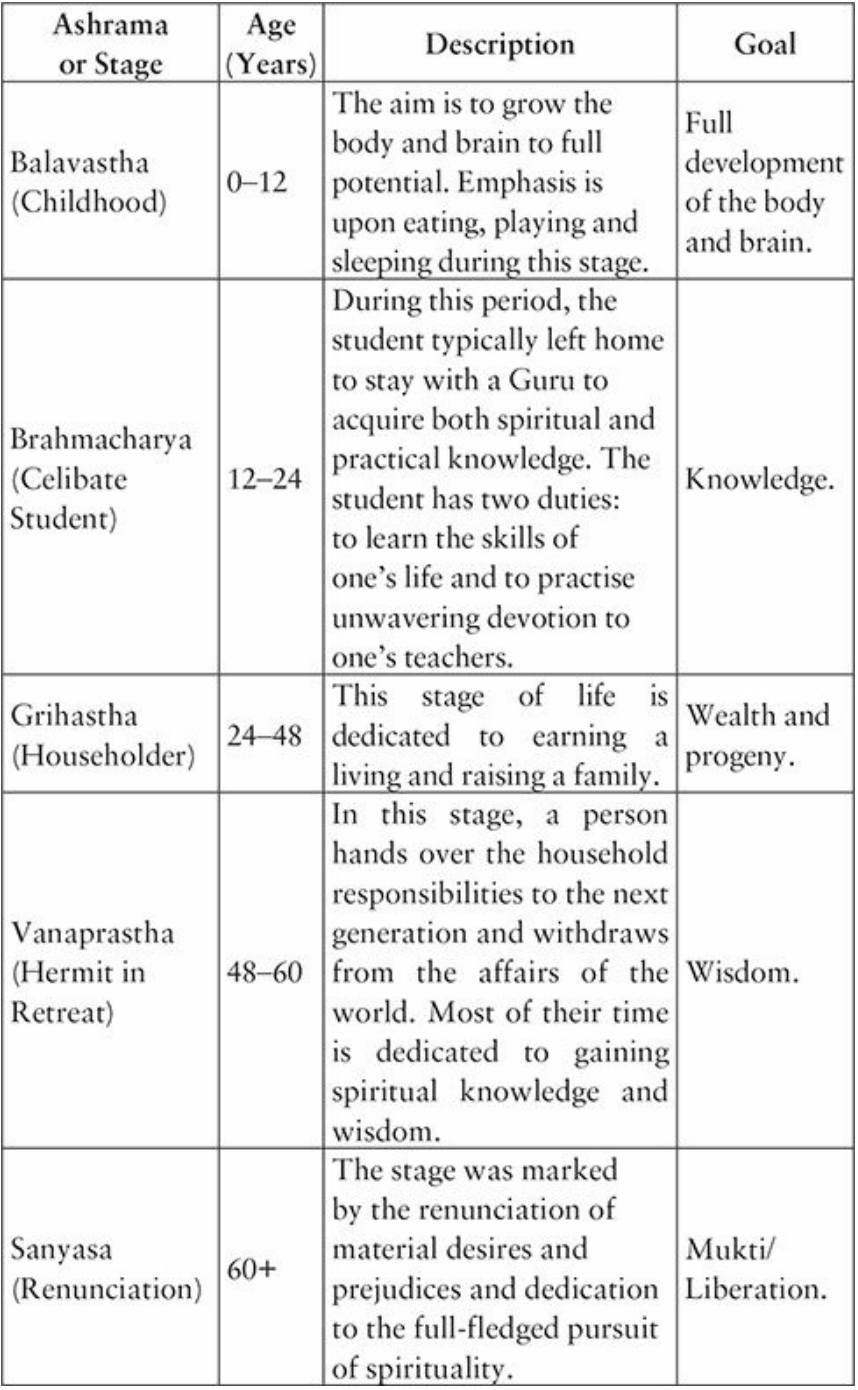
6.6 The Wisdom of Vanaprastha Ashrama

In ancient India, when couples took up Vanaprastha Ashrama, they often withdrew together and lived a very simple ‘back-to-basics’ kind of life, until their death. This was to ensure that they died well or had a good death.

Essentially, the idea of Vanaprastha Ashrama was to withdraw from a place that has four walls. Even if you don’t understand this, your body will understand this very clearly when you sleep outdoors as to how vulnerable it is. Vanaprastha Ashrama meant being in communion with the vana, or forest. The fundamental idea is that after living in a home all your life, now, as the end nears, you move closer to Nature and be aware of this vulnerability. Vanaprastha Ashrama brings a deep sense of mortality home to this body. Once this body is completely conscious it is mortal, it will arrange itself properly.

It is not good for people to die at home in the midst of their family and relatives. It is better not to remain connected to the same reality you are now departing from. if you die among the family, you will die with a huge sense of attachment, which is not good for what happens after. It is best to withdraw into a protected outdoor space, such as, an ashram.

Vanaprastha Ashrama is not about going to die; it is to live your life with a certain kind of awareness and preparation, so that death can happen in the best possible manner. This is not an invitation to death but a profound acceptance of the human condition.

6.7 The Practice of Sallekhana

SALLEKHANA
Sallekhana is a supplementary vow to the ethical code of conduct of Jainism. It is the religious practice of voluntarily fasting to death by gradually reducing the intake of food and liquids. It is viewed in Jainism as the thinning of human passions and the body, and another means of destroying rebirth-influencing karma by withdrawing all physical and mental activities. It is not considered a suicide by Jain scholars because it is not an act of passion, nor does it employ poisons or weapons.After the sallekhana vow, the ritual preparation and practice can extend into years.

BHOGI
A bhogi is one who is lost in material or sensual pleasure

ROGI
A rogi is one whose life is contained by the disease he is suffering from. NOTE: This makes bhogi a mental rogi. 

YOGI
A yogi is someone who has achieved union or harmony with the Existence.

HEALTHCARE INTERVENTION
Today, a large number of people are choosing to die as rogis. There is a whole industry that has come up for this—maybe they feel that they have to support it. Currently, in the US, a disproportionately large number of healthcare interventions are being done in the last thirty days of human life. Why do you need so much intervention at that stage? This effort is not for well-being, as this results mostly in torturing people to the extreme, knowing fully well that they anyway have to die soon.

WALKING OUT OF LIFE
Sallekhana is about being so aware that you know when life has completed its cycle and you walk out of it. This is about developing sufficient awareness to separate yourself from the physicality that you have gathered. In that level of awareness, one can leave. If you do not attain such a level of awareness, then the least you should do is make the last moment very graceful, pleasant, joyful and blissful for yourself. This can be done if you manage certain things beforehand. If none of this is possible, then at least one can take the decision not to choose excessive medical intervention. This will be good for you, and good for the planet.

6.8 The Significance of Dying in Kashi

KASHI
No other city in the world is as deeply associated with death as Kashi is. It is also one of the oldest, continuously inhabited cities in the world. There is evidence of it being at least 12,000 years old. But surely it is much older than that. Not only was Kashi continuously inhabited for thousands of years, it was also the most powerful spiritual magnet that drew people from far and wide. It would not be an overstatement to say that it would have been impossible to find someone in the subcontinent who did not want to go to Kashi for whatever reason.

KALA
Kala means both time and space.

KALABHAIRAVA
Kalabhairava means the dark one, one who represents limitless time and space.

YATANA
Ultimate suffering

YATANA SHARIRA
Once a person loses their physical body, Kalabhairava gives them a yatana sharira, a special subtle energy body, for them to work out their karma. They say the suffering in this yatana sharira is forty-two times more intense than normal suffering. Because it is so intense, it is over almost instantaneously.

BHAIRAVI YATNA
It is something that can happen to you beyond the body, but Kalabhairava will make it happen to you here. So at the moment of death, your many, many lifetimes play out in a few moments with great intensity. Whatever pleasures, sufferings and pains that need to happen to you—spread over many lifetimes—will now happen to you in a microsecond.

FAST FORWARD
Essentially, spirituality means putting your life on fast forward. You may suffer much more because everything happens at a fast pace. What you would have stretched for ten years happens, let us say, in one month. So the intensity of the suffering that you go through is extremely acute. There may be moments of ecstasy and joy, but there is so much suffering also happening rapidly within you.

CONSECRATED SPACE
A consecrated space means just this—it is concentrated life. By saying the suffering is forty-two times more intense means that life there is forty-two times more intense than the way you know it. So that means you burn fuel forty-two times faster. That means everything is faster. After some time, once you get used to it, there is no more yatana, it just burns. You are at a higher rev. That is the purpose of every consecrated space. This whole longing to die in Kashi is to empty out your karma bucket entirely at least towards the end of your life and not make Kashi another item on your bucket list. Emptying one’s karma leads to all experiences happening at a tremendous pace.

.

CHAPTER 5: Mahasamadhi

Reference: DEATH: An Inside Story

“Mahasamadhi is the end of the game. The cycle is over. There is no question of rebirth; it is complete dissolution. You can say this person is truly no more.” ~ Sadhguru

5.1 Samadhi and Death 

SAMADHI
Sama means equanimity, and dhi means buddhi, or the intellect. Samadhi is a state of equanimity where the intellect goes beyond its normal function of discrimination. You are simply here, seeing life in its true working. You do not make a distinction. Samadhi is far from being some deathlike situation as generally misunderstood. In the samadhi state, your discriminatory intellect is perfectly in place but, at the same time, you have transcended it. 

DISCRIMINATION
The fundamental nature of the intellect is to discriminate. You are able to discriminate between a person and a tree only because your intellect is functioning. Discrimination is an instrument that supports and executes the instinct of survival present in every cell of the body. If you transcend the intellect, you become equanimous. But this does not mean you lose the ability to discriminate. If you lose the discriminatory intellect, you will become insane.

TRANSCENDING DISCRIMINATION
The moment you transcend the intellect, you see the wholeness of reality. A state like this gives you an experience of the oneness of the Existence, the unification of everything that is. Everything is here, in this moment. This in turn loosens one from this physical body. A space between what is you and your body is created. The physical body is intact, but the contact with the physical body has become very minimal.

SAVIKALPA SAMADHI
Savikalpa samadhis are samadhis with attributes or qualities. They are very pleasant, blissful and ecstatic.

NIRVIKALPA SAMADHI
Nirvikalpa samadhis are without attributes or qualities. They are beyond pleasant and unpleasant. Those who go into nirvikalpa samadhi states are always kept in protected states because their contact with the body becomes very minimal. The smallest disturbance, like a sound or a pinprick, can dislodge them from their body. These states are maintained for certain periods to establish a firm distinction between oneself and the body. It is a significant step in one’s spiritual evolution, but still not the ultimate.

SELF-REALIZATION
Samadhis by themselves have no great significance in terms of Self-Realization, or knowing the true nature of the Self. Samadhi is just moving into a higher level of experience and you might get more caught up because it is more beautiful than the current reality. If you have made Self-Realization the top priority in your life, then everything else which does not take you one step closer is meaningless.

5.2 Enlightenment and Death 

If you raise the intensity of life energies beyond a certain pitch, you will get Enlightened and leave. If you drop it below a certain level, you will die. This is the natural process. An Enlightened person must constantly create some conscious purpose to hang on to their body. Only a rare few attain a certain level of understanding, and manage to retain this body with their Self-Realization.

5.3 Mukti and Mahasamadhi 

MUKTI
In the Indian way of life, mukti or freedom from the cycle of birth and death is the highest goal of life. Reaching God or heaven is not the highest goal of life. Nor is it flying freely in the sky like a bird. The words Moksha and Nirvana are also referring to mukti.

NIRVANA
Nirvana is a more appropriate word because Nirvana means non-existence. What it means is that you are free from the very burden of existence. Your existence is finished. As long as you exist, one way or the other you are bound. Everything that exists is ruled by some law. Nirvana or mukti means you have broken all laws and they can be broken only when you cease to exist. That is the ultimate freedom.

MAHASAMADHI
Mukti is also called as Mahasamadhi. In Mahasamadhi one is able to walk out of one’s body, consciously, without damaging it, and without using any other external means. You also transcend discrimination so that there is no such thing as you and the other. The life within and life without become one.

5.4 A Few Mahasamadhis

Swami Nirmalananda and Sadhguru’s wife Vijji.

.

CHAPTER 4: Can Death Be Hacked

Reference: DEATH: An Inside Story

“When the body is still strong, what is meant to be can always be transcended.”  – Sadhguru

4.1 Cheating Death

By doing certain things you can postpone death, but you cannot cheat death; you cannot avoid death. It is a silly idea that winning over death is to live forever physically. But one who is beyond the body has won over death. If you transcend the fear of death then, in a way, death does not matter.

TIME
Time is the platform for Creation to exist. Without it, Creation would not exist. You know time because of the cycles of the body. So if you slow down the cycles of the body by going into samadhi, you may reduce time to one year in your experience, what is, otherwise, ten years to other people. 

POSTPONING DEATH
Shirdi Sai Baba was dying due to severe asthma. He managed to postpone his death by going into samadhi and recharging his pranic system. We are not cheating death. We are only making sure life happens, that is all! 

SPIRITUAL DISCIPLINE
You can say each life has its own trajectory as to when it is born, how it lives, what it undergoes, how it dies, and so on. Advanced Isha programs require a precise infrastructure to be maintained and followed in order to be successful. The essence of the spiritual process is getting them all into a trajectory, that ensures that life happens. This is what we ensure in the programs. This is spiritual discipline.

LIMITATION
Since you have to explain everything, there are so many things you cannot do with people. They will put everything under their limited logical lens and come to their own conclusions.

NOTE: Subject Clearing helps overcome this limitation by helping people broaden their viewpoint (logical lens).

4.2 The Dance of Death

MIRACLE
Being able to raise the dead is a deep fascination for most people. For them, that is the ultimate test of someone’s spiritual powers. Only someone who has no sense of life at all would interfere with the life process and try to bring back the dead.

MISDIAGNOSIS
Historically, there have been many people who were declared dead, but they came alive after some time. But these were not cases of miracles or someone meddling with life but that of misdiagnosis.

RAISING FROM THE DEAD
Death is not an event but a process that could stop progressing or can even reverse itself due to various reasons. Until the point where Udana Vayu has withdrawn completely from the body, revival is a possibility, at least in principle. But after Udana Vayu has left the body, there is absolutely no chance to revive someone. When one is bitten by a snake, the prana takes a much longer time to leave the body. In the meantime, if the effect of the venom wears out or if there is an external infusion of prana, then it is possible for the person to be revived.

TANTRIC PROCESS
Tantric processes make use of energy that is still operating at cellular level after the person has died. By investing a certain amount of energy into the corpse, they are able to get it to perform some action for some occult purposes. They want to use this little spurt or energy to transport themselves into something. This is not as if the dead person is being brought back to life, nor is it of much spiritual significance.

4.3 Transmigration

The Eastern and Native American cultures were big on transmigration—the process of someone taking on the body of another person, usually a freshly dead person. This is very much possible. All it takes is a little bit of an understanding of the mechanics of how life happens within you. All this is occult. It is not of spiritual significance, really.

4.4 Seeking Immortality

DESIRE FOR IMMORTALITY
Happy people are loosely attached to life. They are willing to drop off at any time. Miserable people cling to life more than anyone else because they have never really lived.

EXTENDING LIFE
Extending the life of the body may become possible, but unless you have sadhana in your life and a certain level of mastery over your system, you will not have a mind if you live very long. If you want to work on the extension of the life of your body, you need to do it with the right kind of sadhana, not with outside fixing. If you do the right kind of sadhana, when the body is stretched, along with it, the Prarabdha Karma will also open up. It will open up other dimensions of karmic substance, and there will be substance to keep this going. If you do sadhana and live for 400 years, then you would be of tremendous value to the world.

4.5 Seeking the Next Dimensions

The very nature of the being is such that it wants to go to the next dimension or to the ultimate dimension. Living well means that you have grasped all aspects of life. Once one realizes one is repeating the same thing, they will suffer. They will want to move on to the next dimension.

.